







Question: Below is the Case Reading: TRANSPARENCY AND ETHICS AT EVERLANE Everlane was a clothing retailer of modern, everyday basics, such as white t-shirts, jeans, and
Below is the Case Reading:
TRANSPARENCY AND ETHICS AT EVERLANE
Everlane was a clothing retailer of modern, everyday basics, such as white t-shirts, jeans, and backpacks. To set themselves apart from other apparel retailers, the company engaged in what they referred to as radical transparency, and operated with the principles of sustainability and ethics embedded into their business1 . This involved disclosing their costs and pricing, being highly selective of the factories they partnered with and providing detailed information about these factories, and taking steps towards reducing their use of virgin plastic across their supply chain2 . Shortly after the pandemic began in 2020, the company faced backlash after laying off a large number of its employees, many of whom had been organizing to unionize3 . In addition, allegations of a toxic work environment emerged, with some questioning if the company merely presented an image of ethics which it did not actually uphold.4 Moving forward, how could the company re-gain trust and repair their image? EVERLANE Michael Preysman and Jesse Farmer co-founded Everlane in 2010. Located in San Francisco, the company began as a direct-to-consumer retailer of sustainably produced mens clothing, and touted an ethical supply chain and radical transparency. Under Preysmans leadership as CEO, the business grew the company hit $100 million in revenue in 2016, and saw its revenue double each year between 2015-20185 . In 2018, Everlane was listed as number 40 on FastCompanys worlds most innovative companies list6 . By 2020 the company had grown to become a retailer of both mens and womens casual apparel and accessories, including jeans, t-shirts, sweaters, shoes, and activewear7 . These products were sold online as well as in a small number of retail outlets located in major U.S. cities8 . Products Everlane clothing could be described as basics the company typically stuck to neutral colors and minimalistic designs that were well suited to casual offices or weekend occasions. Womens clothing came in sizes XXS to XL, while mens came in sizes XS to XXL. In stark contrast to major fast fashion retailers such as H&M and Zara, Everlane did not try to create clothing that was tailored to trends. Instead, Everlane attempted to create and sell clothing that would stand the test of time. Preysman stated: we make products that are timeless in look. The clothing has a current point of view, but can also be worn in ten years. In our view, the best way to be environmentally sustainable is to create really great quality clothing that lasts and that has a lasting time stamp9 . To that end, the brand offered a Uniform line of everyday staples, such as jeans, t-shirts, button-down shirts, sweatshirts, and hoodies. All products within the Uniform line came with a year-long guarantee: for 365 days after purchase, if a customer was not satisfied with their purchase, or if there were any issues with it, Everlane will replace the item10. Prior to initiating this guarantee, the company did extensive testing; Preysman said We did all the testing. Fifty washes. We did stretch testing, color fastness, because things should last.11 For most items not in the Uniform line, Everlanes standard return policy applied, which allowed consumers to return unworn, unwashed items for up to 90 days after purchase12. In 2018, Everlane announced their commitment to completely remove the use of virgin plastics from their supply chain by 202113. Instead, it intended to use plastic water bottles and renewed materials. In doing so, the company planned to replace all synthetic fabrics with renewed materials, replace all virgin plastic bags with renewed versions, and eliminate all single-use plastics from its offices and stores. Preysman estimated that over the next five years, the company would process about 100 million water bottles through its system.14 As a first step towards the goal of being virgin plastic free by 2021, the retailer launched collection of clothing called ReNew, composed of clothing made from recycled plastics. Their website identified products in the ReNew collection, and for each of them noted that this product is made from recycled plastic bottles, diverting waste from landfills and lessening dependency on fossil fuels.15 Products in the ReNew line included cold-weather outerwear, such as puffer jackets, parkas, and sweatshirts, made from millions of recycled plastic water bottles16. For each garment, the website identified how many plastic bottles were used; for example, the Reversible Hooded Puffer uses 16 renewed plastic bottles17. The garments in the renew collection ranged in price from about $50 to nearly $200 per item18. Another collection was their 100% Human line. Items in this collection had the words 100% Human written on them, and a portion of all sales from this collection were used to support the American Civil Liberties Union (ACLU). The ACLU worked to defend human rights in a number of ways, including through advocating for racial justice, fighting for LGBTQ+ rights, safeguarding voting rights and free speech, among other causes19. Across all Everlane product lines and collections, to avoid the problem of having excess inventory, and to minimize waste, Everlane intentionally under-produced its apparel.20 In cases where demand for an item is much higher than expected, Everlane allows customers to enter into a waitlist while the garment is manufactured. The waitlist approach had proven successful for the company; in 2017, for example, a pair for ballet slippers sold out after three days, and twenty-eight thousand customers subsequently signed up for the waiting list for the shoes21. Distribution Everlane products were manufactured in one of its factories, then transported to warehouses in the United States and sold to consumers via the Everlane website or in retail outlets22. Although the company partnered with one factory in California and a handful of factories in Europe, the majority of the factories were located in Asia23. Before partnering with a factory, Everlane conducts an audit in which they evaluate the working conditions of the facility this includes evaluation of the wages, hours worked, and overall environment. In addition, all Everlane factories must make sustainability a priority. The factory that manufactures Everlane jeans, for example, recycles 98% of its water and turns the rest of the sludge into bricks that are used to build affordable housing.24 In total, Everlane partnered with 36 factories around the world, all of which were listed on its website, with information about the factories owners, locations, number of employees, as well as what products are made in any particular factory25. In addition, a number of photographs of each factory were included, allowing people to see inside every location26. Everlane had a Black Friday Fund initiative, which entailed that profits generated on the Friday before American Thanksgiving were used to support critical but unfilled needs of suppliers. For example, Everlane discovered that the majority of employees in their Ho Chi Minh City, Vietnam factory drove mopeds to work but that they did so without helmets, as helmets were not widely available. In response, Everlane tapped into their Black Friday Fund to provide helmets to all eight thousand of the employees at that factory.27 Another Black Friday Fund initiative led to developing a sustainable, pesticide-free method of providing free meals to all four thousand employees at their Bien Hoa, Vietnam factory.28 The company began as an online-only retailer, with Preysman saying in 2012 that he would rather shut the company down than open a physical store. Early on, the company offered a delivery service called EverlaneNow, which allowed customers located in New York City and San Francisco to order select items and receive them within one hour. This service applied to roughly three quarters of its garments, which would be packed within minutes of an order being placed and then delivered by car, scooter, bicycle, or on foot. By 2017, the idea of retail outlets had become much more attractive; Preysman noted that "our customers tell us all the time that they want to touch a product before they buy it realized we need to have stores if were going to grow on a national and global scale."29 They opened their first brick-andmortar outlet in 2017. By 2020, the retailer had seven store locations split across New York, California, Texas, and Massachusetts. Storefronts were deliberately free of mannequins so that people walking by could see customers and staff inside the stores. Preysman said: the people are the important component of the store, not product.30 Price The Everlane website explained the company philosophy about pricing by stating that we believe customers have the right to know what their products cost to make.31 To that end, for each of the garments available for sale, the company broke down its costs into five categories: material costs, hardware costs, labor costs, duties, and transport costs. The sum of these costs represented the true cost of the garment. Everlane then set a price that is typically a markup of 2x or 3x the true cost; they also indicated their estimate of a traditional retail markup, which they estimated to be a markup of 5x or 6x the true cost of a garment. For example, a garment whose true cost is $54 may retail at Everlane for $168, but would be priced at about $270 by a traditional retailer. When speaking about the transparent pricing approach, Preysman said: people know that we have to make money at the end of the day and they feel good about supporting someone that is not ripping them off because they trust us.32 Promotion When Everlane first opened, the company had a no discounts approach. However, by 2015 the company began offering sales promotions with a unique twist: customers were asked to pay what they thought was fair.33 The Choose What You Pay approach involved asking customers to pick between three different price options for overstocked items. Each price point came with an explanation as to how much profit Everlane would generate. The lowest price option, which was equal to their stated total costs, stated: $0 to Everlane. This only covers our cost of production and shipping. The middle option shows how much profit the company gains at that price point, and stated: This helps cover production, shipping, and overhead for our 70-person team. The highest price also shows how much profit the company gains, but stated: This helps cover production, shipping, our team, and allows us to invest in growth. Thanks!. Twelve percent of customers choose the highest option.34 To connect with customers, Everlane had a social media presence on a number of different platforms, including Facebook, Twitter, Instagram, and Snapchat, among others. However, the company was most active on Instagram and Twitter; as of September 2020, their Instagram account had just shy of one million followers and their Twitter account had nearly 36 thousand followers. They used these accounts to showcase photos of garments, retail stores, factories, or influencers, and to share information. Preysman said of the company social media presence that Social is important to us because its naturally transparent, and we push that part of our brand.35 However, in contrast to how many businesses use social media, Everlane typically did not use social media to directly sell its products: most social media posts did not include links to purchase clothing that was showcased. Rather, customer engagement was the key goal on social media. Preysman said: this works for engagement. Its hard to prove dollars for social. So we know our objective.36 EVERLANES IMAGE PROBLEM In early 2020, the COVID-19 pandemic led to stay-at-home orders for citizens, a drastically suppressed economy, and a number of retail outlets being closed indefinitely. Like all retailers, Everlane was forced to adapt to the situation, and in March of 2020 Everlane laid off 222 employees37. Preysman said: this is the most difficult decision I have ever made as a leader. Each of these individuals has contributed meaningfully to Everlane and we are doing everything we can to support them with the resources we have available percent.38 The company also noted that each employee that was laid off would receive two weeks of severance pay and that the company hoped to build their employee numbers back up once the economy improved. 39 The layoffs included 42 of the 57 members of its customer experience team a group who had announced in November of the previous year that they intended to unionize.40 Despite stating their intention, when the layoffs occurred in March of 2020, the group had not yet gained signatures from the majority of the customer experience team in support of the unionization effort a necessary requirement in order for the group to unionize.41 In addition, Everlane stated that its layoffs were in response to the pandemic not the unionization efforts and that they did not know which of the layoffs were of employees who were part of the unionization effort. In April 2020, Preysman released a statement (see Exhibit 1). A few months later, Everlane continued to face criticism and backlash. In particular, the company faced backlash from a number of former employees who accused the company of being anti-Black, anti-union, and of having a toxic internal culture.42 In response, the organization undertook an internal investigation, which ultimately confirmed many of the accusations. The investigation revealed that Black models or people of color were described using insensitive on inappropriate terms, that employees sometimes felt that their personal space was violated, and that new hires felt unwelcome, among other issues. These issues were likely exacerbated by the lack of a formal process for employees to use in order to communicate and that there was a lack of a formal process for employees to use to communicate and escalate concerns related to harassment or discrimination.43 Preysman told his staff that he had faced the hardest three months of my life, with the start of the pandemic, accusations of an unethical and harmful work environment, and employee layoffs bringing him to tears.44 Next Steps Moving forward, the company needed to address a number of key issues. One issue was financial the impact of the pandemic and bad public relations was significant in 2020, Everlane was on track to lose $15 million in profits.45 Another critical issue was the organizational culture. Preysman stated that Everlane had urgent work to do to rewrite Everlanes code of ethics.46 The company committed to a number of steps to rectify the situation. Everlane would open a seat on the board for a Black member, and add a Black person to the companys senior leadership; in addition, the entire company would undergo anti-racism training, and would team up with two racism accountability organizations47.
Questions:
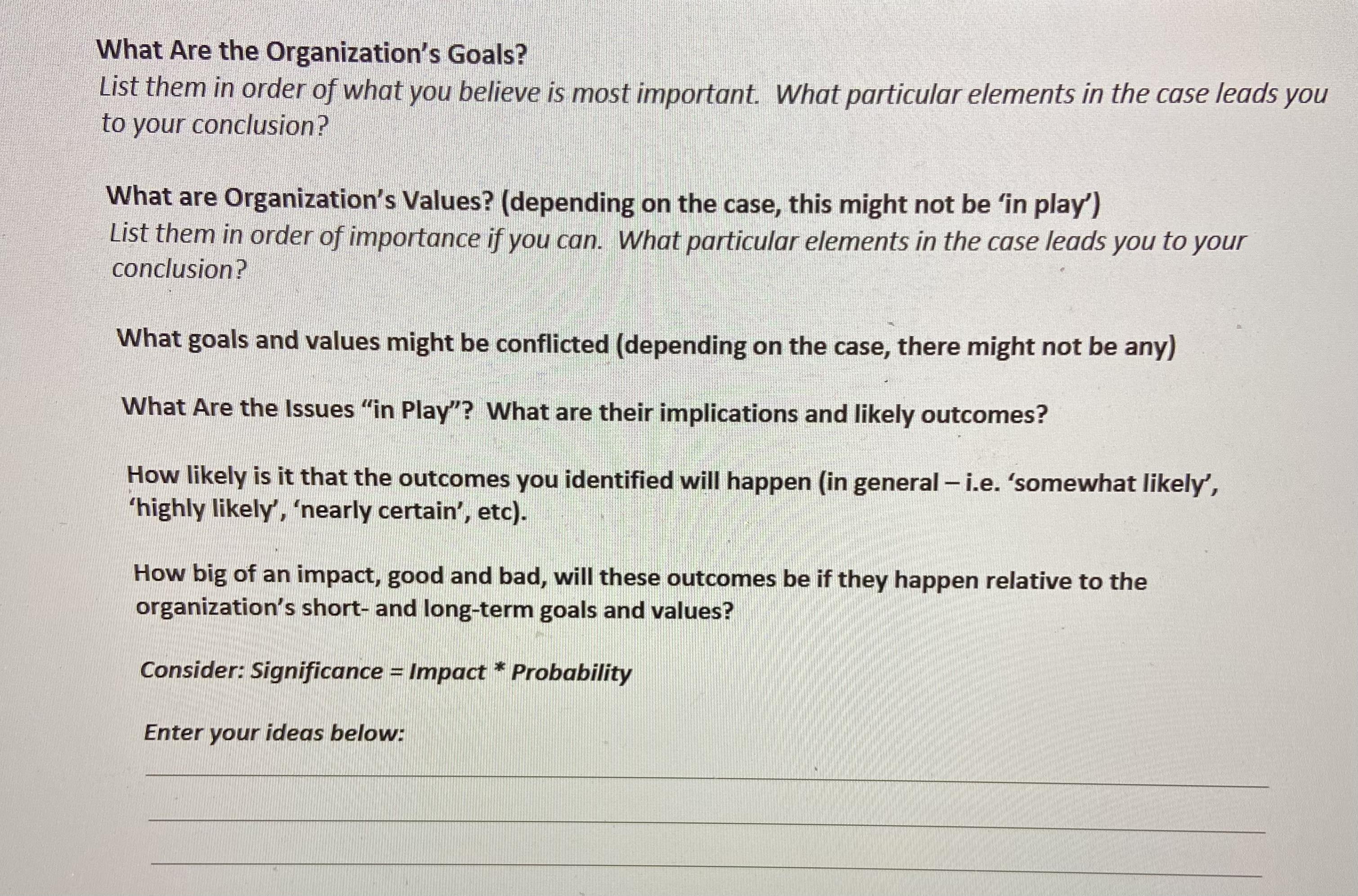
Can someone please help me answer the above questions urgently?
PLEASE HELP!!!
What Are the Organization's Goals? List them in order of what you believe is most important. What particular elements in the case leads you to your conclusion? What are Organization's Values? (depending on the case, this might not be 'in play') List them in order of importance if you can. What particular elements in the case leads you to your conclusion? What goals and values might be conflicted (depending on the case, there might not be any) What Are the Issues "in Play"? What are their implications and likely outcomes? How likely is it that the outcomes you identified will happen (in general - i.e. 'somewhat likely', 'highly likely', 'nearly certain', etc). How big of an impact, good and bad, will these outcomes be if they happen relative to the organization's short- and long-term goals and values? Consider: Significance = Impact Probability Enter your ideas below
Step by Step Solution
There are 3 Steps involved in it

Get step-by-step solutions from verified subject matter experts
 Study Help