Question: Below is the guideline to complete this weekly assignment: 1. Read the case and review relevant leadership concepts from the chapter. 2. Type your answers
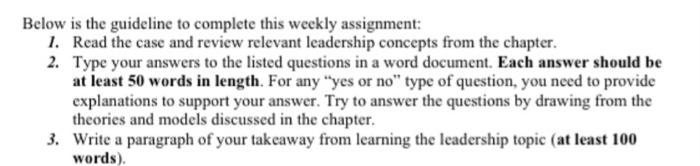
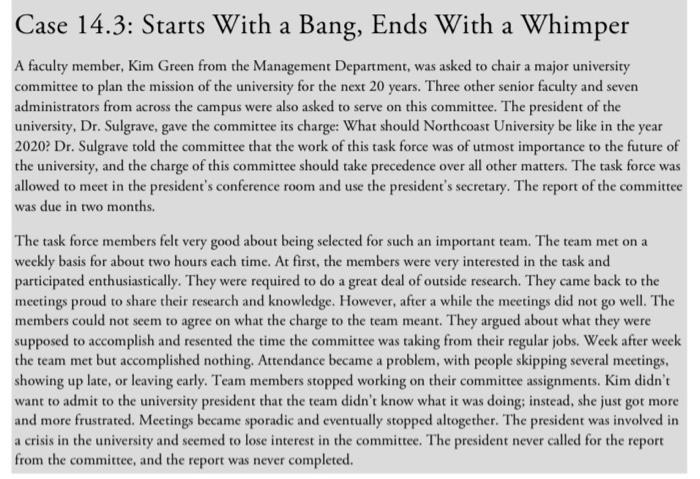
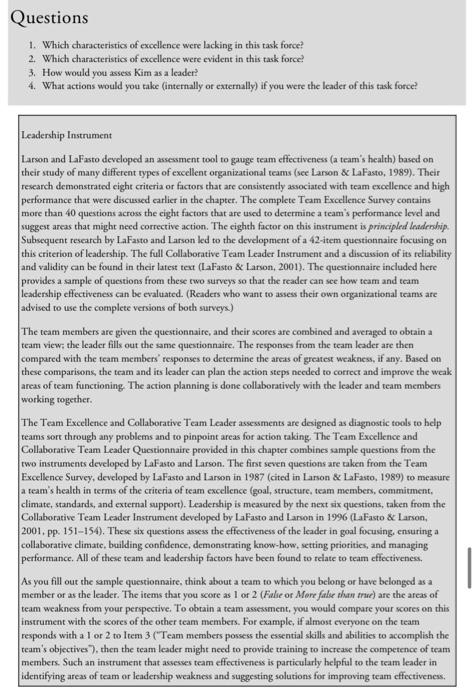
Below is the guideline to complete this weekly assignment: 1. Read the case and review relevant leadership concepts from the chapter. 2. Type your answers to the listed questions in a word document. Each answer should be at least 50 words in length. For any "yes or no" type of question, you need to provide explanations to support your answer. Try to answer the questions by drawing from the theories and models discussed in the chapter. 3. Write a paragraph of your takeaway from learning the leadership topic (at least 100 words). Case 14.3: Starts With a Bang, Ends With a whimper A faculty member, Kim Green from the Management Department, was asked to chair a major university committee to plan the mission of the university for the next 20 years. Three other senior faculty and seven administrators from across the campus were also asked to serve on this committee. The president of the university, Dr. Sulgrave, gave the committee its charge: What should Northcoast University be like in the year 2020? Dr. Sulgrave told the committee that the work of this task force was of utmost importance to the future of the university, and the charge of this committee should take precedence over all other matters. The task force was allowed to meet in the president's conference room and use the president's secretary. The report of the committee was due in two months. The task force members felt very good about being selected for such an important team. The team met on a weekly basis for about two hours each time. At first, the members were very interested in the task and participated enthusiastically. They were required to do a great deal of outside research. They came back to the meetings proud to share their research and knowledge. However, after a while the meetings did not go well. The members could not seem to agree on what the charge to the team meant. They argued about what they were supposed to accomplish and resented the time the committee was taking from their regular jobs. Week after week the team met but accomplished nothing. Attendance became a problem, with people skipping several meetings, showing up late, or leaving early. Team members stopped working on their committee assignments. Kim didn't want to admit to the university president that the team didn't know what it was doing; instead, she just got more and more frustrated. Meetings became sporadic and eventually stopped altogether. The president was involved in a crisis in the university and seemed to lose interest in the committee. The president never called for the report from the committee, and the report was never completed. Questions 1. Which characteristics of excellence were lacking in this task force? 2. Which characteristics of excellence were evident in this task force! 3. How would you assess Kim as a leader? 4. What actions would you take (internally or externally) if you were the leader of this task force? a Leadership Instrument Larson and LaFasto developed an assessment tool to gauge team effectiveness (a team's health) based on their study of many different types of excellent organizational teams (see Larson & LaFasto, 1989). Their research demonstrated eight criteria or factors that are consistently associated with team excellence and high performance that were discussed earlier in the chapter. The complete Team Excellence Survey contains more than 40 questions across the eight factors that are used to determine a team's performance level and suggest areas that might need corrective action. The eighth factor on this instrument is principled Leadership Subsequent research by La Fasto and Larson led to the development of a 42-item questionnaire focusing on this criterion of leadership. The full Collaborative Team Leader Instrument and a discussion of its reliability and validity can be found in their latest text (LaFasto & Larson, 2001). The questionnaire included here provides a sample of questions from these two surveys so that the reader can see how team and team leadership effectiveness can be evaluated. (Readers who want to assess their own organizational teams are advised to use the complete versions of both surveys.) The team members are given the questionnaire, and their scores are combined and averaged to obtain a team view, the leader fill out the same questionnaire. The responses from the team leader are then compared with the team members responses to determine the areas of greatest weakness, if any. Based on these comparisons, the team and its leader can plan the action steps needed to correct and improve the weak areas of team functioning. The action planning is done collaboratively with the cader and team members working together The Team Excellence and Collaborative Team Leader assessments are designed as diagnostic tools to help cams sort through any problems and to pinpoint arcas for action taking. The Team Excellence and Collaborative Team Leader Questionnaire provided in this chapter combines sample questions from the two instruments developed by LaFasto and Larson. The first seven questions are taken from the Team Excellence Survey, developed by La Fasto and Larson in 1987 (cited in Larson & LaFasto, 1989) to measure a team's health in terms of the criteria of team excellence (goal, structure, team members, commitment climate, standards, and external support). Leadership is measured by the next six questions, taken from the Collaborative Team Leader Instrument developed by LaFasto and Larson in 1996 (LaFasto & Larson, 2001, pp. 151-154). These six questions assess the effectiveness of the leader in goal focusing, ensuring a collaborative climate, building confidence, demonstrating know-how, setting priorities, and managing performance. All of these team and leadership factors have been found to relate to team effectiveness, As you fill out the sample questionnaire, think about a team to which you belong or have belonged as a member or as the leader. The items that you score as 1 of 2 (Fale or More false than trae) are the areas of team weakness from your perspective. To obtain a team assessment, you would compare your scores on this instrument with the scores of the other team members. For example, if almost everyone on the team responds with a 1 or 2 to Item 3 ("Team members possess the essential skills and abilities to accomplish the team's objectives"), then the team leader might need to provide training to increase the competence of team members. Such an instrument that assesses team effectiveness is particularly helpful to the team leader in identifying areas of team or leadership weakness and suggesting solutions for improving team effectiveness









 Study Help