







Question: ((Below is the information needed for question 16-17)) Please answer questions 16-17 & 16-18 (including the additional question Gross Margin Percentage Method). Thanks a lot.
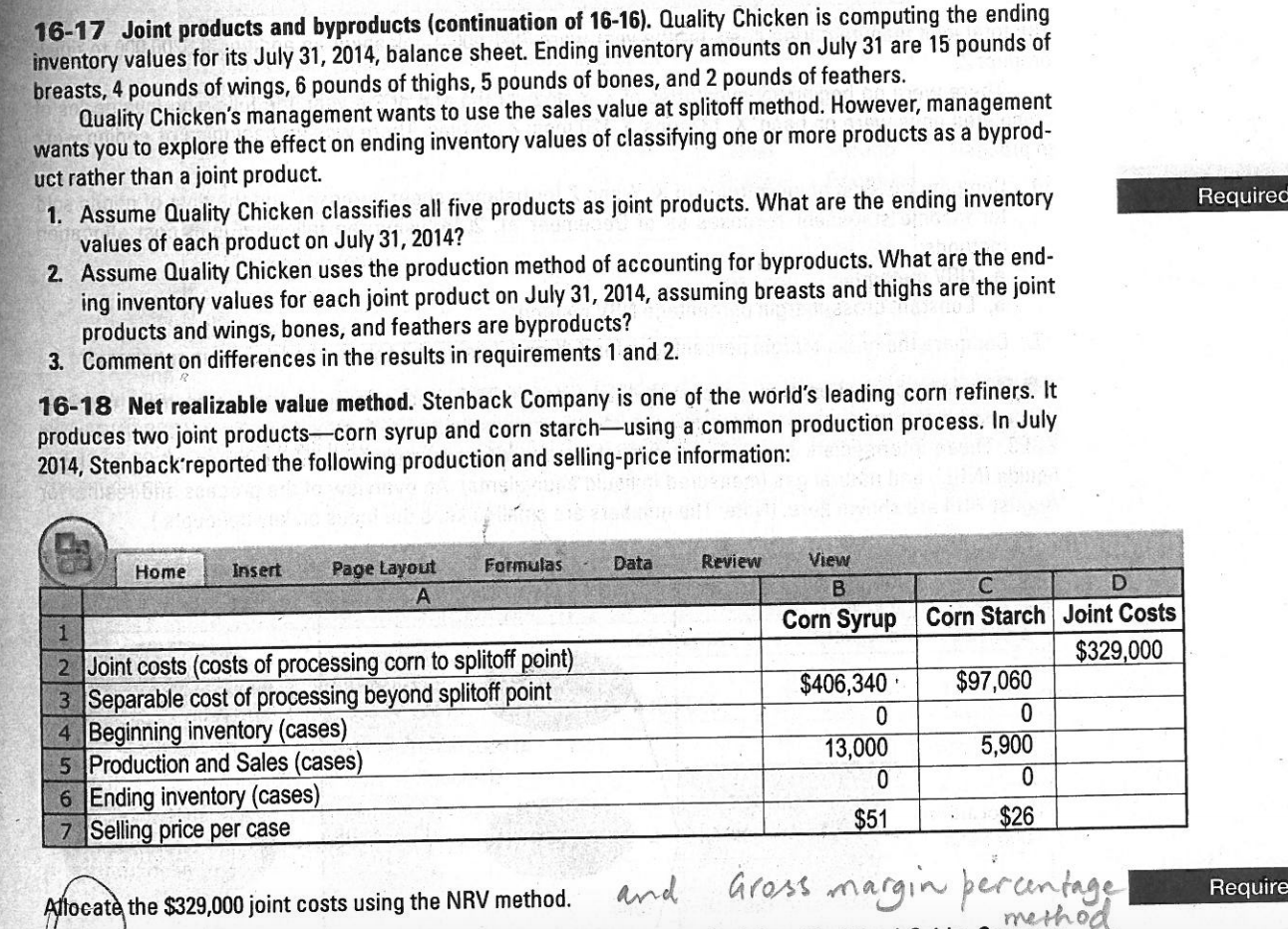
((Below is the information needed for question 16-17))
Please answer questions 16-17 & 16-18 (including the additional question "Gross Margin Percentage Method").
Thanks a lot.
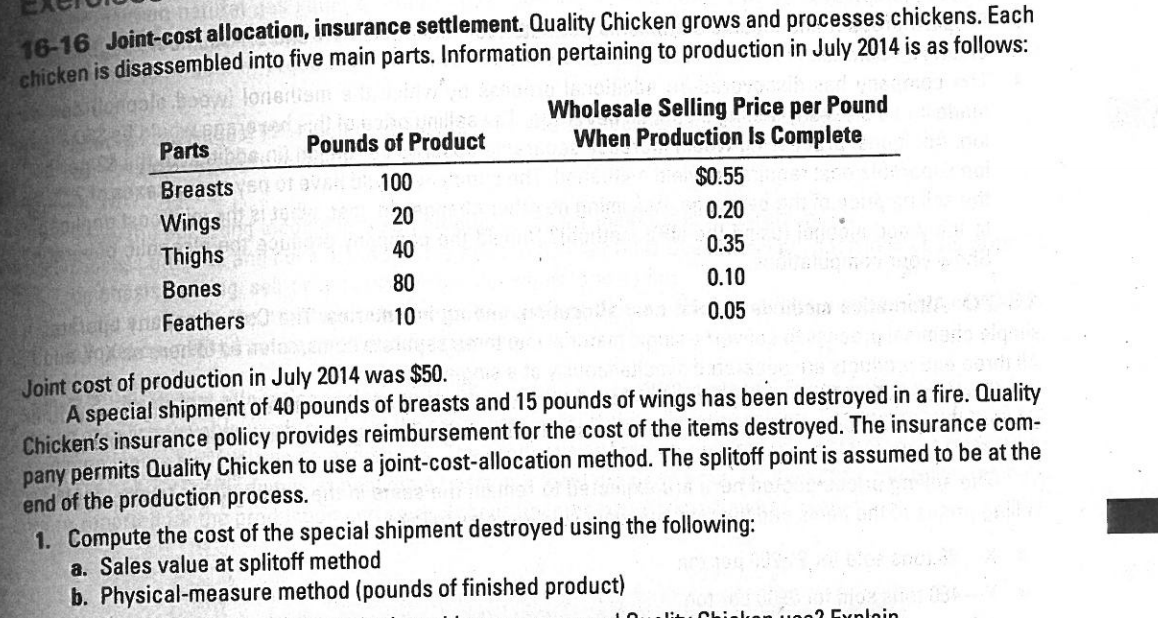
16-17 Joint products and byproducts (continuation of 16-16). Quality Chicken is computing the ending inventory values for its July 31, 2014, balance sheet. Ending inventory amounts on July 31 are 15 pounds of breasts, 4 pounds of wings, 6 pounds of thighs, 5 pounds of bones, and 2 pounds of feathers. Quality Chicken's management wants to use the sales value at splitoff method. However, management wants you to explore the effect on ending inventory values of classifying one or more products as a byprod- uct rather than a joint product. 1. Assume Quality Chicken classifies all five products as joint products. What are the ending inventory values of each product on July 31, 2014? 2. Assume Quality Chicken uses the production method of accounting for byproducts. What are the end- ing inventory values for each joint product on July 31, 2014, assuming breasts and thighs are the joint products and wings, bones, and feathers are byproducts? 3. Comment on differences in the results in requirements 1 and 2. Required 16-18 Net realizable value method. Stenback Company is one of the world's leading corn refiners. It produces two joint products-corn syrup and corn starch-using a common production process. In July 2014, Stenback'reported the following production and selling-price information: Home Insert Formulas Data Review View Page Layout B Corn Syrup Corn Starch Joint Costs $329,000 $97,060 $406,340 0 2 Joint costs (costs of processing corn to splitoff point) | 3 Separable cost of processing beyond splitoff point 4 Beginning inventory (cases) 5 Production and Sales (cases) | 6 Ending inventory (cases) 7 Selling price per case 5,900 13,000 O $51 0 $26 : Afocate the $329,000 joint costs using the NRV method. and Gross margin percentage Require method 46. Joint-cost allocation, insurance settlement. Quality Chicken grows and processes chickens. Each Licken is disassembled into five main parts. Information pertaining to production in July 2014 is as follows: le long Wholesale Selling Price per Pound Parts Pounds of Product When Production Is Complete Breasts not 100 $0.55 0.20 Thighs 0.35 Bones 0.10 Bat Feathers 10 0 .05 Wings Joint cost of production in July 2014 was $50. A special shipment of 40 pounds of breasts and 15 pounds of wings has been destroyed in a fire. Quality Chicken's insurance policy provides reimbursement for the cost of the items destroyed. The insurance com- pany permits Quality Chicken to use a joint-cost-allocation method. The splitoff point is assumed to be at the end of the production process. 1. Compute the cost of the special shipment destroyed using the following: a. Sales value at splitoff method b. Physical-measure method (pounds of finished product) 16-17 Joint products and byproducts (continuation of 16-16). Quality Chicken is computing the ending inventory values for its July 31, 2014, balance sheet. Ending inventory amounts on July 31 are 15 pounds of breasts, 4 pounds of wings, 6 pounds of thighs, 5 pounds of bones, and 2 pounds of feathers. Quality Chicken's management wants to use the sales value at splitoff method. However, management wants you to explore the effect on ending inventory values of classifying one or more products as a byprod- uct rather than a joint product. 1. Assume Quality Chicken classifies all five products as joint products. What are the ending inventory values of each product on July 31, 2014? 2. Assume Quality Chicken uses the production method of accounting for byproducts. What are the end- ing inventory values for each joint product on July 31, 2014, assuming breasts and thighs are the joint products and wings, bones, and feathers are byproducts? 3. Comment on differences in the results in requirements 1 and 2. Required 16-18 Net realizable value method. Stenback Company is one of the world's leading corn refiners. It produces two joint products-corn syrup and corn starch-using a common production process. In July 2014, Stenback'reported the following production and selling-price information: Home Insert Formulas Data Review View Page Layout B Corn Syrup Corn Starch Joint Costs $329,000 $97,060 $406,340 0 2 Joint costs (costs of processing corn to splitoff point) | 3 Separable cost of processing beyond splitoff point 4 Beginning inventory (cases) 5 Production and Sales (cases) | 6 Ending inventory (cases) 7 Selling price per case 5,900 13,000 O $51 0 $26 : Afocate the $329,000 joint costs using the NRV method. and Gross margin percentage Require method 46. Joint-cost allocation, insurance settlement. Quality Chicken grows and processes chickens. Each Licken is disassembled into five main parts. Information pertaining to production in July 2014 is as follows: le long Wholesale Selling Price per Pound Parts Pounds of Product When Production Is Complete Breasts not 100 $0.55 0.20 Thighs 0.35 Bones 0.10 Bat Feathers 10 0 .05 Wings Joint cost of production in July 2014 was $50. A special shipment of 40 pounds of breasts and 15 pounds of wings has been destroyed in a fire. Quality Chicken's insurance policy provides reimbursement for the cost of the items destroyed. The insurance com- pany permits Quality Chicken to use a joint-cost-allocation method. The splitoff point is assumed to be at the end of the production process. 1. Compute the cost of the special shipment destroyed using the following: a. Sales value at splitoff method b. Physical-measure method (pounds of finished product)
Step by Step Solution
There are 3 Steps involved in it

Get step-by-step solutions from verified subject matter experts
 Study Help