Question: Below is the question description. I know how to solve. But I don't know how to represent it properly and formally. Computer Science Department -
Below is the question description. I know how to solve. But I don't know how to represent it properly and formally.
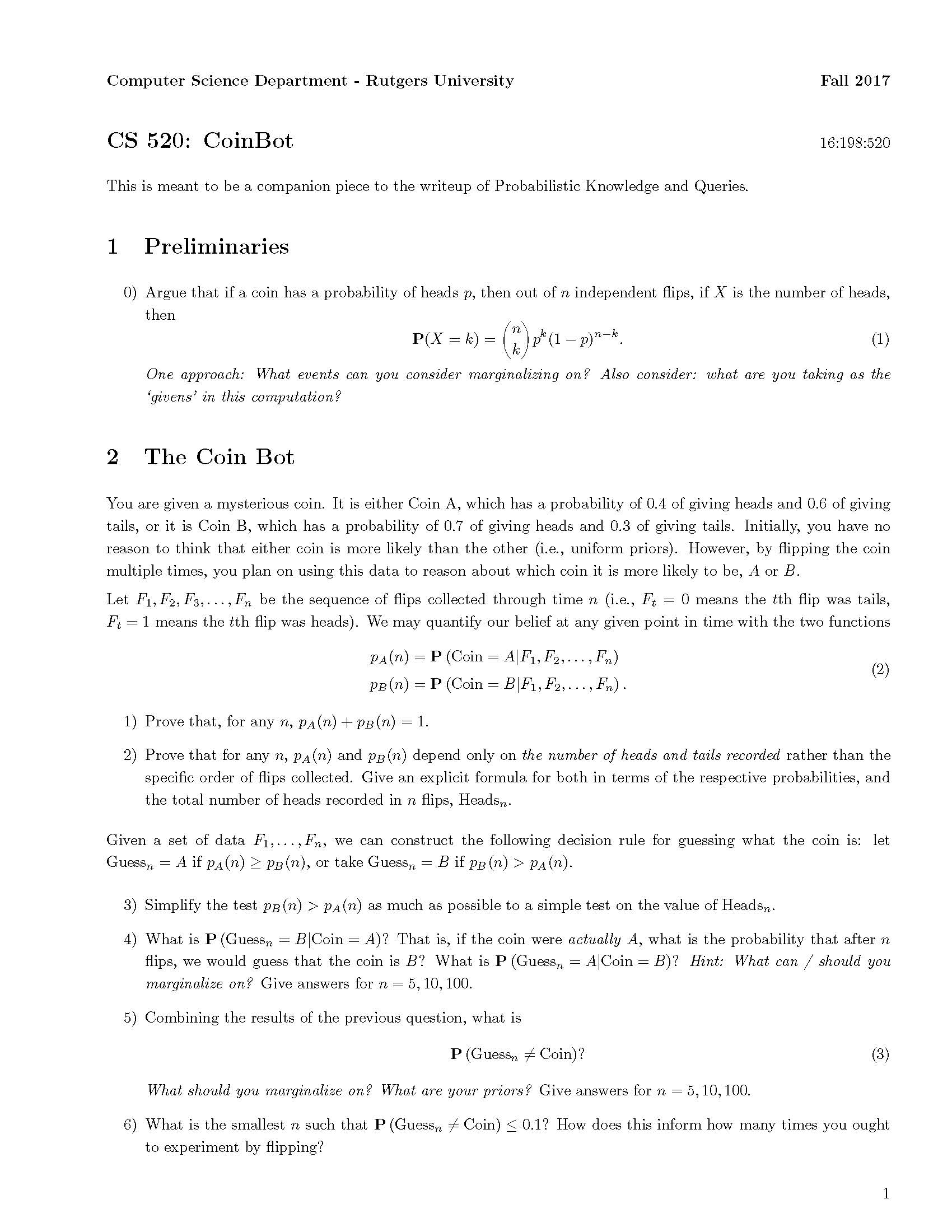
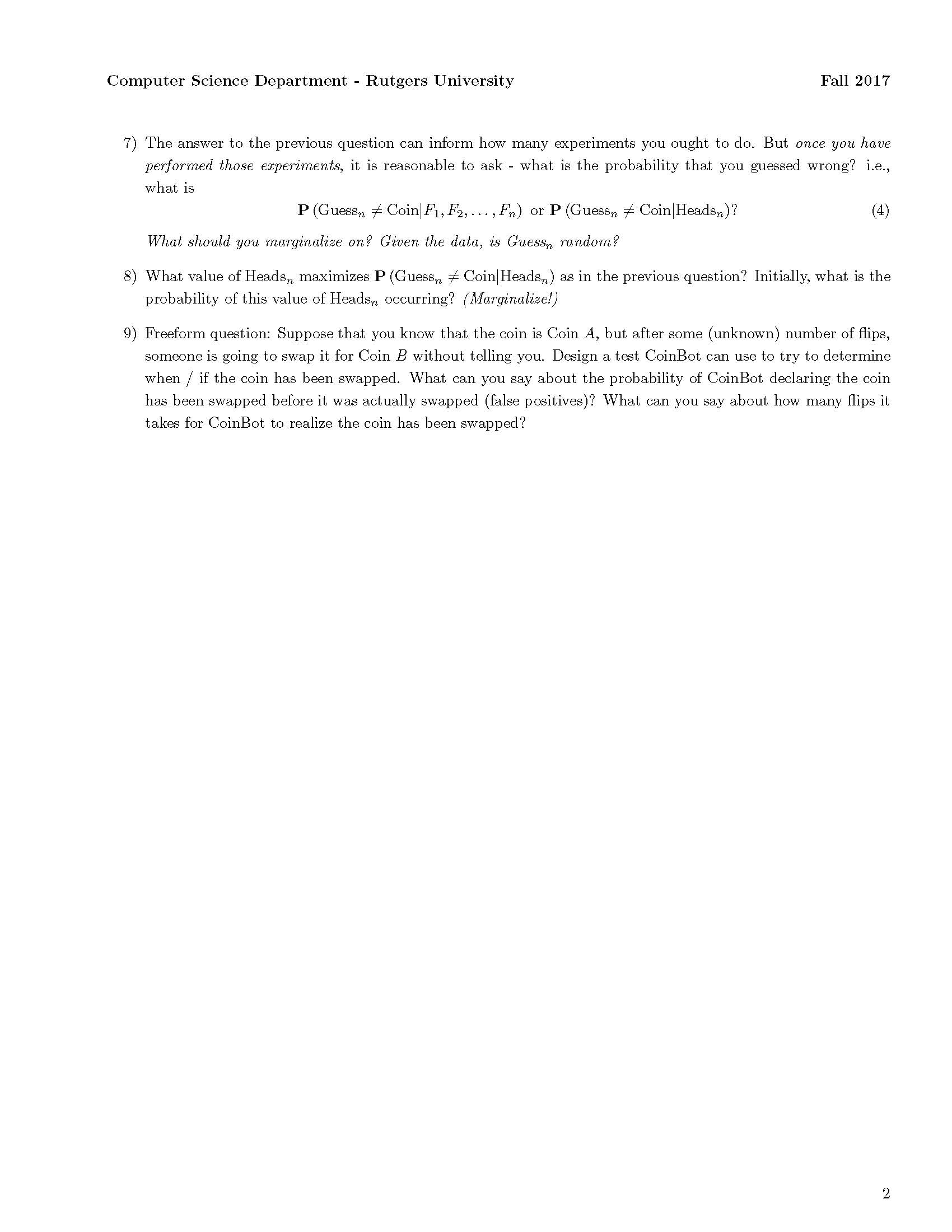
Computer Science Department - Rutgers University Fall 2017 CS 520: CoinBot 1621982520 This is meant to be a companion piece to the writeup of Probabilistic Knowledge and Queries; 1 Preliminaries 0) Argue that if a coin has a probability of heads p, then out of n independent flips, if X is the number of heads, then M 2 k) = (QM 7 p)\". (1) One approach: What events can you consider marginalizing on? Also consider: what are you taking as the 'givens' in this computation? 2 The Coin Bot You are given a mysterious coin. It is either Coin A, which has a probability of 0.4 of giving heads and 0.6 of giving tails, or it is Coin B, which has a probability of 0.7 of giving heads and 0.3 of giving tails. Initially, you have no reason to think that either coin is more likely than the other (i.e., uniform priors). However, by ipping the coin multiple times, you plan on using this data to reason about which coin it is more likely to be, A or B. Let F1,F2, F3, . . . ,Fn be the sequence of ips collected through time n (i.e., F3 : 0 means the tth ip was tails, Ft : 1 means the tth flip was heads)' We may quantify our belief at any given point in time with the two functions pA(n) : P (Coin : A|F1,F2,..A ,Fn) 2 pB(n):P(Coin:BlF1,Fg,...,Fn). () l) Prove that, for any n, pA(ri) + p301) : ll 2) Prove that for any n, PA (n) and 103 (n) depend only on the number of heads and tails recorded rather than the specic order of ips collected' Give an explicit formula for both in terms of the respective probabilities, and the total number of heads recorded in n ips, Headsn. Given a set of data F1,.l.,Fn, we can construct the following decision rule for guessing what the coin is: let Guessn : A if pA(n) 2 p301), or take Guessn : B if 103 (n) > 3);; (n). 3) Simplify the test 103(71) > 13,4(71) as much as possible to a simple test on the value of Heads\". 4) What is P (Guessn : BlCoin : A)? That is, if the coin were actually A, what is the probability that after n flips, we would guess that the coin is B? What is P (Guessn : A'Coin : B)? Hint: What can / should you marginalize on? Give answers for n : 5, 10, 100' 5) Combining the results of the previous question, what is P (Guessn 7 Coin)? (3) What should you marginalize on? What are your priors? Give answers for n : 5,10,100. 6) What is the smallest n such that P (Guessn 9E Coin) g 0.1? How does this inform how many times you ought to experiment by ipping? Computer Science Department - Rutgers University Fall 2017 7) The answer to the previous question can inform how many experiments you ought to do. But once you have performed those experiments, it is reasonable to ask - what is the probability that you guessed wrong? i.e., what is P (Guessn % Coin|F1, F2, . .' ,Fn) or P (Guessn % Coianeadsn)? (4) What should you marginalize on? Given the data, is Guess?l random? What value of Headsn maximizes P (Guessn 9E Coianeadsn) as in the previous question? Initially, what is the probability of this value of Headsn occurring? (Marginalizef) Freeform question: Suppose that you know that the coin is Coin A, but after some (unknown) number of ips, someone is going to swap it for Coin B without telling you. Design a test CoinBot can use to try to determine when / if the coin has been swapped What can you say about the probability of CoinBot declaring the coin has been swapped before it was actually swapped (false positives)? What can you say about how many flips it takes for CoinBot to realize the coin has been swapped









 Study Help