







Question: Below is the second article Question: After reading the above articles 1 and 2, who do you think is driving markets - short-term or long-term
Below is the second article
Question: After reading the above articles 1 and 2, who do you think is driving markets - short-term or long-term investors?
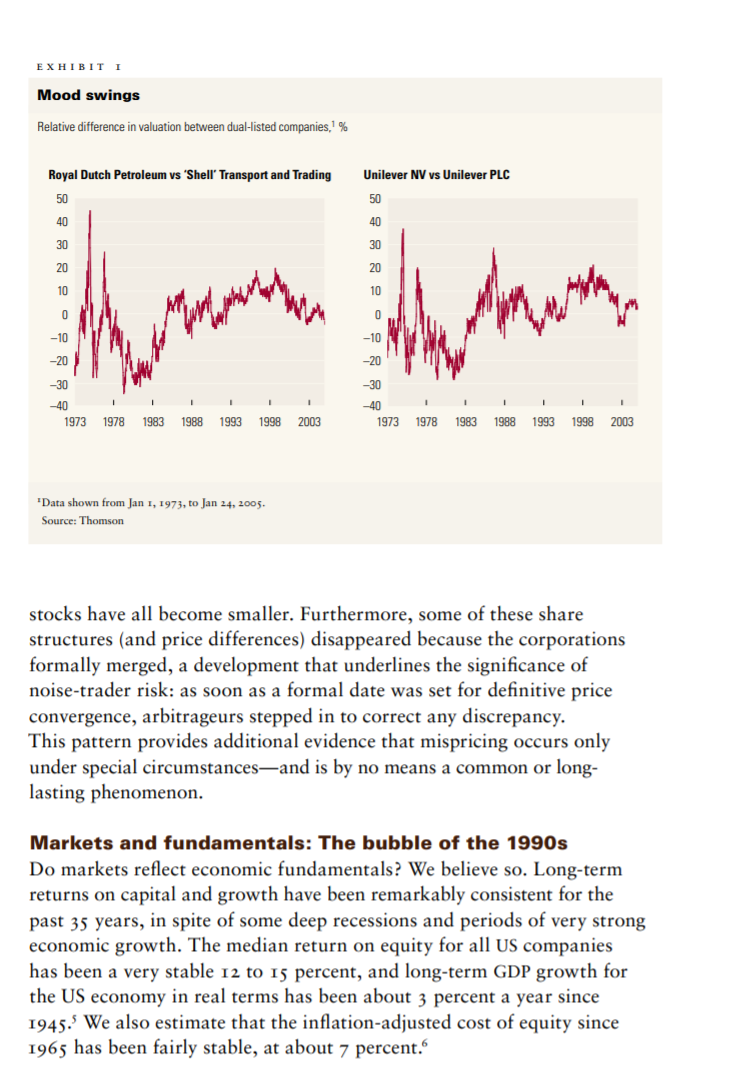
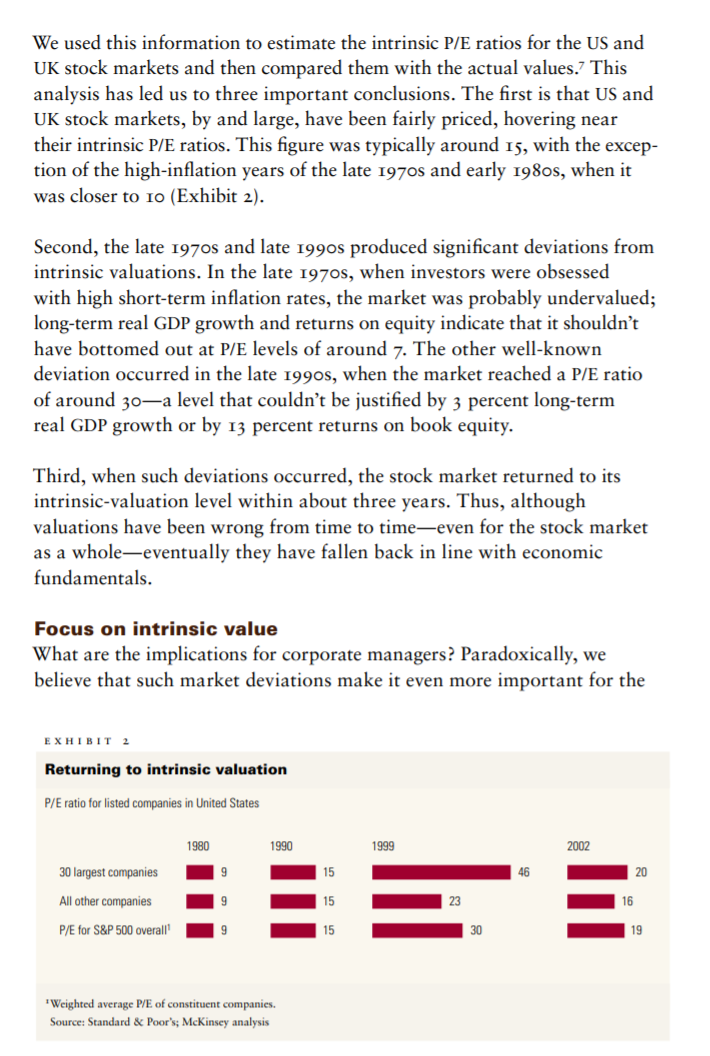
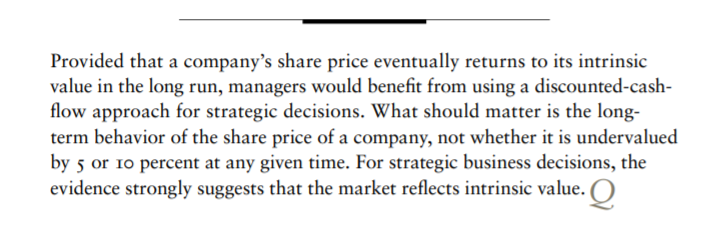
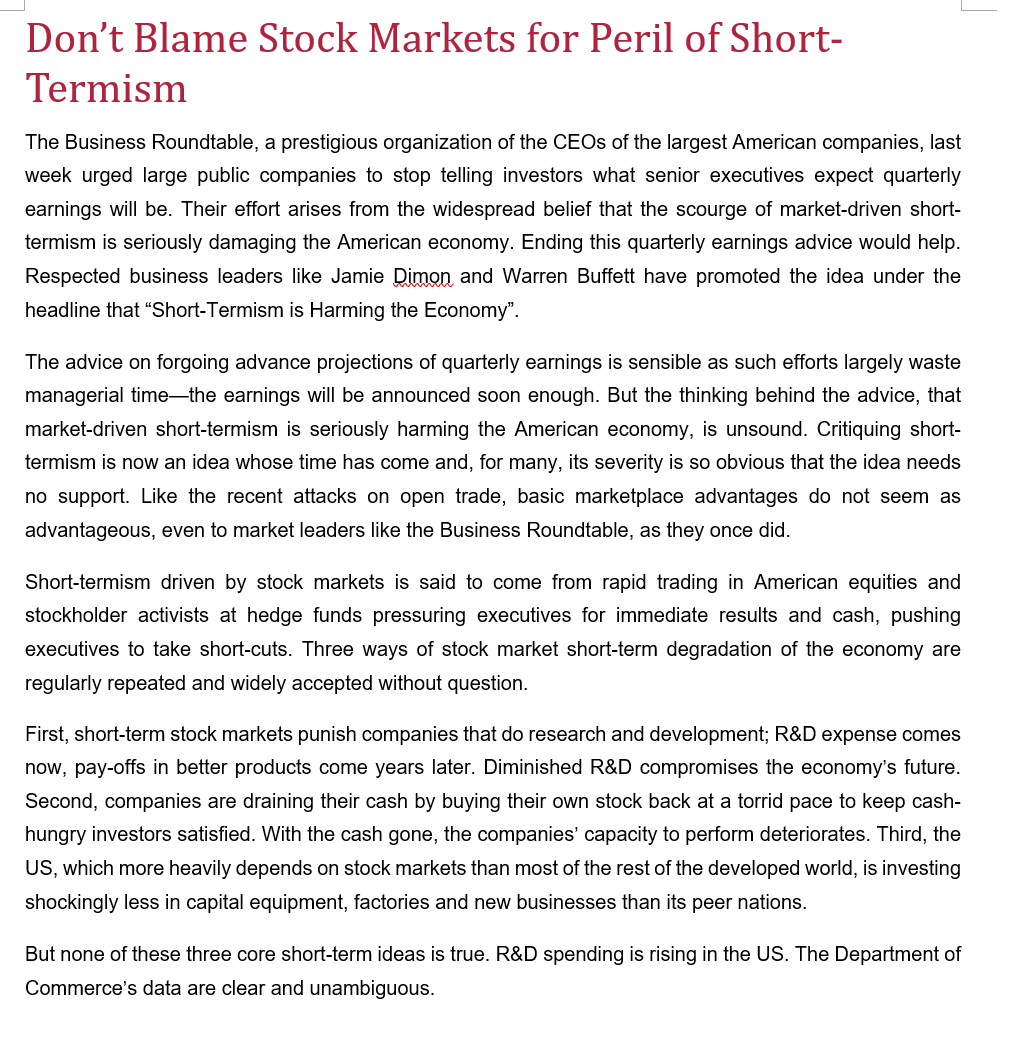
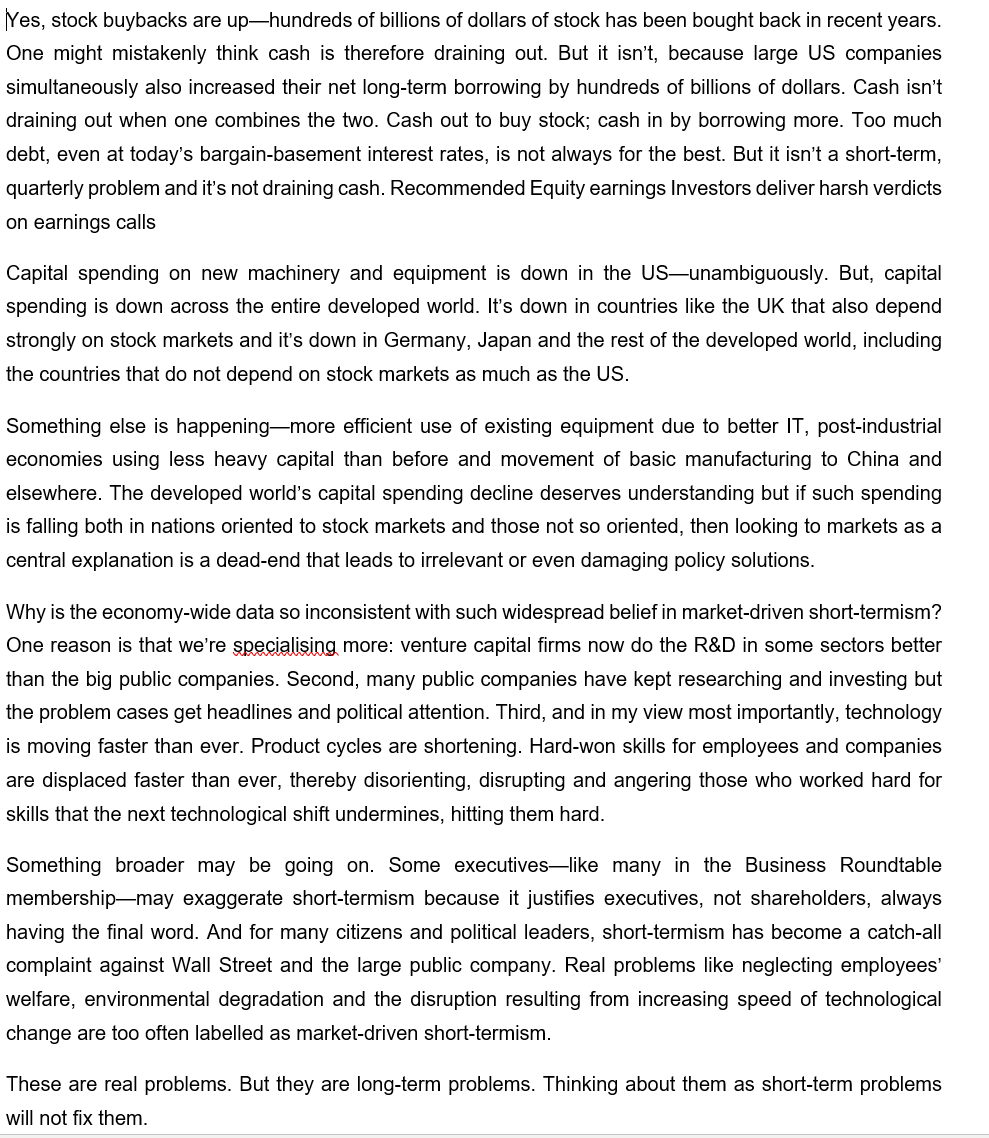
DO Tundamentais or emotionsdrive the stock market? Emotions can drive market behavior in a few short-lived situations. But fundamentals still rule. Marc Goedhart, Timothy Koller, and David Wessels There's never been a better time to be a behaviorist. During four decades, the academic theory that financial markets accurately reflect a stock's underlying value was all but unassailable. But lately, the view that investors can fundamentally change a market's course through irrational decisions has been moving into the mainstream. With the exuberance of the high-tech stock bubble and the crash of the late 1990s still fresh in investors' memories, adherents of the behaviorist school are finding it easier than ever to spread the belief that markets can be something less than efficient in immediately distilling new information and that investors, driven by emotion, can indeed lead markets awry. Some behaviorists would even assert that stock markets lead lives of their own, detached from economic growth and business profitability. A number of finance scholars and practitioners have argued that stock markets are not efficientthat is, that they don't necessarily reflect economic fundamentals.' According to this point of view, significant and lasting deviations from the intrinsic value of a company's share price occur in market valuations. The argument is more than academic. In the 1980s the rise of stock market index funds, which now hold some $1 trillion in assets, was caused in large part by the conviction among investors that efficient-market theories were valuable. And current debates in the United States and else- where about privatizing Social Security and other retirement systems may hinge on assumptions about how investors are likely to handle their retirement options. We agree that behavioral finance offers some valuable insightschief among them the idea that markets are not always right, since rational investors can't always correct for mispricing by irrational ones. But for managers, the critical question is how often these deviations arise and whether they are so frequent and significant that they should affect the process of financial decision making. In fact, significant deviations from intrinsic value are rare, and markets usually revert rapidly to share prices commen- surate with economic fundamentals. Therefore, managers should continue to use the tried-and-true analysis of a company's discounted cash flow to make their valuation decisions. When markets deviate Behavioral-finance theory holds that markets might fail to reflect economic fundamentals under three conditions. When all three apply, the theory predicts that pricing biases in financial markets can be both significant and persistent. Irrational behavior. Investors behave irrationally when they don't correctly process all the available information while forming their expectations of a company's future performance. Some investors, for example, attach too much importance to recent events and results, an error that leads them to overprice companies with strong recent performance. Others are excessively conservative and underprice stocks of companies that have released positive news. Systematic patterns of behavior. Even if individual investors decided to buy or sell without consulting economic fundamentals, the impact on share prices would still be limited. Only when their irrational behavior is also systematic (that is, when large groups of investors share particular patterns of behavior) should persistent price deviations occur. Hence behavioral-finance theory argues that patterns of overconfidence, over- reaction, and overrepresentation are common to many investors and that such groups can be large enough to prevent a company's share price from reflecting underlying economic fundamentalsat least for some stocks, some of the time. Limits to arbitrage in financial markets. When investors assume that a company's recent strong performance alone is an indication of future performance, they may start bidding for shares and drive up the price. Some investors might expect a company that surprises the market in one quarter to go on exceeding expectations. As long as enough other investors notice this myopic overpricing and respond by taking short positions, the share price will fall in line with its underlying indicators. This sort of arbitrage doesn't always occur, however. In practice, the costs, complexity, and risks involved in setting up a short position can be too high for individual investors. If, for example, the share price doesn't return to its fundamental value while they can still hold on to a short positionthe so-called noise-trader riskthey may have to sell their holdings at a loss. Momentum and other matters Two well-known patterns of stock market devia- tions have received considerable attention in academic studies during the past decade: long- term reversals in share prices and short-term momentum. First, consider the phenomenon of reversal- high-performing stocks of the past few years typically become low-performing stocks of the next few. Behavioral finance argues that this effect is caused by an overreaction on the part of investors: when they put too much weight on a company's recent performance, the share price becomes inflated. As additional infor- mation becomes available, investors adjust their expectations and a reversal occurs. The same behavior could explain low returns after an initial public offering (IPO), seasoned offerings, a new listing, and so on. Presumably, such companies had a history of strong performance, which was why they went public in the first place. Momentum, on the other hand, occurs when positive returns for stocks over the past few months are followed by several more months of positive returns. Behavioral-finance theory suggests that this trend results from systematic underreaction: overconservative investors underestimate the true impact of earnings, divestitures, and share repurchases, for example, so stock prices don't instantaneously react to good or bad news. But academics are still debating whether irrational investors alone can be blamed for the long-term-reversal and short-term-momentum patterns in returns. Some believe that long-term reversals result merely from incorrect measurements of a stock's risk premium, because investors ignore the risks associated with a company's size and market-to-capital ratio. These statistics could be a proxy for liquidity and distress risk. Similarly, irrational investors don't necessarily drive short-term momentum in share price returns. Profits from these patterns are relatively limited after transaction costs have been deducted. Thus, small momentum biases could exist even if all investors were rational. Furthermore, behavioral finance still cannot explain why investors overreact under some conditions (such as IPOs) and underreact in others (such as earnings announcements). Since there is no systematic way to predict how markets will respond, some have concluded that this is a further indication of their accuracy. Persistent mispricing in carve-outs and dual-listed companies Two well-documented types of market deviationthe mispricing of carve- outs and of dual-listed companiesare used to support behavioral- finance theory. The classic example is the pricing of 3Com and Palm after the latter's carve-out in March 2000. In anticipation of a full spin-off within nine months, 3Com floated 5 percent of its Palm subsidiary. Almost immediately, Palm's market capitali- zation was higher than the entire market value of 3Com, implying that 3Com's other businesses had a negative value. Given the size and Two types of market deviationthe profitability of the rest of 3Com's mispricing of carve-outs and of businesses, this result would dual-listed companiesare used to clearly indicate mispricing. Why support behavioral-finance theory did rational investors fail to exploit the anomaly by going short on Palm's shares and long on 3Com's? The reason was that the number of available Palm shares was extremely small after the carve-out: 3Com still held 95 percent of them. As a result, it was extremely difficult to establish a short position, which would have required borrowing shares from a Palm shareholder. During the months following the carve-out, the mispricing gradually became less pronounced as the supply of shares through short sales increased steadily. Yet while many investors and analysts knew about the price difference, it persisted for two monthsuntil the Internal Revenue Service formally approved the carve-out's tax-free status in early May 2002. At that point, a significant part of the uncertainty around the spin- off was removed and the price discrepancy disappeared. This correction suggests that at least part of the mispricing was caused by the risk that the spin-off wouldn't occur. Additional cases of mispricing between parent companies and their carved- out subsidiaries are well documented. In general, these cases involve difficulties setting up short positions to exploit the price differences, which persist until the spin-off takes place or is abandoned. In all cases, the mispricing was corrected within several months. A second classic example of investors deviating from fundamentals is the price disparity between the shares of the same company traded on two different exchanges. Consider the case of Royal Dutch Petroleum and "Shell Transport and Trading, which are traded on the Amsterdam and London stock markets, respectively. Since these twin shares are entitled to a fixed 60-40 portion of the dividends of Royal Dutch/Shell, you would expect their share prices to remain in this fixed ratio. Over long periods, however, they have not. In fact, prolonged periods of mispricing can be found for several similar twin-share structures, such as Unilever (Exhibit 1, on the next page). This phenomenon occurs because large groups of investors prefer (and are prepared to pay a premium for) one of the twin shares. Rational investors typically do not take positions to exploit the opportunity for arbitrage. Thus in the case of Royal Dutch/Shell, a price differential of as much as 30 percent has persisted at times. Why? The opportunity to arbitrage dual- listed stocks is actually quite unpredictable and potentially costly. Because of noise-trader risk, even a large gap between share prices is no guarantee that those prices will converge in the near term. Does this indict the market for mispricing? We don't think so. In recent years, the price differences for Royal Dutch/Shell and other twin-share EXHIBITI Mood swings Relative difference in valuation between dual-listed companies,1 % Royal Dutch Petroleum vs 'Shell' Transport and Trading Unilever NV vs Unilever PLC 50 50 40 40 30 30 20 20 10 10 Wwwww 0 0 -10 -10 -20 -30 -30 1 1 1 1 1 1 I 1 -40 1973 -40 1973 1978 1983 1988 1993 1998 2003 1978 1983 1988 1993 1998 2003 Data shown from Jan 1, 1973, to Jan 24, 2005. Source: Thomson stocks have all become smaller. Furthermore, some of these share structures (and price differences) disappeared because the corporations formally merged, a development that underlines the significance of noise-trader risk: as soon as a formal date was set for definitive price convergence, arbitrageurs stepped in to correct any discrepancy. This pattern provides additional evidence that mispricing occurs only under special circumstancesand is by no means a common or long- lasting phenomenon. Markets and fundamentals: The bubble of the 1990s Do markets reflect economic fundamentals? We believe so. Long-term returns on capital and growth have been remarkably consistent for the past 35 years, in spite of some deep recessions and periods of very strong economic growth. The median return on equity for all US companies has been a very stable 12 to 15 percent, and long-term GDP growth for the US economy in real terms has been about 3 percent a year since 1945. We also estimate that the inflation-adjusted cost of equity since 1965 has been fairly stable, at about 7 percent. We used this information to estimate the intrinsic P/E ratios for the US and UK stock markets and then compared them with the actual values. This analysis has led us to three important conclusions. The first is that US and UK stock markets, by and large, have been fairly priced, hovering near their intrinsic P/E ratios. This figure was typically around 15, with the excep- tion of the high-inflation years of the late 1970s and early 1980s, when it was closer to 10 (Exhibit 2). Second, the late 1970s and late 1990s produced significant deviations from intrinsic valuations. In the late 1970s, when investors were obsessed with high short-term inflation rates, the market was probably undervalued; long-term real GDP growth and returns on equity indicate that it shouldn't have bottomed out at P/E levels of around 7. The other well-known deviation occurred in the late 1990s, when the market reached a P/E ratio of around 30a level that couldn't be justified by 3 percent long-term real GDP growth or by 13 percent returns on book equity. Third, when such deviations occurred, the stock market returned to its intrinsic-valuation level within about three years. Thus, although valuations have been wrong from time to timeeven for the stock market as a whole-eventually they have fallen back in line with economic fundamentals. Focus on intrinsic value What are the implications for corporate managers? Paradoxically, we believe that such market deviations make it even more important for the EXHIBIT 2 Returning to intrinsic valuation P/E ratio for listed companies in United States 1980 1990 1999 2002 30 largest companies 9 15 46 20 All other companies 9 15 23 16 P/E for S&P 500 overall 15 30 19 Weighted average P/E of constituent companies. Source: Standard & Poor's; McKinsey analysis executives of a company to understand the intrinsic value of its shares. This knowledge allows it to exploit any deviations, if and when they occur, to time the implementation of strategic decisions more successfully. Here are some examples of how corporate managers can take advantage of market deviations. Issuing additional share capital when the stock market attaches too high a value to the company's shares relative to their intrinsic value Repurchasing shares when the market underprices them relative to their intrinsic value Paying for acquisitions with shares instead of cash when the market overprices them relative to their intrinsic value Divesting particular businesses at times when trading and transaction multiples are higher than can be justified by underlying fundamentals Bear two things in mind. First, we don't recommend that companies base decisions to issue or repurchase their shares, to divest or acquire businesses, or to settle transactions with cash or shares solely on an assumed difference between the market and intrinsic value of their shares. Instead, these decisions must be grounded in a strong business strategy driven by the goal of creating shareholder value. Market deviations are more relevant as tactical considerations when companies time and execute such decisions-for example, when to issue additional capital or how to pay for a particular transaction. Second, managers should be wary of analyses claiming to highlight market devia- tions. Most of the alleged cases that we have come across in our client experience proved to be insignificant or even nonexistent, so the evidence should be compelling. Furthermore, the deviations should be significant in both size and duration, given the capital and time needed to take advantage of the types of opportunities listed previously. Provided that a company's share price eventually returns to its intrinsic value in the long run, managers would benefit from using a discounted-cash- flow approach for strategic decisions. What should matter is the long- term behavior of the share price of a company, not whether it is undervalued by 5 or 10 percent at any given time. For strategic business decisions, the evidence strongly suggests that the market reflects intrinsic value. Q Don't Blame Stock Markets for Peril of Short- Termism The Business Roundtable, a prestigious organization of the CEOs of the largest American companies, last week urged large public companies to stop telling investors what senior executives expect quarterly earnings will be. Their effort arises from the widespread belief that the scourge of market-driven short- termism is seriously damaging the American economy. Ending this quarterly earnings advice would help. Respected business leaders like Jamie Dimon and Warren Buffett have promoted the idea under the headline that "Short-Termism is Harming the Economy". The advice on forgoing advance projections of quarterly earnings is sensible as such efforts largely waste managerial timethe earnings will be announced soon enough. But the thinking behind the advice, that market-driven short-termism is seriously harming the American economy, is unsound. Critiquing short- termism is now an idea whose time has come and, for many, its severity is so obvious that the idea needs no support. Like the recent attacks on open trade, basic marketplace advantages do not seem as advantageous, even to market leaders like the Business Roundtable, as they once did. Short-termism driven by stock markets is said to come from rapid trading in American equities and stockholder activists at hedge funds pressuring executives for immediate results and cash, pushing executives to take short-cuts. Three ways of stock market short-term degradation of the economy are regularly repeated and widely accepted without question. First, short-term stock markets punish companies that do research and development; R&D expense comes now, pay-offs in better products come years later. Diminished R&D compromises the economy's future. Second, companies are draining their cash by buying their own stock back at a torrid pace to keep cash- hungry investors satisfied. With the cash gone, the companies' capacity to perform deteriorates. Third, the US, which more heavily depends on stock markets than most of the rest of the developed world, is investing shockingly less in capital equipment, factories and new businesses than its peer nations. But none of these three core short-term ideas is true. R&D spending is rising in the US. The Department of Commerce's data are clear and unambiguous. Yes, stock buybacks are uphundreds of billions of dollars of stock has been bought back in recent years. One might mistakenly think cash is therefore draining out. But it isn't, because large US companies simultaneously also increased their net long-term borrowing by hundreds of billions of dollars. Cash isn't draining out when one combines the two. Cash out to buy stock; cash in by borrowing more. Too much debt, even at today's bargain-basement interest rates, is not always for the best. But it isn't a short-term, quarterly problem and it's not draining cash. Recommended Equity earnings Investors deliver harsh verdicts on earnings calls Capital spending on new machinery and equipment is down in the Usunambiguously. But, capital spending is down across the entire developed world. It's down in countries like the UK that also depend strongly on stock markets and it's down in Germany, Japan and the rest of the developed world, including the countries that do not depend on stock markets as much as the US. Something else is happening-more efficient use of existing equipment due to better IT, post-industrial economies using less heavy capital than before and movement of basic manufacturing to China and elsewhere. The developed world's capital spending decline deserves understanding but if such spending is falling both in nations oriented to stock markets and those not so oriented, then looking to markets as a central explanation is a dead-end that leads to irrelevant or even damaging policy solutions. Why is the economy-wide data so inconsistent with such widespread belief in market-driven short-termism? One reason is that we're specialising more: venture capital firms now do the R&D in some sectors better than the big public companies. Second, many public companies have kept researching and investing but the problem cases get headlines and political attention. Third, and in my view most importantly, technology is moving faster than ever. Product cycles are shortening. Hard-won skills for employees and companies are displaced faster than ever, thereby disorienting, disrupting and angering those who worked hard for skills that the next technological shift undermines, hitting them hard. Something broader may be going on. Some executiveslike many in the Business Roundtable membershipmay exaggerate short-termism because it justifies executives, not shareholders, always having the final word. And for many citizens and political leaders, short-termism has become a catch-all complaint against Wall Street and the large public company. Real problems like neglecting employees' welfare, environmental degradation and the disruption resulting from increasing speed of technological change are too often labelled as market-driven short-termism. These are real problems. But they are long-term problems. Thinking about them as short-term problems will not fix them. DO Tundamentais or emotionsdrive the stock market? Emotions can drive market behavior in a few short-lived situations. But fundamentals still rule. Marc Goedhart, Timothy Koller, and David Wessels There's never been a better time to be a behaviorist. During four decades, the academic theory that financial markets accurately reflect a stock's underlying value was all but unassailable. But lately, the view that investors can fundamentally change a market's course through irrational decisions has been moving into the mainstream. With the exuberance of the high-tech stock bubble and the crash of the late 1990s still fresh in investors' memories, adherents of the behaviorist school are finding it easier than ever to spread the belief that markets can be something less than efficient in immediately distilling new information and that investors, driven by emotion, can indeed lead markets awry. Some behaviorists would even assert that stock markets lead lives of their own, detached from economic growth and business profitability. A number of finance scholars and practitioners have argued that stock markets are not efficientthat is, that they don't necessarily reflect economic fundamentals.' According to this point of view, significant and lasting deviations from the intrinsic value of a company's share price occur in market valuations. The argument is more than academic. In the 1980s the rise of stock market index funds, which now hold some $1 trillion in assets, was caused in large part by the conviction among investors that efficient-market theories were valuable. And current debates in the United States and else- where about privatizing Social Security and other retirement systems may hinge on assumptions about how investors are likely to handle their retirement options. We agree that behavioral finance offers some valuable insightschief among them the idea that markets are not always right, since rational investors can't always correct for mispricing by irrational ones. But for managers, the critical question is how often these deviations arise and whether they are so frequent and significant that they should affect the process of financial decision making. In fact, significant deviations from intrinsic value are rare, and markets usually revert rapidly to share prices commen- surate with economic fundamentals. Therefore, managers should continue to use the tried-and-true analysis of a company's discounted cash flow to make their valuation decisions. When markets deviate Behavioral-finance theory holds that markets might fail to reflect economic fundamentals under three conditions. When all three apply, the theory predicts that pricing biases in financial markets can be both significant and persistent. Irrational behavior. Investors behave irrationally when they don't correctly process all the available information while forming their expectations of a company's future performance. Some investors, for example, attach too much importance to recent events and results, an error that leads them to overprice companies with strong recent performance. Others are excessively conservative and underprice stocks of companies that have released positive news. Systematic patterns of behavior. Even if individual investors decided to buy or sell without consulting economic fundamentals, the impact on share prices would still be limited. Only when their irrational behavior is also systematic (that is, when large groups of investors share particular patterns of behavior) should persistent price deviations occur. Hence behavioral-finance theory argues that patterns of overconfidence, over- reaction, and overrepresentation are common to many investors and that such groups can be large enough to prevent a company's share price from reflecting underlying economic fundamentalsat least for some stocks, some of the time. Limits to arbitrage in financial markets. When investors assume that a company's recent strong performance alone is an indication of future performance, they may start bidding for shares and drive up the price. Some investors might expect a company that surprises the market in one quarter to go on exceeding expectations. As long as enough other investors notice this myopic overpricing and respond by taking short positions, the share price will fall in line with its underlying indicators. This sort of arbitrage doesn't always occur, however. In practice, the costs, complexity, and risks involved in setting up a short position can be too high for individual investors. If, for example, the share price doesn't return to its fundamental value while they can still hold on to a short positionthe so-called noise-trader riskthey may have to sell their holdings at a loss. Momentum and other matters Two well-known patterns of stock market devia- tions have received considerable attention in academic studies during the past decade: long- term reversals in share prices and short-term momentum. First, consider the phenomenon of reversal- high-performing stocks of the past few years typically become low-performing stocks of the next few. Behavioral finance argues that this effect is caused by an overreaction on the part of investors: when they put too much weight on a company's recent performance, the share price becomes inflated. As additional infor- mation becomes available, investors adjust their expectations and a reversal occurs. The same behavior could explain low returns after an initial public offering (IPO), seasoned offerings, a new listing, and so on. Presumably, such companies had a history of strong performance, which was why they went public in the first place. Momentum, on the other hand, occurs when positive returns for stocks over the past few months are followed by several more months of positive returns. Behavioral-finance theory suggests that this trend results from systematic underreaction: overconservative investors underestimate the true impact of earnings, divestitures, and share repurchases, for example, so stock prices don't instantaneously react to good or bad news. But academics are still debating whether irrational investors alone can be blamed for the long-term-reversal and short-term-momentum patterns in returns. Some believe that long-term reversals result merely from incorrect measurements of a stock's risk premium, because investors ignore the risks associated with a company's size and market-to-capital ratio. These statistics could be a proxy for liquidity and distress risk. Similarly, irrational investors don't necessarily drive short-term momentum in share price returns. Profits from these patterns are relatively limited after transaction costs have been deducted. Thus, small momentum biases could exist even if all investors were rational. Furthermore, behavioral finance still cannot explain why investors overreact under some conditions (such as IPOs) and underreact in others (such as earnings announcements). Since there is no systematic way to predict how markets will respond, some have concluded that this is a further indication of their accuracy. Persistent mispricing in carve-outs and dual-listed companies Two well-documented types of market deviationthe mispricing of carve- outs and of dual-listed companiesare used to support behavioral- finance theory. The classic example is the pricing of 3Com and Palm after the latter's carve-out in March 2000. In anticipation of a full spin-off within nine months, 3Com floated 5 percent of its Palm subsidiary. Almost immediately, Palm's market capitali- zation was higher than the entire market value of 3Com, implying that 3Com's other businesses had a negative value. Given the size and Two types of market deviationthe profitability of the rest of 3Com's mispricing of carve-outs and of businesses, this result would dual-listed companiesare used to clearly indicate mispricing. Why support behavioral-finance theory did rational investors fail to exploit the anomaly by going short on Palm's shares and long on 3Com's? The reason was that the number of available Palm shares was extremely small after the carve-out: 3Com still held 95 percent of them. As a result, it was extremely difficult to establish a short position, which would have required borrowing shares from a Palm shareholder. During the months following the carve-out, the mispricing gradually became less pronounced as the supply of shares through short sales increased steadily. Yet while many investors and analysts knew about the price difference, it persisted for two monthsuntil the Internal Revenue Service formally approved the carve-out's tax-free status in early May 2002. At that point, a significant part of the uncertainty around the spin- off was removed and the price discrepancy disappeared. This correction suggests that at least part of the mispricing was caused by the risk that the spin-off wouldn't occur. Additional cases of mispricing between parent companies and their carved- out subsidiaries are well documented. In general, these cases involve difficulties setting up short positions to exploit the price differences, which persist until the spin-off takes place or is abandoned. In all cases, the mispricing was corrected within several months. A second classic example of investors deviating from fundamentals is the price disparity between the shares of the same company traded on two different exchanges. Consider the case of Royal Dutch Petroleum and "Shell Transport and Trading, which are traded on the Amsterdam and London stock markets, respectively. Since these twin shares are entitled to a fixed 60-40 portion of the dividends of Royal Dutch/Shell, you would expect their share prices to remain in this fixed ratio. Over long periods, however, they have not. In fact, prolonged periods of mispricing can be found for several similar twin-share structures, such as Unilever (Exhibit 1, on the next page). This phenomenon occurs because large groups of investors prefer (and are prepared to pay a premium for) one of the twin shares. Rational investors typically do not take positions to exploit the opportunity for arbitrage. Thus in the case of Royal Dutch/Shell, a price differential of as much as 30 percent has persisted at times. Why? The opportunity to arbitrage dual- listed stocks is actually quite unpredictable and potentially costly. Because of noise-trader risk, even a large gap between share prices is no guarantee that those prices will converge in the near term. Does this indict the market for mispricing? We don't think so. In recent years, the price differences for Royal Dutch/Shell and other twin-share EXHIBITI Mood swings Relative difference in valuation between dual-listed companies,1 % Royal Dutch Petroleum vs 'Shell' Transport and Trading Unilever NV vs Unilever PLC 50 50 40 40 30 30 20 20 10 10 Wwwww 0 0 -10 -10 -20 -30 -30 1 1 1 1 1 1 I 1 -40 1973 -40 1973 1978 1983 1988 1993 1998 2003 1978 1983 1988 1993 1998 2003 Data shown from Jan 1, 1973, to Jan 24, 2005. Source: Thomson stocks have all become smaller. Furthermore, some of these share structures (and price differences) disappeared because the corporations formally merged, a development that underlines the significance of noise-trader risk: as soon as a formal date was set for definitive price convergence, arbitrageurs stepped in to correct any discrepancy. This pattern provides additional evidence that mispricing occurs only under special circumstancesand is by no means a common or long- lasting phenomenon. Markets and fundamentals: The bubble of the 1990s Do markets reflect economic fundamentals? We believe so. Long-term returns on capital and growth have been remarkably consistent for the past 35 years, in spite of some deep recessions and periods of very strong economic growth. The median return on equity for all US companies has been a very stable 12 to 15 percent, and long-term GDP growth for the US economy in real terms has been about 3 percent a year since 1945. We also estimate that the inflation-adjusted cost of equity since 1965 has been fairly stable, at about 7 percent. We used this information to estimate the intrinsic P/E ratios for the US and UK stock markets and then compared them with the actual values. This analysis has led us to three important conclusions. The first is that US and UK stock markets, by and large, have been fairly priced, hovering near their intrinsic P/E ratios. This figure was typically around 15, with the excep- tion of the high-inflation years of the late 1970s and early 1980s, when it was closer to 10 (Exhibit 2). Second, the late 1970s and late 1990s produced significant deviations from intrinsic valuations. In the late 1970s, when investors were obsessed with high short-term inflation rates, the market was probably undervalued; long-term real GDP growth and returns on equity indicate that it shouldn't have bottomed out at P/E levels of around 7. The other well-known deviation occurred in the late 1990s, when the market reached a P/E ratio of around 30a level that couldn't be justified by 3 percent long-term real GDP growth or by 13 percent returns on book equity. Third, when such deviations occurred, the stock market returned to its intrinsic-valuation level within about three years. Thus, although valuations have been wrong from time to timeeven for the stock market as a whole-eventually they have fallen back in line with economic fundamentals. Focus on intrinsic value What are the implications for corporate managers? Paradoxically, we believe that such market deviations make it even more important for the EXHIBIT 2 Returning to intrinsic valuation P/E ratio for listed companies in United States 1980 1990 1999 2002 30 largest companies 9 15 46 20 All other companies 9 15 23 16 P/E for S&P 500 overall 15 30 19 Weighted average P/E of constituent companies. Source: Standard & Poor's; McKinsey analysis executives of a company to understand the intrinsic value of its shares. This knowledge allows it to exploit any deviations, if and when they occur, to time the implementation of strategic decisions more successfully. Here are some examples of how corporate managers can take advantage of market deviations. Issuing additional share capital when the stock market attaches too high a value to the company's shares relative to their intrinsic value Repurchasing shares when the market underprices them relative to their intrinsic value Paying for acquisitions with shares instead of cash when the market overprices them relative to their intrinsic value Divesting particular businesses at times when trading and transaction multiples are higher than can be justified by underlying fundamentals Bear two things in mind. First, we don't recommend that companies base decisions to issue or repurchase their shares, to divest or acquire businesses, or to settle transactions with cash or shares solely on an assumed difference between the market and intrinsic value of their shares. Instead, these decisions must be grounded in a strong business strategy driven by the goal of creating shareholder value. Market deviations are more relevant as tactical considerations when companies time and execute such decisions-for example, when to issue additional capital or how to pay for a particular transaction. Second, managers should be wary of analyses claiming to highlight market devia- tions. Most of the alleged cases that we have come across in our client experience proved to be insignificant or even nonexistent, so the evidence should be compelling. Furthermore, the deviations should be significant in both size and duration, given the capital and time needed to take advantage of the types of opportunities listed previously. Provided that a company's share price eventually returns to its intrinsic value in the long run, managers would benefit from using a discounted-cash- flow approach for strategic decisions. What should matter is the long- term behavior of the share price of a company, not whether it is undervalued by 5 or 10 percent at any given time. For strategic business decisions, the evidence strongly suggests that the market reflects intrinsic value. Q Don't Blame Stock Markets for Peril of Short- Termism The Business Roundtable, a prestigious organization of the CEOs of the largest American companies, last week urged large public companies to stop telling investors what senior executives expect quarterly earnings will be. Their effort arises from the widespread belief that the scourge of market-driven short- termism is seriously damaging the American economy. Ending this quarterly earnings advice would help. Respected business leaders like Jamie Dimon and Warren Buffett have promoted the idea under the headline that "Short-Termism is Harming the Economy". The advice on forgoing advance projections of quarterly earnings is sensible as such efforts largely waste managerial timethe earnings will be announced soon enough. But the thinking behind the advice, that market-driven short-termism is seriously harming the American economy, is unsound. Critiquing short- termism is now an idea whose time has come and, for many, its severity is so obvious that the idea needs no support. Like the recent attacks on open trade, basic marketplace advantages do not seem as advantageous, even to market leaders like the Business Roundtable, as they once did. Short-termism driven by stock markets is said to come from rapid trading in American equities and stockholder activists at hedge funds pressuring executives for immediate results and cash, pushing executives to take short-cuts. Three ways of stock market short-term degradation of the economy are regularly repeated and widely accepted without question. First, short-term stock markets punish companies that do research and development; R&D expense comes now, pay-offs in better products come years later. Diminished R&D compromises the economy's future. Second, companies are draining their cash by buying their own stock back at a torrid pace to keep cash- hungry investors satisfied. With the cash gone, the companies' capacity to perform deteriorates. Third, the US, which more heavily depends on stock markets than most of the rest of the developed world, is investing shockingly less in capital equipment, factories and new businesses than its peer nations. But none of these three core short-term ideas is true. R&D spending is rising in the US. The Department of Commerce's data are clear and unambiguous. Yes, stock buybacks are uphundreds of billions of dollars of stock has been bought back in recent years. One might mistakenly think cash is therefore draining out. But it isn't, because large US companies simultaneously also increased their net long-term borrowing by hundreds of billions of dollars. Cash isn't draining out when one combines the two. Cash out to buy stock; cash in by borrowing more. Too much debt, even at today's bargain-basement interest rates, is not always for the best. But it isn't a short-term, quarterly problem and it's not draining cash. Recommended Equity earnings Investors deliver harsh verdicts on earnings calls Capital spending on new machinery and equipment is down in the Usunambiguously. But, capital spending is down across the entire developed world. It's down in countries like the UK that also depend strongly on stock markets and it's down in Germany, Japan and the rest of the developed world, including the countries that do not depend on stock markets as much as the US. Something else is happening-more efficient use of existing equipment due to better IT, post-industrial economies using less heavy capital than before and movement of basic manufacturing to China and elsewhere. The developed world's capital spending decline deserves understanding but if such spending is falling both in nations oriented to stock markets and those not so oriented, then looking to markets as a central explanation is a dead-end that leads to irrelevant or even damaging policy solutions. Why is the economy-wide data so inconsistent with such widespread belief in market-driven short-termism? One reason is that we're specialising more: venture capital firms now do the R&D in some sectors better than the big public companies. Second, many public companies have kept researching and investing but the problem cases get headlines and political attention. Third, and in my view most importantly, technology is moving faster than ever. Product cycles are shortening. Hard-won skills for employees and companies are displaced faster than ever, thereby disorienting, disrupting and angering those who worked hard for skills that the next technological shift undermines, hitting them hard. Something broader may be going on. Some executiveslike many in the Business Roundtable membershipmay exaggerate short-termism because it justifies executives, not shareholders, always having the final word. And for many citizens and political leaders, short-termism has become a catch-all complaint against Wall Street and the large public company. Real problems like neglecting employees' welfare, environmental degradation and the disruption resulting from increasing speed of technological change are too often labelled as market-driven short-termism. These are real problems. But they are long-term problems. Thinking about them as short-term problems will not fix them
Step by Step Solution
There are 3 Steps involved in it

Get step-by-step solutions from verified subject matter experts
 Study Help