







Question: Bending Light - Snell's Law | Refraction | Reflection - PhET Interactive Simulations (colorado.edu) Open the simulation. Click on Intro, and then on the red
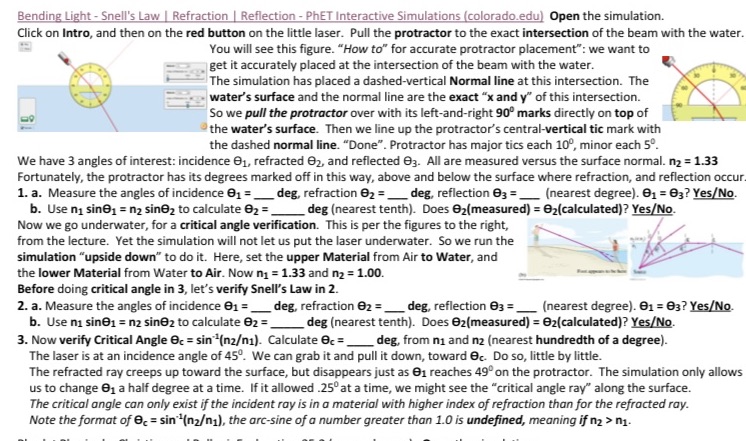
Bending Light - Snell's Law | Refraction | Reflection - PhET Interactive Simulations (colorado.edu) Open the simulation. Click on Intro, and then on the red button on the little laser. Pull the protractor to the exact intersection of the beam with the water. You will see this figure. "How to" for accurate protractor placement": we want to get it accurately placed at the intersection of the beam with the water. The simulation has placed a dashed-vertical Normal line at this intersection. The water's surface and the normal line are the exact "x and y" of this intersection. So we pull the protractor over with its left-and-right 90" marks directly on top of the water's surface. Then we line up the protractor's central-vertical tic mark with the dashed normal line. "Done". Protractor has major tics each 10", minor each 5". We have 3 angles of interest: incidence 01, refracted 02, and reflected 03. All are measured versus the surface normal. n2 = 1.33 Fortunately, the protractor has its degrees marked off in this way, above and below the surface where refraction, and reflection occur 1. a. Measure the angles of incidence 01 = _deg, refraction 02 = _deg, reflection 03 = _ (nearest degree). 01 = 03? Yes/No. b. Use nj sine1 = n2 sin02 to calculate 02 = deg (nearest tenth). Does 02(measured) = 02(calculated)? Yes/No. Now we go underwater, for a critical angle verification. This is per the figures to the right, from the lecture. Yet the simulation will not let us put the laser underwater. So we run the simulation "upside down" to do it. Here, set the upper Material from Air to Water, and the lower Material from Water to Air. Now nj = 1.33 and n2 = 1.00. Before doing critical angle in 3, let's verify Snell's Law in 2. 2. a. Measure the angles of incidence 01 = _deg, refraction 02 = _deg, reflection 03 = _(nearest degree). 01 = 03? Yes/No. b. Use n sin01 = n2 sin02 to calculate 02 = deg (nearest tenth). Does 02(measured) = 02(calculated)? Yes/No. 3. Now verify Critical Angle Oc = sin" (nz1). Calculate Oc = _ deg, from n1 and n2 (nearest hundredth of a degree). The laser is at an incidence angle of 45". We can grab it and pull it down, toward Oc. Do so, little by little. The refracted ray creeps up toward the surface, but disappears just as @1 reaches 49 on the protractor. The simulation only allows us to change 01 a half degree at a time. If it allowed .25" at a time, we might see the "critical angle ray" along the surface. The critical angle can only exist if the incident ray is in a material with higher index of refraction than for the refracted ray. Note the format of O = sin"(n2j), the arc-sine of a number greater than 1.0 is undefined, meaning if ny > n1
Step by Step Solution
There are 3 Steps involved in it

Get step-by-step solutions from verified subject matter experts
 Study Help