







Question: BEYOND THE NUMBERS 2.20 | LEARNING OUTCOMES 4 TO 7 A Challenging Interpretation e Section Number: Name: To be groded, olfl assignments must be
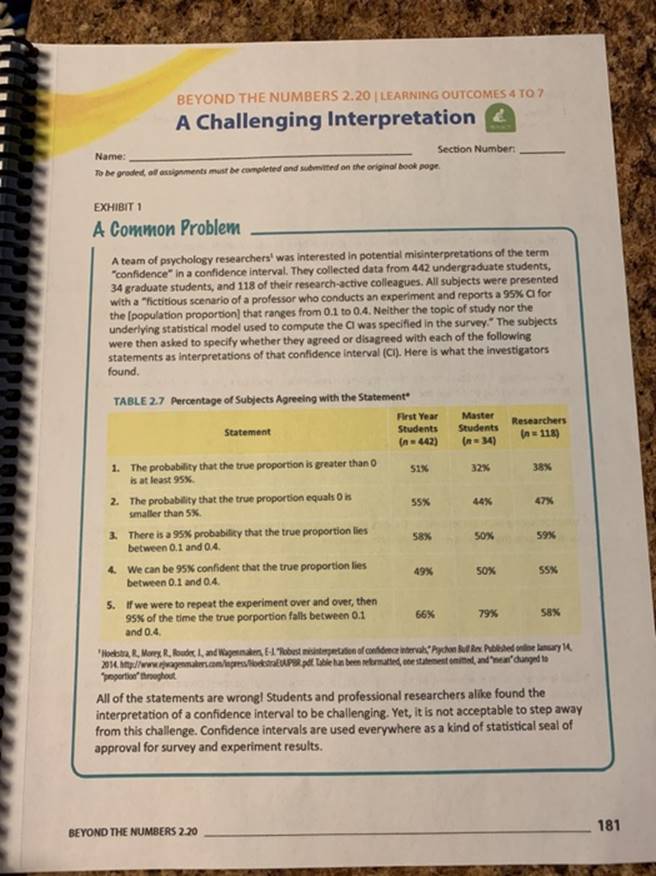
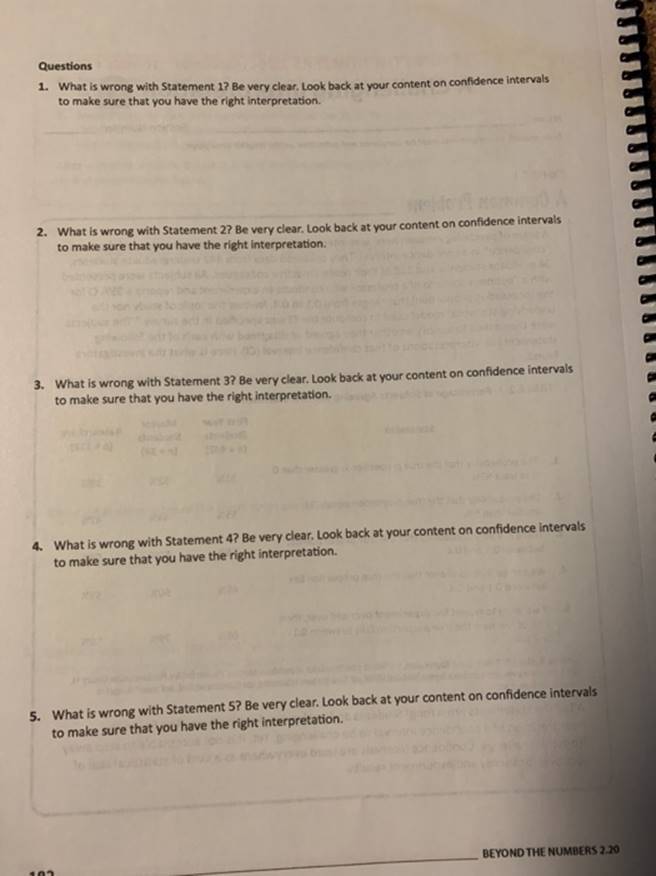
BEYOND THE NUMBERS 2.20 | LEARNING OUTCOMES 4 TO 7 A Challenging Interpretation e Section Number: Name: To be groded, olfl assignments must be completed and submited on the original book poge. EXHIBIT 1 A Common Problem A team of psychology researchers' was interested in potential misinterpretations of the term "confidence" in a confidence interval. They collected data from 442 undergraduate students, 34 graduate students, and 118 of their research-active colleagues. All subjects were presented with a "fictitious scenario of a professor who conducts an experiment and reports a 95% a for the (population proportion] that ranges from 0.1 to 0.4. Neither the topic of study nor the underlying statistical model used to compute the Cl was specified in the survey." The subjects were then asked to specify whether they agreed or disagreed with each of the following statements as interpretations of that confidence interval (CI). Here is what the investigators found. TABLE 27 Percentage of Subjects Agreeing with the Statement First Year Students Master Researchers Students Statement =118) (n-442) (n-34) 1. The probability that the true proportion is greater than O is at least 95% S1% 32% 38% 2. The probability that the true proportion equals 0 is smaller than 5X 55% 44% 47% 3. There is a 95N% probability that the true proportion lies between 0.1 and 0.4. 58% 50% 59% 4 We can be 95% confident that the true proportion lies between 0.1 and 0.4. 49% 50% S5% 5. f we were to repeat the experiment over and over, then 95% of the time the true porportion falls between 0.1 66% 79% S8% and 0.4. "Noestra, R. Morey R, Roudec , and Wagennaen, E1best nisntpetaton of confidemaintervah" Pycon Min hbled onloe lanury 14 2014. p/www.agmmalm.ampesotraPRp aie han ben retrmated, ene statemest onitmet, and near'dunged to poportion throoghout All of the statements are wrongl Students and professional researchers alike found the interpretation of a confidence interval to be challenging. Yet, it is not acceptable to step away from this challenge. Confidence intervals are used everywhere as a kind of statistical seal of approval for survey and experiment results. 181 BEYOND THE NUMBERS 2.20 Questions 1. What is wrong with Statement 17 Be very clear, Look back at your content on confidence intervals to make sure that you have the right interpretation. 2. What is wrong with Statement 2? Be very clear. Look back at your content on confidence intervals to make sure that you have the right interpretation. 3. What is wrong with Statement 3? Be very clear. Look back at your content on confidence intervals to make sure that you have the right interpretation. 4. What is wrong with Statement 4? Be very clear. Look back at your content on confidence intervals to make sure that you have the right interpretation. 5. What is wrong with Statement 5? Be very clear. Look back at your content on confidence intervals to make sure that you have the right interpretation. BEYOND THE NUMBERS 2.20 100
Step by Step Solution
3.43 Rating (156 Votes )
There are 3 Steps involved in it
Answer I First statement is wrong because the proportion of confidence interval has nothing to do wi... View full answer

Get step-by-step solutions from verified subject matter experts
 Study Help