







Question: Bicycle Shop uses a periodic inventory system. For the specific identification method, the March 5 sale consists of bikes from beginning inventory, the March 17
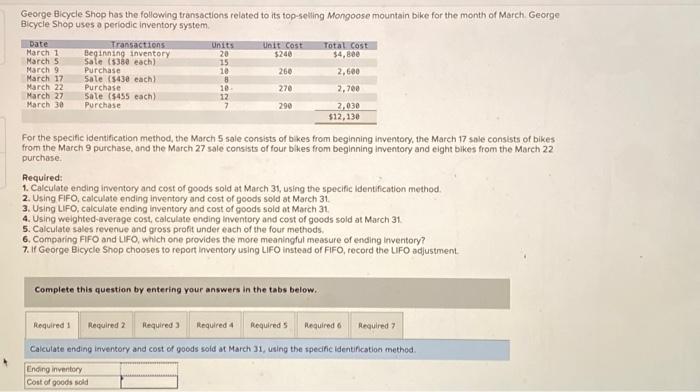
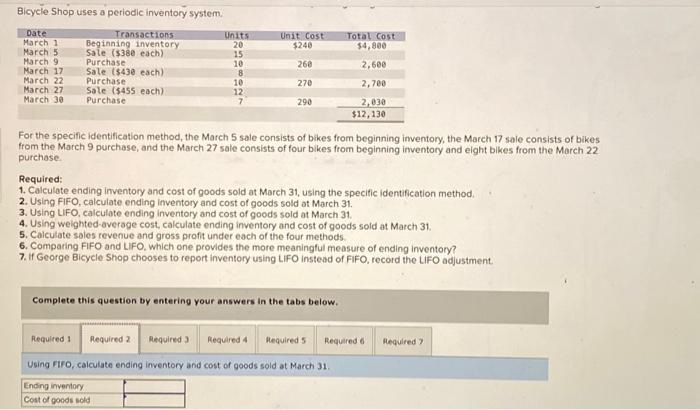
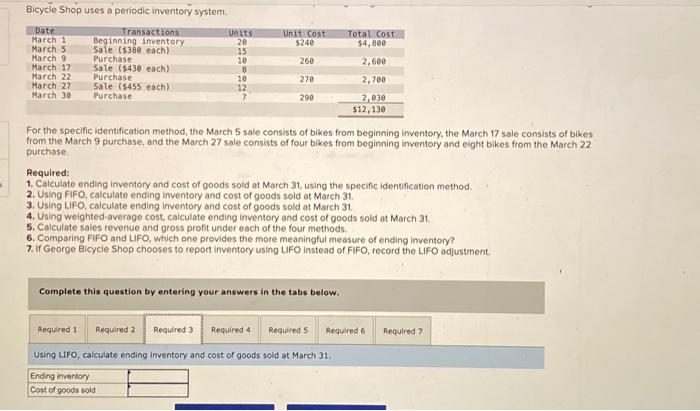
Bicycle Shop uses a periodic inventory system. For the specific identification method, the March 5 sale consists of bikes from beginning inventory, the March 17 sale consists of bikes from the March 9 purchase, and the March 27 sale consists of four bikes from beginning inventory and eight bikes from the March 22 purchase. Required: 1. Calculate ending inventory and cost of goods sold at March 31, using the specific identification method: 2. Using FFF, calculate ending inventory and cost of goods sold ot March 31. 3. Using LFO, calculote ending inventory and cost of goods sold at March 31. 4. Using weighted-average cost, calculate ending inventory and cost of goods sold at March 31. 5. Calculate sales revenue and gross profit under each of the four methods. 6. Comparing FIFO and LIFO, which one provides the more meaningful measure of ending inventory? 7. If George Bicycle Shop chooses to report inventory using LIFO instead of FIFO, record the LIFO adjustment. Complete this question by entering your answers in the tabs below. Using Firo, colculate ending inventory and cost of goods sold at March 31. Bicycle Shop uses o periodic inventory system. For the specific identification method, the March 5 sale consists of bikes from beginning inventory, the March 17 sale consists of bikes from the March 9 purchase, and the March 27 sale consists of four bikes from beginning inventory and eight bikes from the March 22 purchase. Required: 1. Calculate ending inventory and cost of goods sold at March 31, using the specific identification method. 2. Using FIFO, calculate ending inventory and cost of goods sold at March 31. 3. Using LIFO, calculate ending inventory and cost of goods sold ot March 31. 4. Using weighted-average cost, calculate ending inventory and cost of goods sold at March 31. 5. Calculate sales revenue and gross profit under each of the four methods. 6. Comparing FIFO and LIFO, which one provides the more meaningful measure of ending inventory? 7. If George Bicycle Shop chooses to report inventory using LIFO instead of FIFO, record the LIFO adjustment. Complete this question by entering your answers in the tabs below. Using LIFO, calculate ending inventory and cost of goods sold at March 31. George Eicycle Shop has the following transactions related to its top-selling Mongoose mountain bike for the month of March. George Bicycle Shop uses a periodic inventory system. For the specific identification method, the March 5 sale consists of bikes from beginning inventory, the March 17 sole consists of bikes from the March 9 purchase, and the March 27 sale consists of four bikes from beginning inventory and eight bikes from the March 22 purchase. Required: 1. Calculate ending inventory and cost of goods sold at March 3t, using the specific identification method. 2. Using FIFO, calculate ending inventory and cost of goods sold at March 31 . 3. Using LIFO, calculate ending inventory and cost of goods soid ot March 31 . 4. Using weighted-average cost, calculate ending inventory and cost of goods sold at March 31. 5. Calculate sales revenue and gross profit under each of the four methods. 6. Comparing FIFO and LIFO, which one provides the more meaningfut measure of ending irventory? 7. If George Bicycle Shop chooses to report inventory using LIFO instead of FIFO, record the LFO adjustment. Complete this question by entering your answers in the tabs below. Calculate ending inventory and cost of goods sold at March 31 , using the specific identifcation method
Step by Step Solution
There are 3 Steps involved in it

Get step-by-step solutions from verified subject matter experts
 Study Help