







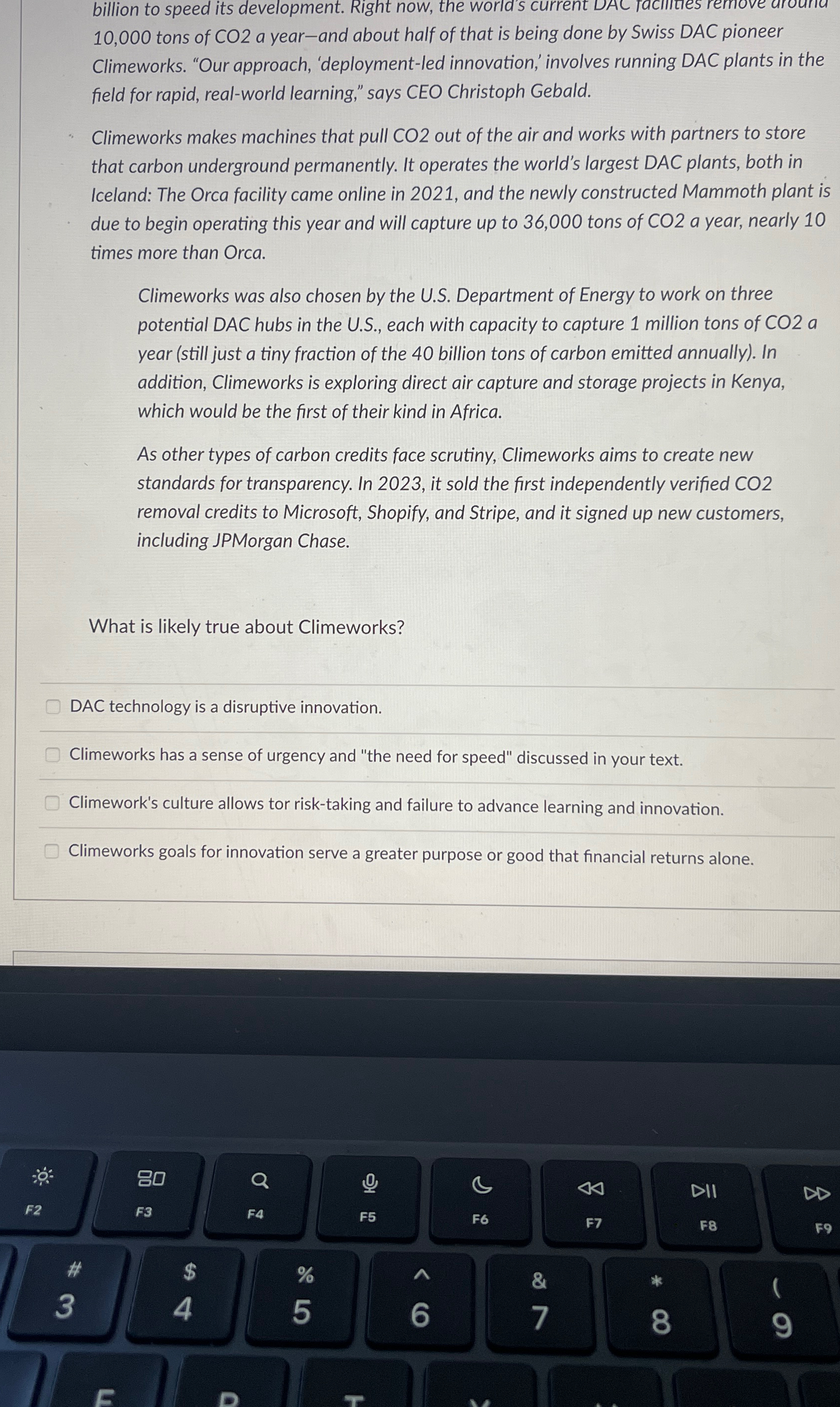
Question: billion to speed its development. Right now, the world's current 1 0 , 0 0 0 tons of CO 2 a year - and about
billion to speed its development. Right now, the world's current tons of CO a yearand about half of that is being done by Swiss DAC pioneer Climeworks. "Our approach, 'deploymentled innovation, involves running DAC plants in the field for rapid, realworld learning," says CEO Christoph Gebald.
Climeworks makes machines that pull CO out of the air and works with partners to store that carbon underground permanently. It operates the world's largest DAC plants, both in Iceland: The Orca facility came online in and the newly constructed Mammoth plant is due to begin operating this year and will capture up to tons of a year, nearly times more than Orca.
Climeworks was also chosen by the US Department of Energy to work on three potential DAC hubs in the US each with capacity to capture million tons of CO a year still just a tiny fraction of the billion tons of carbon emitted annually In addition, Climeworks is exploring direct air capture and storage projects in Kenya, which would be the first of their kind in Africa.
As other types of carbon credits face scrutiny, Climeworks aims to create new standards for transparency. In it sold the first independently verified CO removal credits to Microsoft, Shopify, and Stripe, and it signed up new customers, including JPMorgan Chase.
What is likely true about Climeworks?
DAC technology is a disruptive innovation.
Climeworks has a sense of urgency and "the need for speed" discussed in your text.
Climework's culture allows tor risktaking and failure to advance learning and innovation.
Climeworks goals for innovation serve a greater purpose or good that financial returns alone.
Step by Step Solution
There are 3 Steps involved in it
1 Expert Approved Answer
Step: 1 Unlock

Question Has Been Solved by an Expert!
Get step-by-step solutions from verified subject matter experts
Step: 2 Unlock
Step: 3 Unlock
 Study Help