







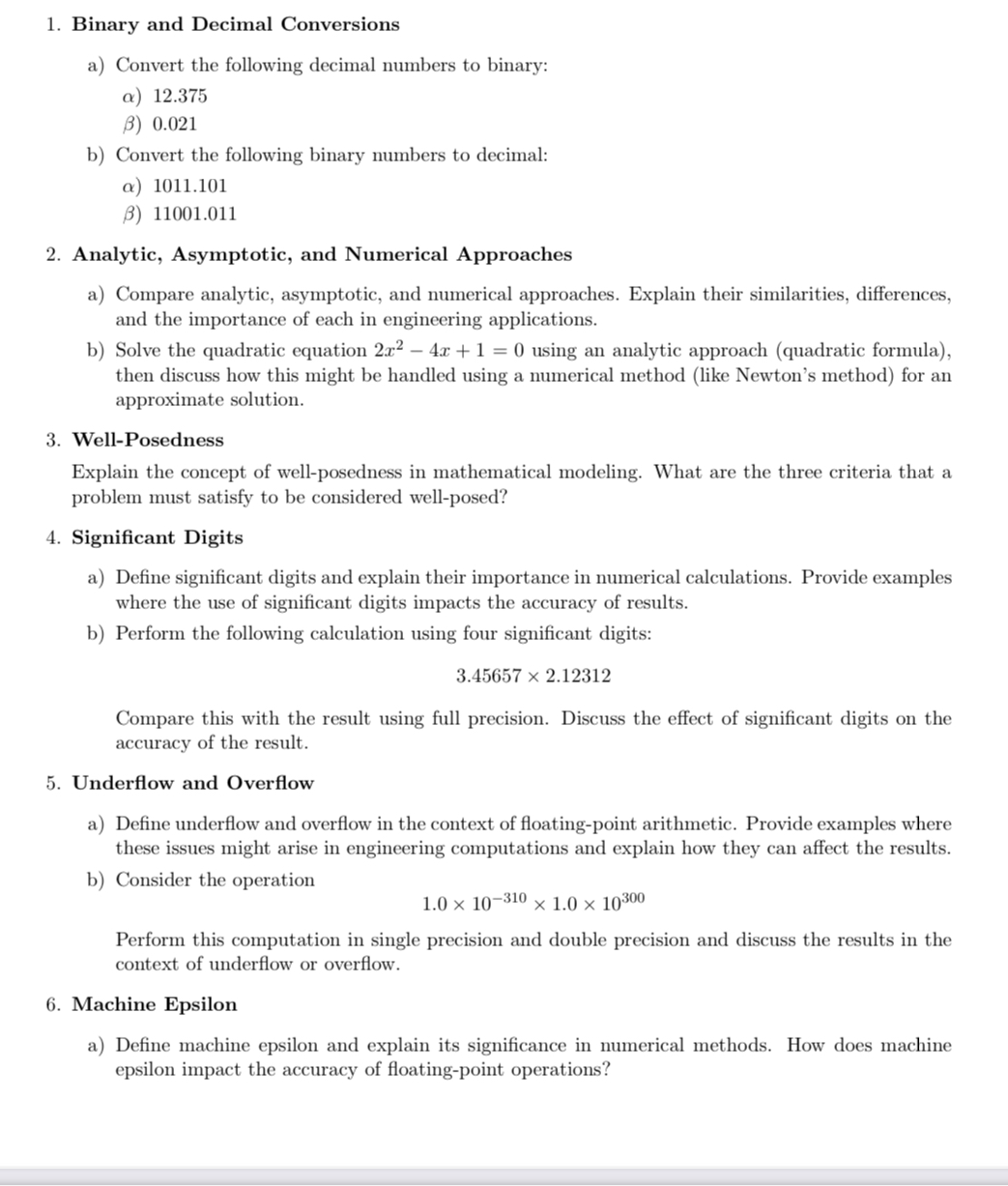
Question: Binary and Decimal Conversions a ) Convert the following decimal numbers to binary: ) 1 2 . 3 7 5 ) 0 . 0 2
Binary and Decimal Conversions
a Convert the following decimal numbers to binary:
b Convert the following binary numbers to decimal:
Analytic, Asymptotic, and Numerical Approaches
a Compare analytic, asymptotic, and numerical approaches. Explain their similarities, differences, and the importance of each in engineering applications.
b Solve the quadratic equation using an analytic approach quadratic formula then discuss how this might be handled using a numerical method like Newton's method for an approximate solution.
WellPosedness
Explain the concept of wellposedness in mathematical modeling. What are the three criteria that a problem must satisfy to be considered wellposed?
Significant Digits
a Define significant digits and explain their importance in numerical calculations. Provide examples where the use of significant digits impacts the accuracy of results.
b Perform the following calculation using four significant digits:
Compare this with the result using full precision. Discuss the effect of significant digits on the accuracy of the result.
Underflow and Overflow
a Define underflow and overflow in the context of floatingpoint arithmetic. Provide examples where these issues might arise in engineering computations and explain how they can affect the results.
b Consider the operation
Perform this computation in single precision and double precision and discuss the results in the context of underflow or overflow.
Machine Epsilon
a Define machine epsilon and explain its significance in numerical methods. How does machine epsilon impact the accuracy of floatingpoint operations?
Step by Step Solution
There are 3 Steps involved in it
1 Expert Approved Answer
Step: 1 Unlock

Question Has Been Solved by an Expert!
Get step-by-step solutions from verified subject matter experts
Step: 2 Unlock
Step: 3 Unlock
 Study Help