







Question: Binary numbers can be negative ( unsigned ) , but do not display a negative sign when the subtrahend exceeds the minuend. Try using the
Binary numbers can be negative ( unsigned ) , but do not display a negative sign when the subtrahend exceeds the minuend. Try using the Windows Calculator
( set to Bin and Byte ) and subtract 100 by 101 . Observe the result.
Show how the decimal number ? 3,173 would be expressed as a 16 - bit binary integer using two's complement notation. Remember for binary addition use these rules: 0 + 0 = 0 , 1 + 0 = 1 , 0 + 1 = 1 and 1 + 1 = 10 ( the 1 is the " carried " number ) .
Hint: first create the complement of the binary number, substitute a 0 for a 1 and a 1 for a 0 , and then add a 1 to this complement binary number.
(1) write the original decimal number in a binary number format
|
|
|
|
|
|
|
|
|
|
|
|
|
|
|
|
|
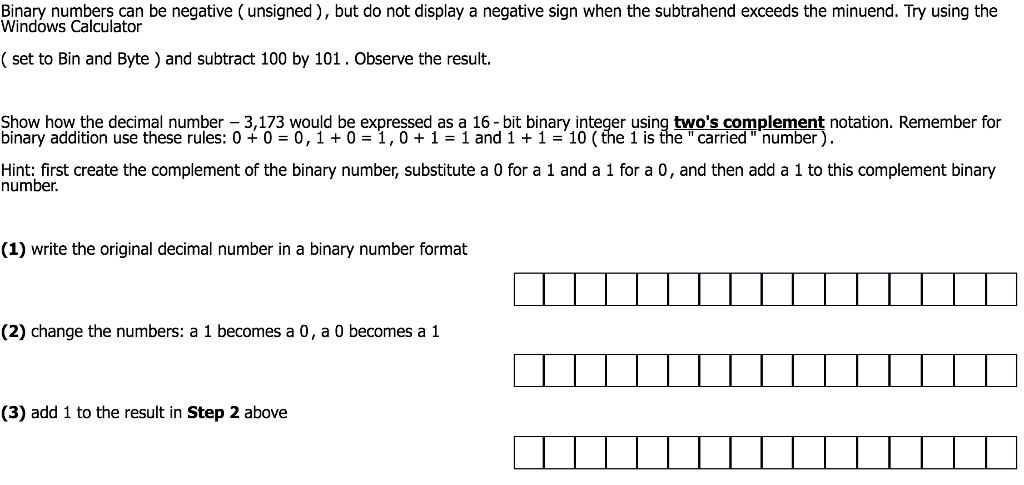
(2) change the numbers: a 1 becomes a 0 , a 0 becomes a 1
|
|
|
|
|
|
|
|
|
|
|
|
|
|
|
|
|
(3) add 1 to the result in Step 2 above
|
|
|
|
|
|
|
|
|
|
|
|
|
|
|
|
|
Step by Step Solution
There are 3 Steps involved in it

Get step-by-step solutions from verified subject matter experts
 Study Help