



Question: binomial distribution Suppose X follows a Binomial{n,p) distribution: with n lcuown and 3: unknown. We 1want a 100(1 a}% oondence interval for p. The standard
binomial distribution
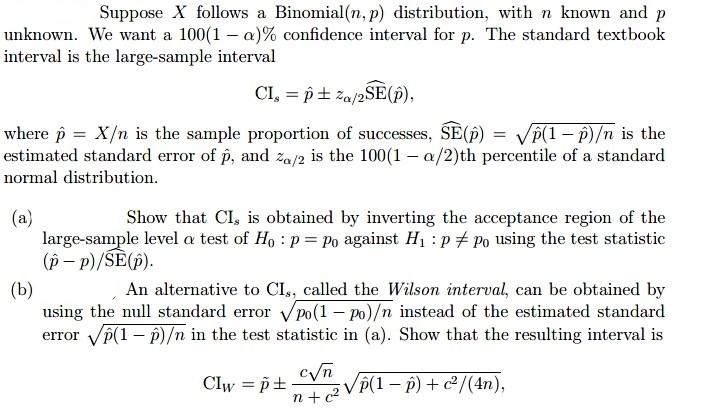
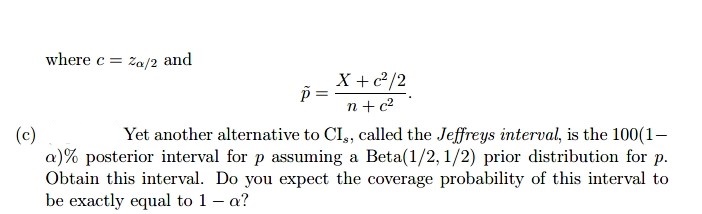
Suppose X follows a Binomial{n,p) distribution: with n lcuown and 3: unknown. We 1want a 100(1 a}% oondence interval for p. The standard textbook interval is the large-sample interval CL = :3 i awaits), where 33 = an is the sample proportion of successes, Si} = 1;\" 351:1 pun is the estimated standard error of p, and 2.11;: is the 11]]{1 car/mth percentile of a standard normal distribution. {a} Show that CL, is obtained by inverting the acceptance region of the largehsanriple level or test of Hg : p 2 Pa against H1 : p # Pu using the test statistic (:5 PlfSEl)' {b} x An alternative to CL, called the Wilson interval, can be obtained by using the null standard error 1.! p.1[1 pu}fn instead of the estimated standard error 1Hp{1 pun in the test statistic in {a}. Show that the resulting interval is 01w :13: N: s/ll J Wren), \"fl-l- 1Where c = 3.132 and _ _ X + .2ng p + n. + c2 I {c} Yet another alternative to C13, called the Jereys interval, is the 100(1 o:]% posterior interval for p assuming a Betaf 2: 1}?) prior distribution for p. IUbtain this interval. Do you expect the coverage probability of this interval to be exactly equal to 1 or
Step by Step Solution
There are 3 Steps involved in it

Get step-by-step solutions from verified subject matter experts