



Question: Binomial Distributions Statistics Lesson 13: Individual Preparation Name: Introduction to Binomial Probability Distributions You flip a (fair) coin 3 times. What is the probability of
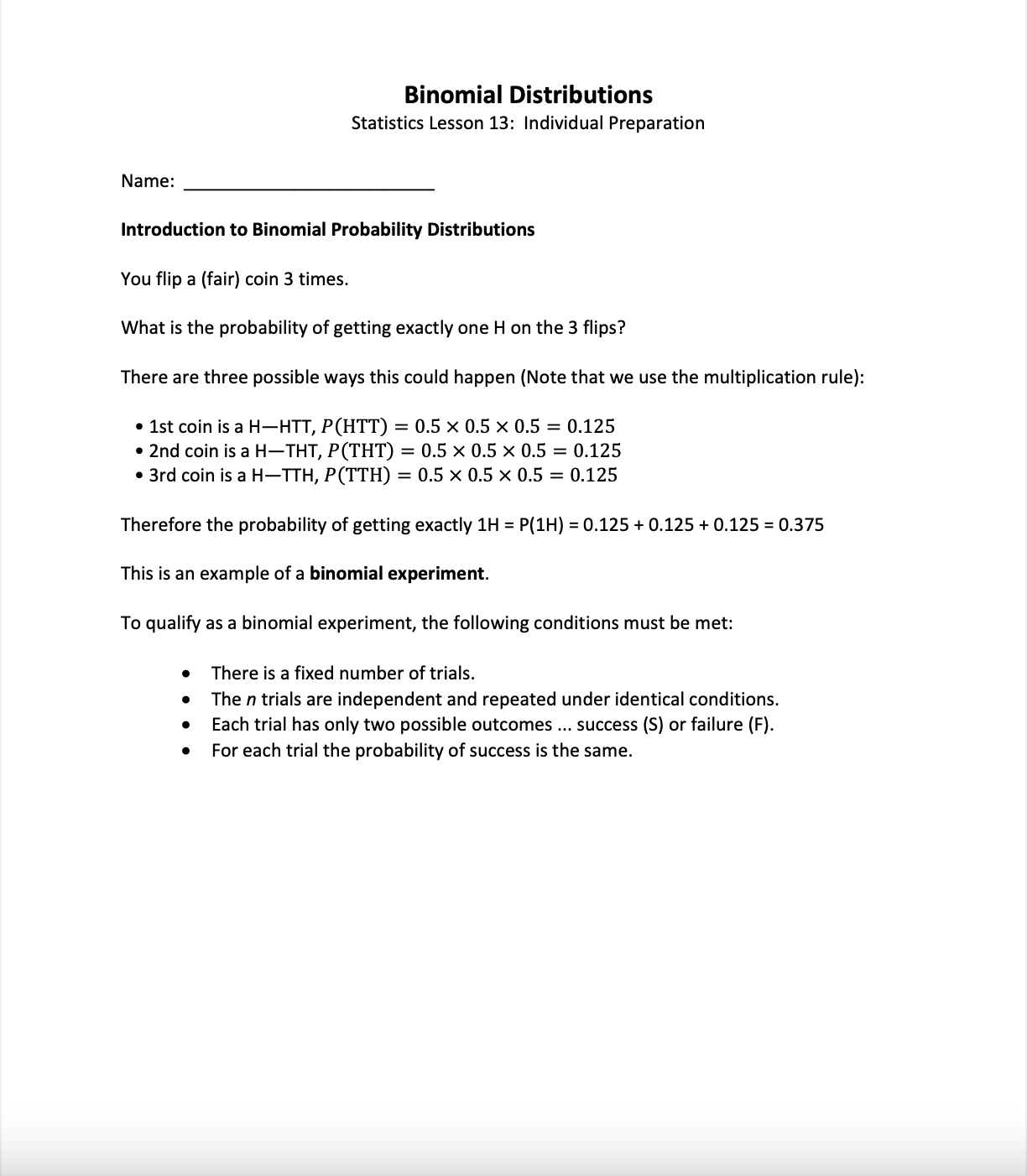
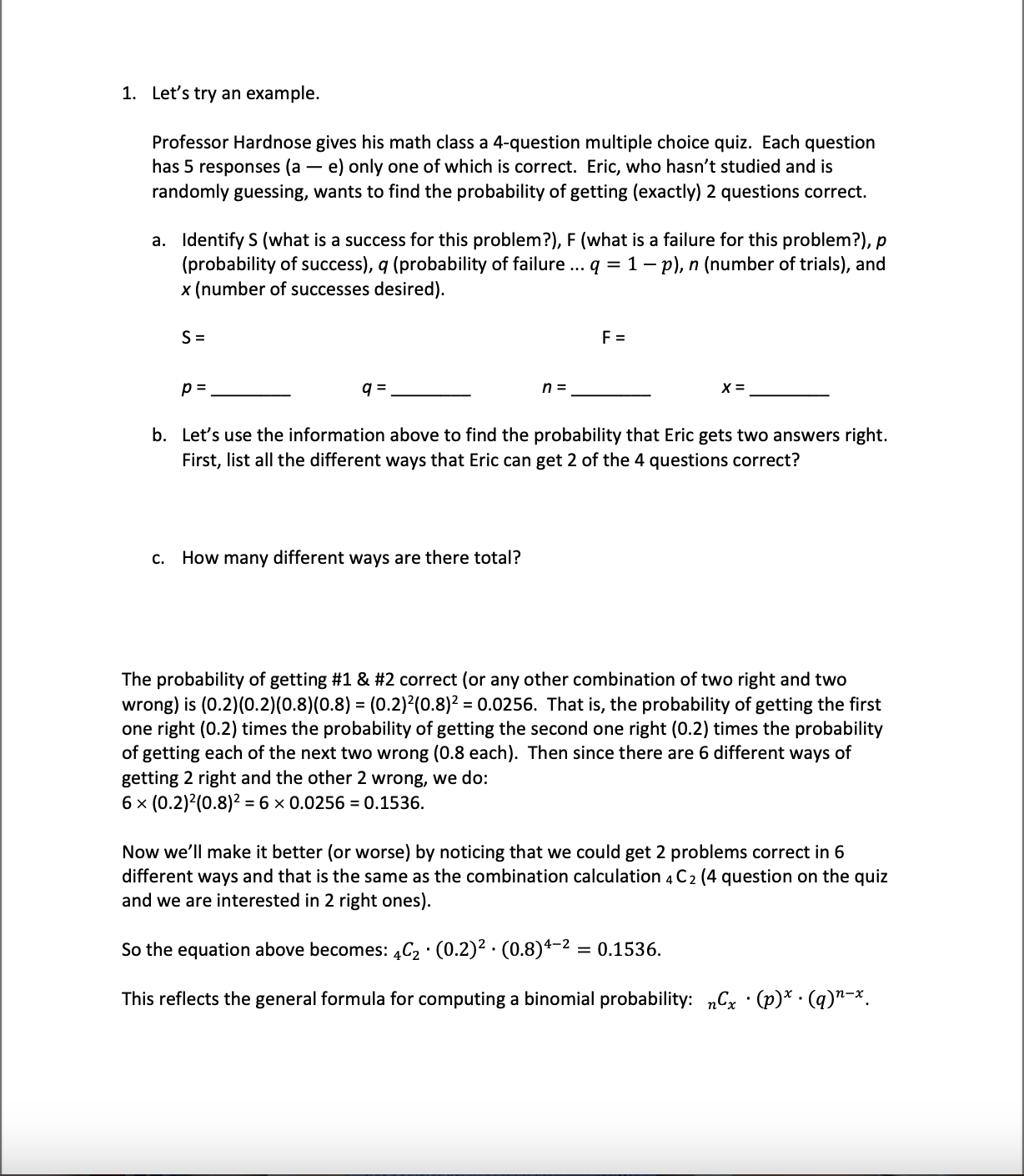
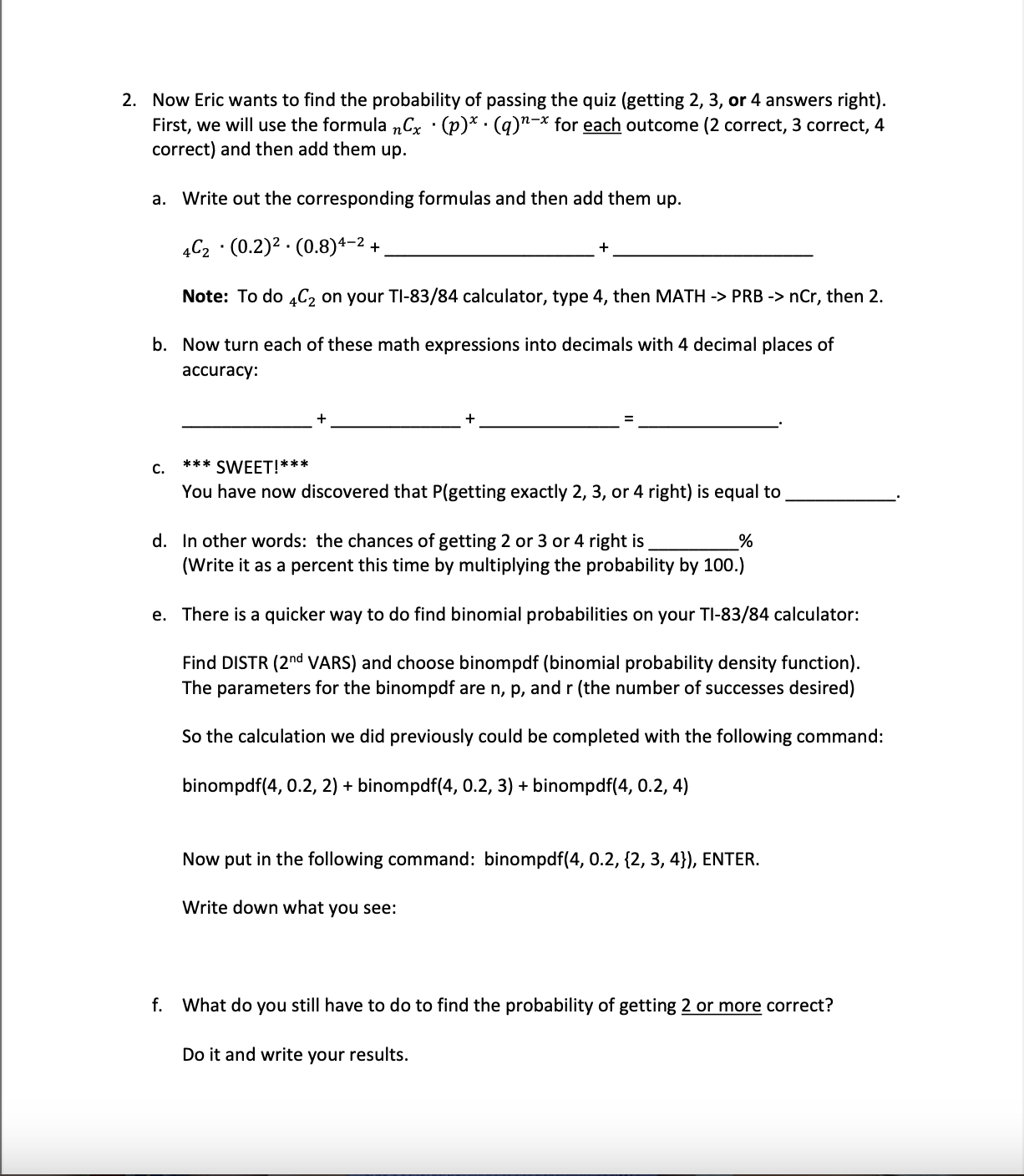
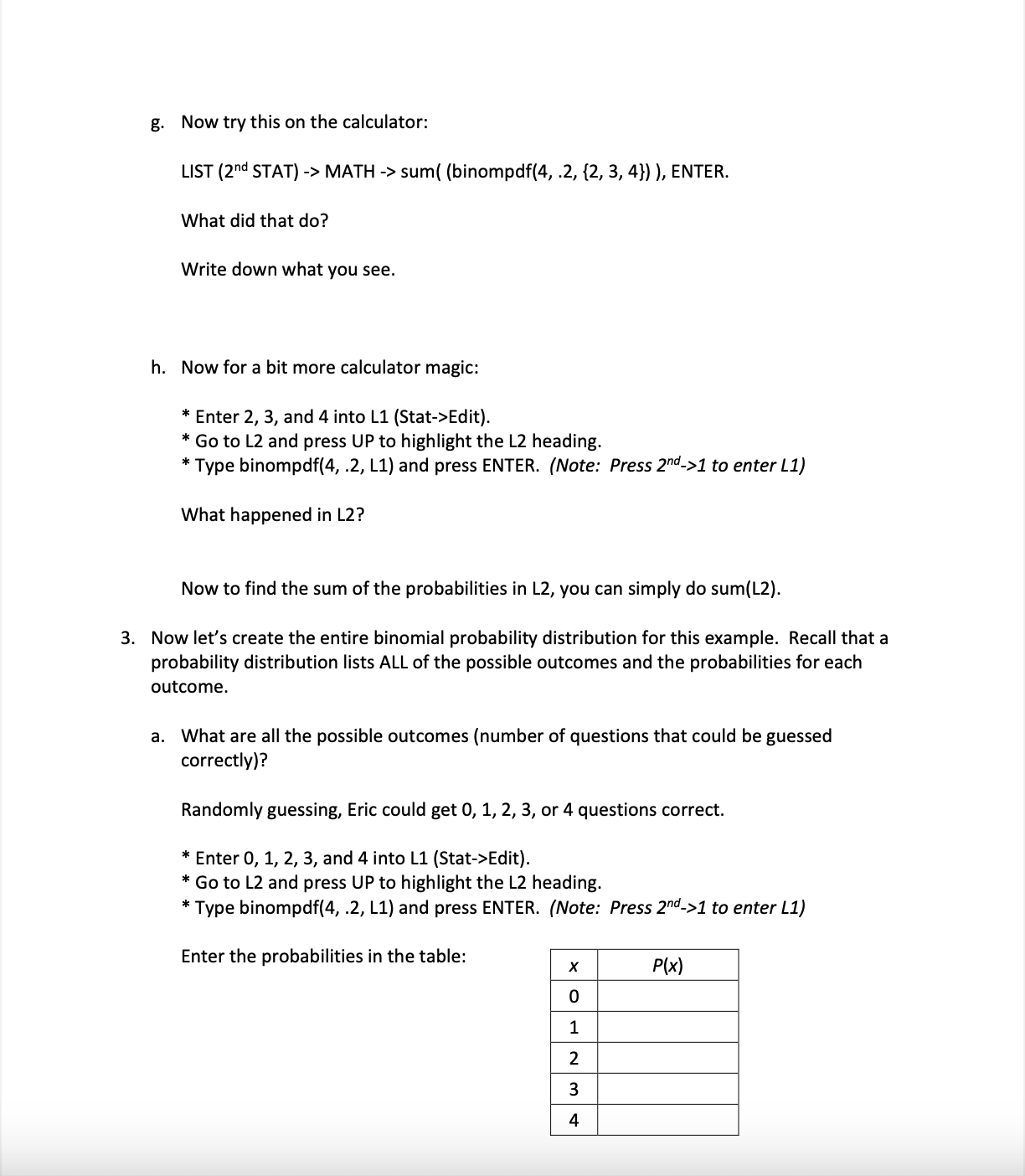
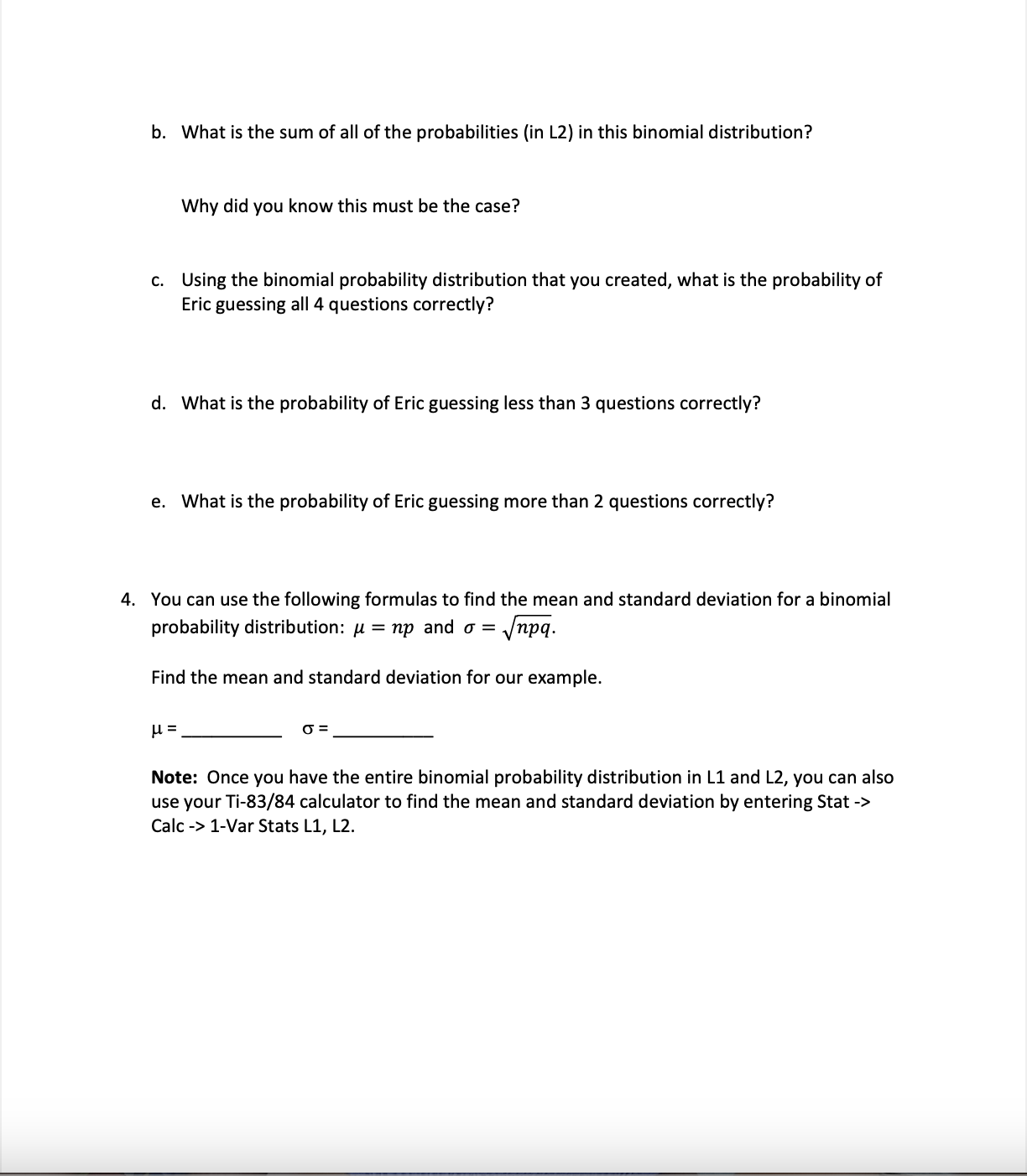
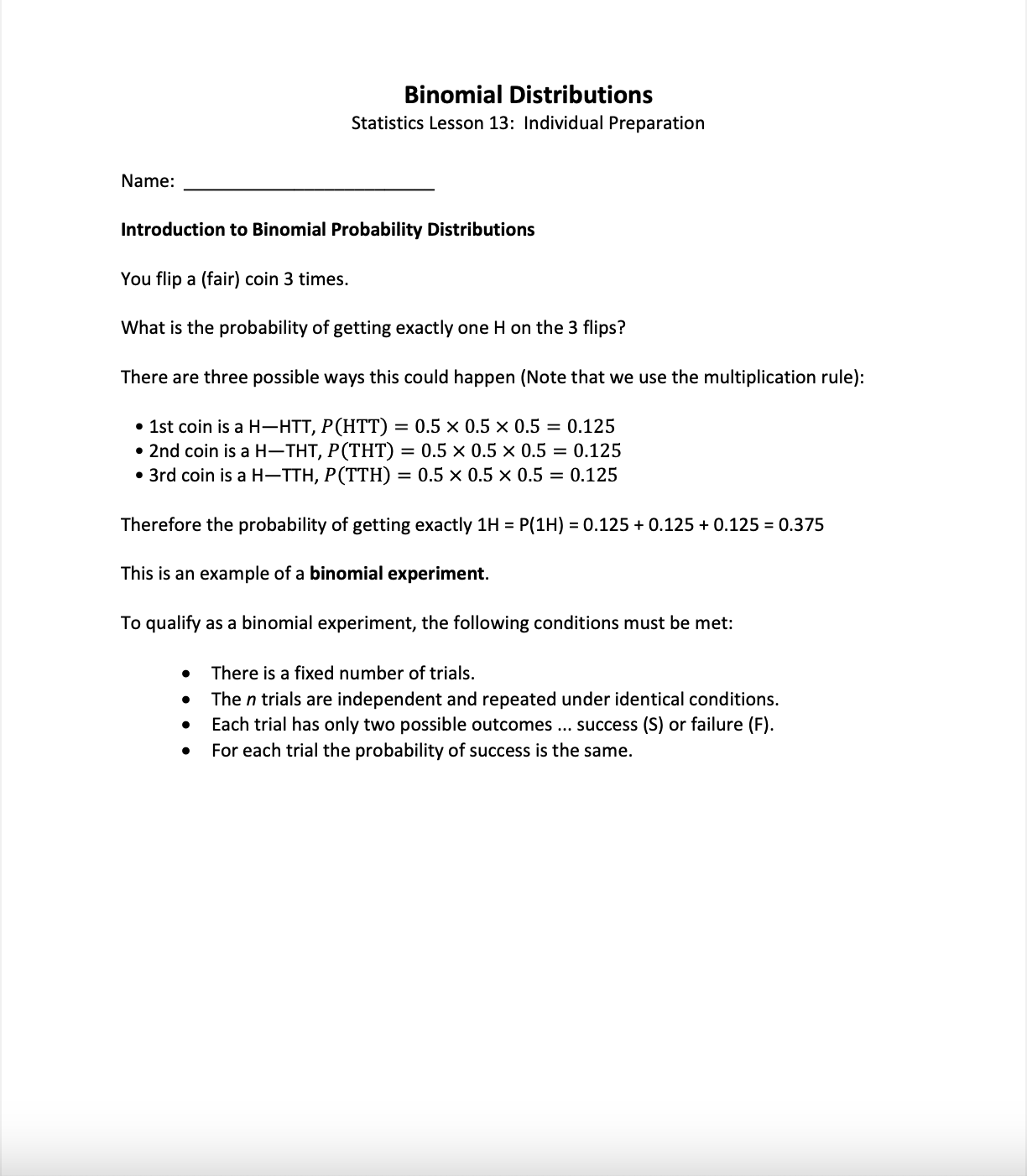
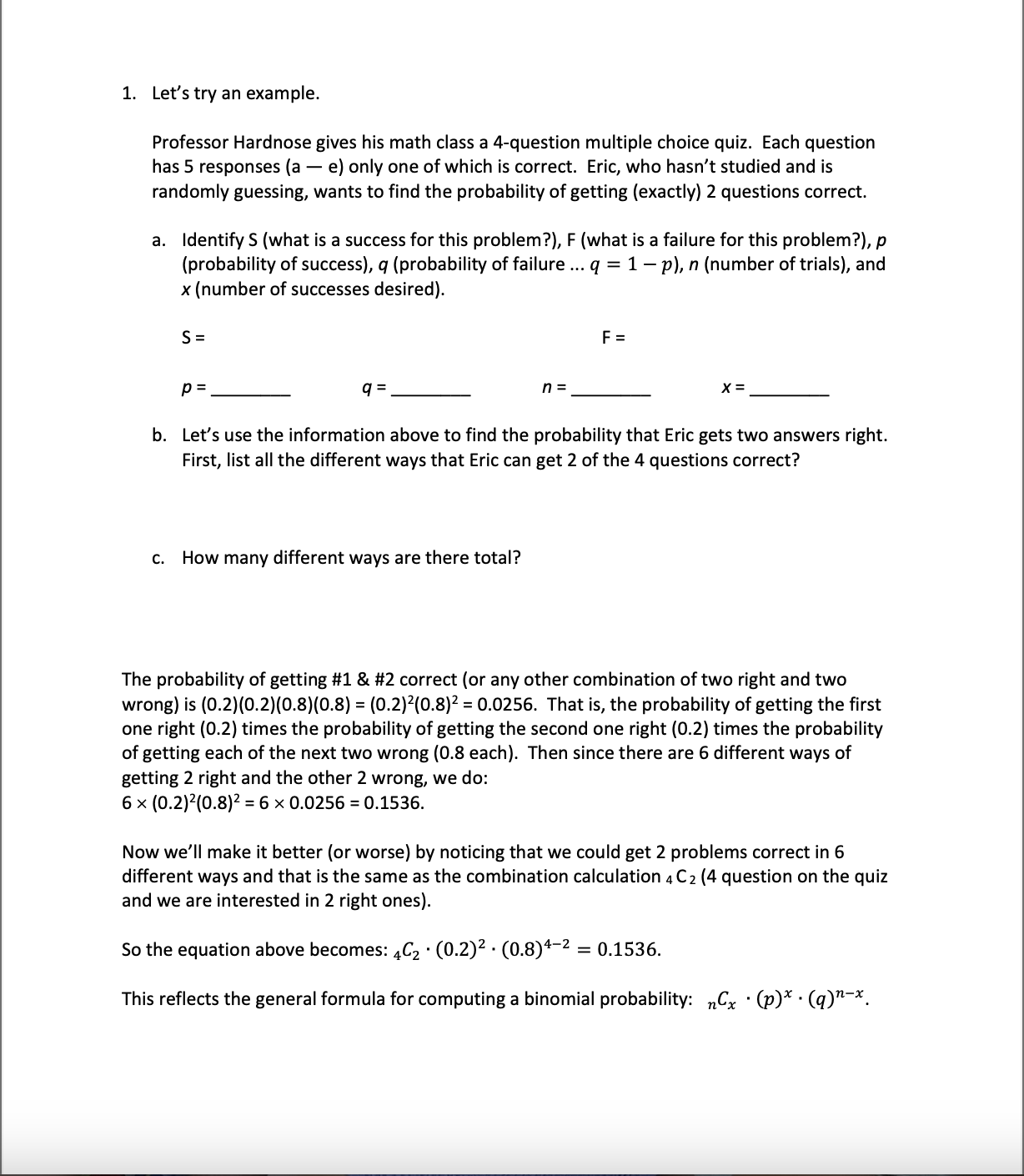
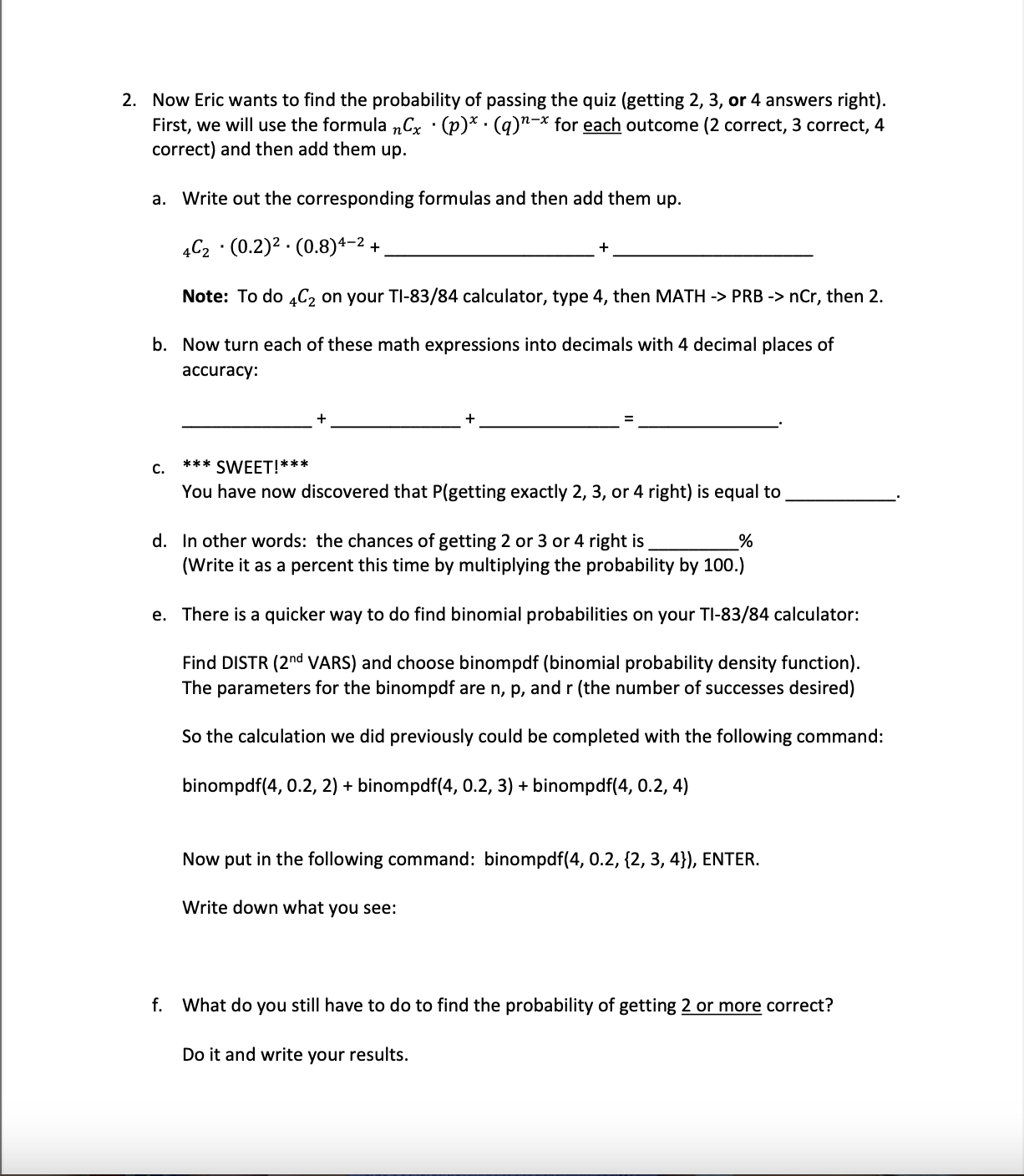
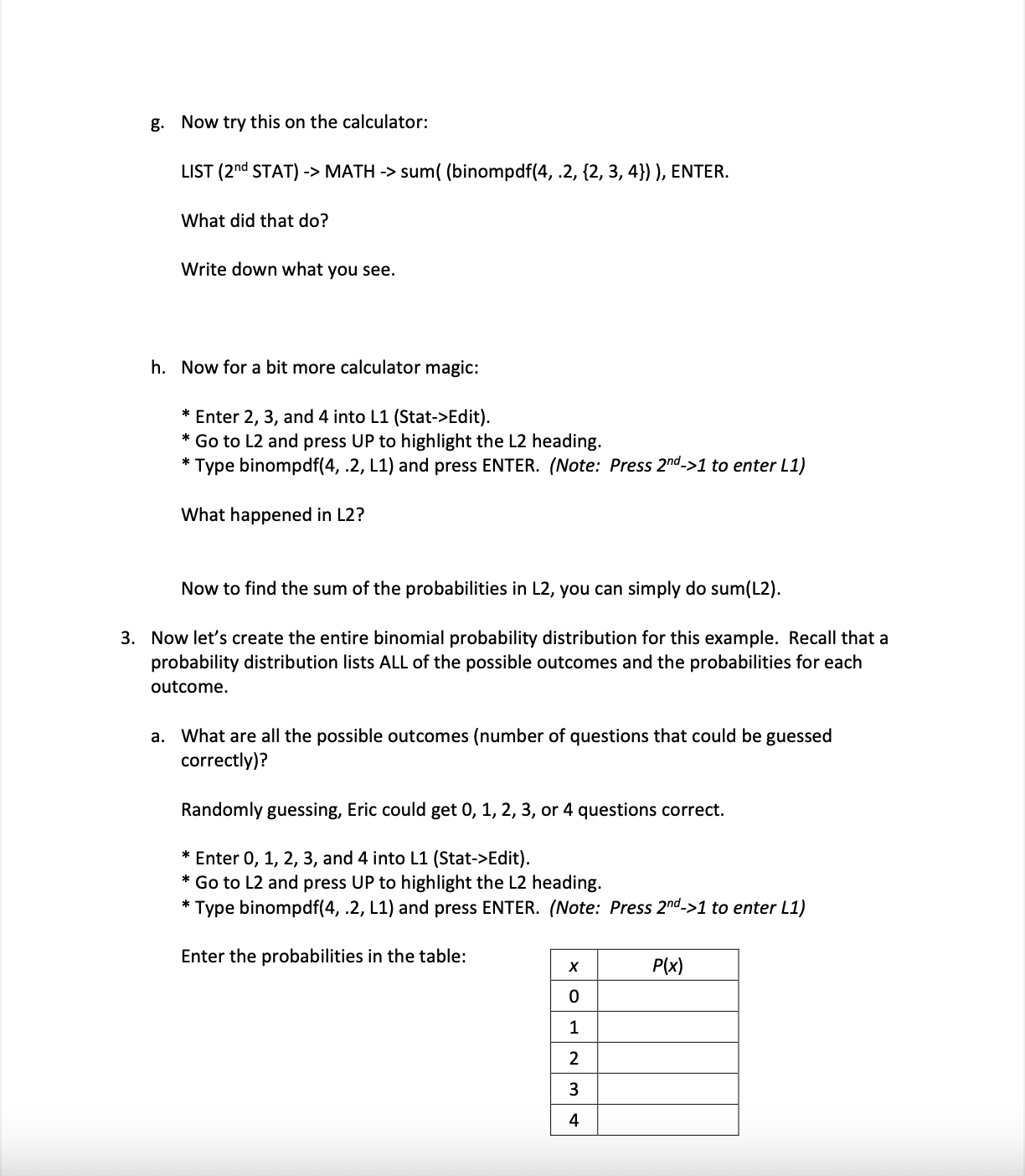
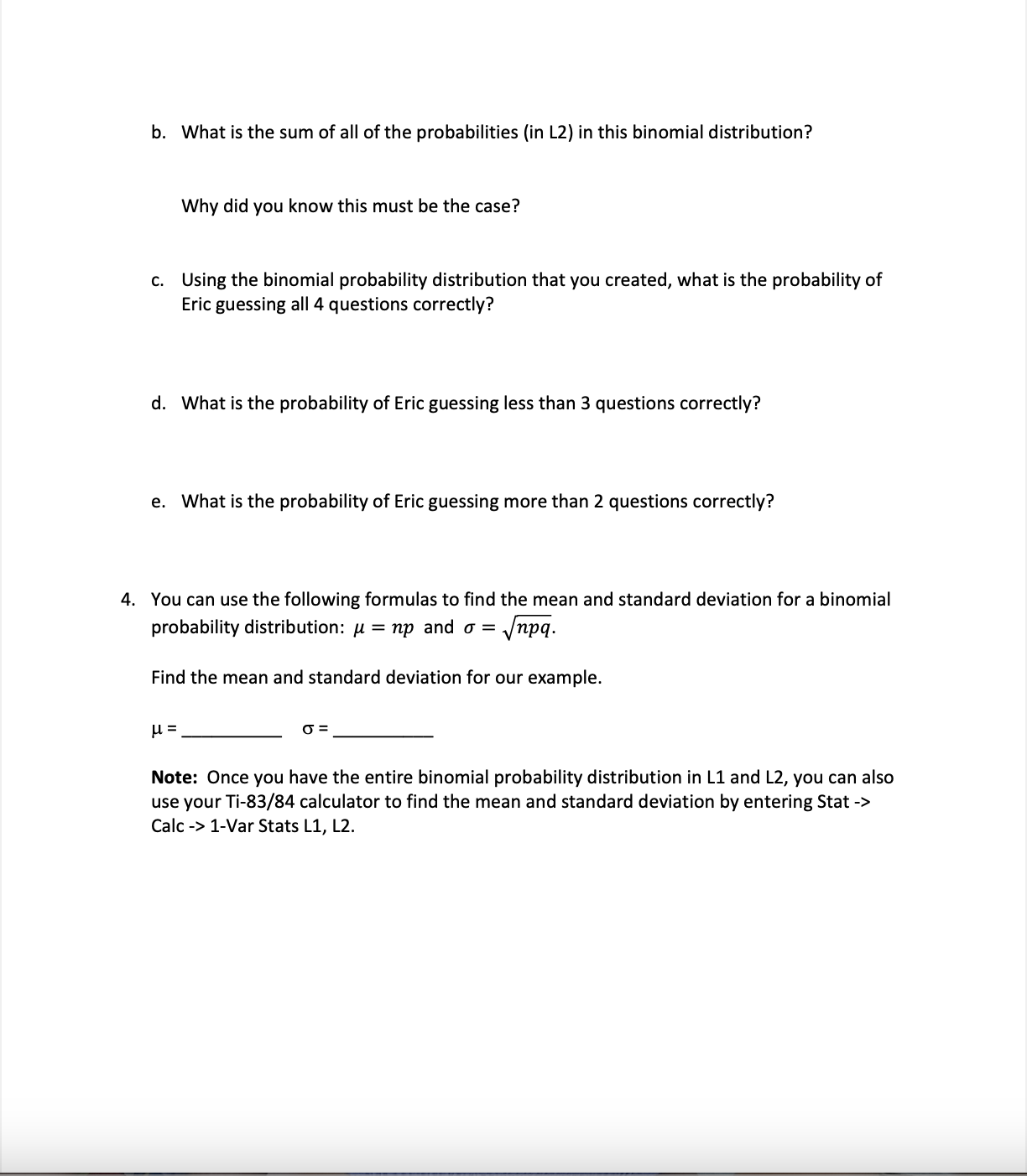
Binomial Distributions Statistics Lesson 13: Individual Preparation Name: Introduction to Binomial Probability Distributions You flip a (fair) coin 3 times. What is the probability of getting exactly one H on the 3 flips? There are three possible ways this could happen (Note that we use the multiplication rule): . 1st coin is a H-HTT, P(HTT) = 0.5 x 0.5 x 0.5 = 0.125 . 2nd coin is a H-THT, P(THT) = 0.5 x 0.5 x 0.5 = 0.125 . 3rd coin is a H-TTH, P(TTH) = 0.5 x 0.5 x 0.5 = 0.125 Therefore the probability of getting exactly 1H = P(1H) = 0.125 + 0.125 + 0.125 = 0.375 This is an example of a binomial experiment. To qualify as a binomial experiment, the following conditions must be met: There is a fixed number of trials. . The n trials are independent and repeated under identical conditions. Each trial has only two possible outcomes ... success (S) or failure (F). For each trial the probability of success is the same.1. Let's try an example. Professor Hardnose gives his math class a 4-question multiple choice quiz. Each question has 5 responses (a e) only one of which is correct. Eric, who hasn't studied and is randomly guessing, wants to find the probability of getting (exactly) 2 questions correct. a. Identify S (what is a success for this problem?), F (what is a failure for this problem?), p (probability of success), q (probability of failure q = 1 p), n (number of trials), and x (number of successes desired). p: q: n: X: b. Let's use the information above to find the probability that Eric gets two answers right. First, list all the different ways that Eric can get 2 of the 4 questions correct? c. How many different ways are there total? The probability of getting #1 8L #2 correct (or any other combination of two right and two wrong) is (0.2)(0.2)(0.8)(0.8) = (0.2)2(0.8)2 = 0.0256. That is, the probability of getting the first one right (0.2) times the probability of getting the second one right (0.2) times the probability of getting each of the next two wrong (0.8 each). Then since there are 6 different ways of getting 2 right and the other 2 wrong, we do: 6 x (0.2)2(0.8)2 = 5 x 0.0256 = 0.1535. Now we'll make it better (or worse) by noticing that we could get 2 problems correct in 5 different ways and that is the same as the combination calculation 4C2 (4 question on the quiz and we are interested in 2 right ones). So the equation above becomes: 462 - (0.2)2 - (0.8)\"'2 = 0.1536. This reflects the general formula for computinga binomial probability: an - (pf - (q)\"'x. 2. Now Eric wants to nd the probability of passing the quiz (getting 2, 3, or 4 answers right). First, we will use the formula an - (1))" - (qO'Hr for each outcome (2 correct, 3 correct, 4 correct) and then add them up. a. Write out the corresponding formulas and then add them up. 462 ' (0.2)2 ' (0.8)4_2 ++ Note: To do 4C2 on your Tl-83/84 calculator, type 4, then MATH -> PRB -> nCr, then 2. b. Now turn each of these math expressions into decimals with 4 decimal places of accuracy: c. *** SWEET!*** You have now discovered that P(getting exactly 2, 3, or 4 right) is equal to d. In other words: the chances of getting 2 or 3 or 4 right is % (Write it as a percent this time by multiplying the probability by 100.) e. There is a quicker way to do find binomial probabilities on your Tl-83/84 calculator: Find DISTR (2'1d VARS) and choose binompdf (binomial probability density function). The parameters for the binom pdf are n, p, and r (the number of successes desired) 50 the calculation we did previously could be completed with the following command: binompdf(4, 0.2, 2) + binompdf(4, 0.2, 3) + binompdf(4, 0.2, 4) Now put in the following command: binompdf(4, 0.2, {2, 3, 4}), ENTER. Write down what you see: f. What do you still have to do to find the probability of getting 2 or more correct? Do it and write your results. g. Now try this on the calculator: LIST (2"d STAT) -> MATH -> sum( (binompdf(4, .2, {2, 3, 4}) ), ENTER. What did that do? Write down what you see. h. Now for a bit more calculator magic: * Enter 2, 3, and 4 into L1 (Stat->Edit). * Go to L2 and press UP to highlight the L2 heading. * Type binompdfl4, .2, L1) and press ENTER. (Note: Press 2\"d->1 to enter L1) What happened in L2? Now to find the sum ofthe probabilities in L2, you can simply do sum(L2). 3. Now let's create the entire binomial probability distribution for this example. Recall that a probability distribution lists ALL ofthe possible outcomes and the probabilities for each outcome. a. What are all the possible outcomes (number of questions that could be guessed correctly)? Randomly guessing, Eric could get 0, 1, 2, 3, or 4 questions correct. * Enter 0, 1, 2, 3, and 4 into L1 (Stat->Edit). * Go to L2 and press UP to highlight the L2 heading. * Type binompdfl4, .2, L1) and press ENTER. (Note: Press 2\"d->1 to enter L1) Enter the probabilities in the table: PlX) waixok b. What is the sum of all of the probabilities (in L2) in this binomial distribution? Why did you know this must be the case? c. Using the binomial probability distribution that you created, what is the probability of Eric guessing all 4 questions correctly? d. What is the probability of Eric guessing less than 3 questions correctly? e. What is the probability of Eric guessing more than 2 questions correctly? 4. You can use the following formulas to find the mean and standard deviation for a binomial probability distribution: p = np and o' = 1m q. Find the mean and standard deviation for our example. p = 5 = Note: Once you have the entire binomial probability distribution in L1 and L2, you can also use your Ti-83/84 calculator to find the mean and standard deviation by entering Stat -> Calc -> 1-Var Stats L1, L2
Step by Step Solution
There are 3 Steps involved in it

Get step-by-step solutions from verified subject matter experts