







Question: Bivariate Association -nominal and ordinal variables Problem set #4 Homework 10 Following the scores of a sample of 15 nations on a measure of
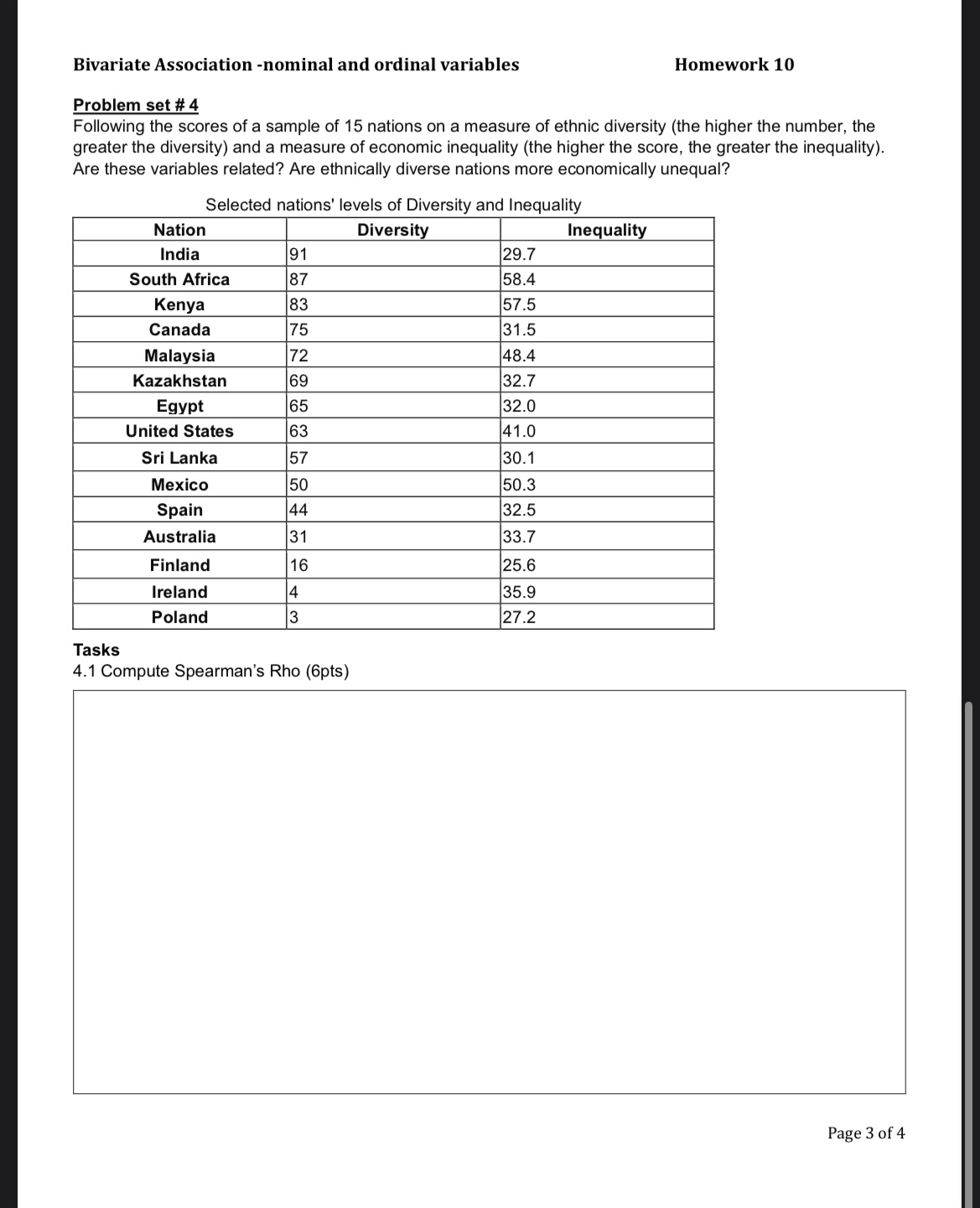
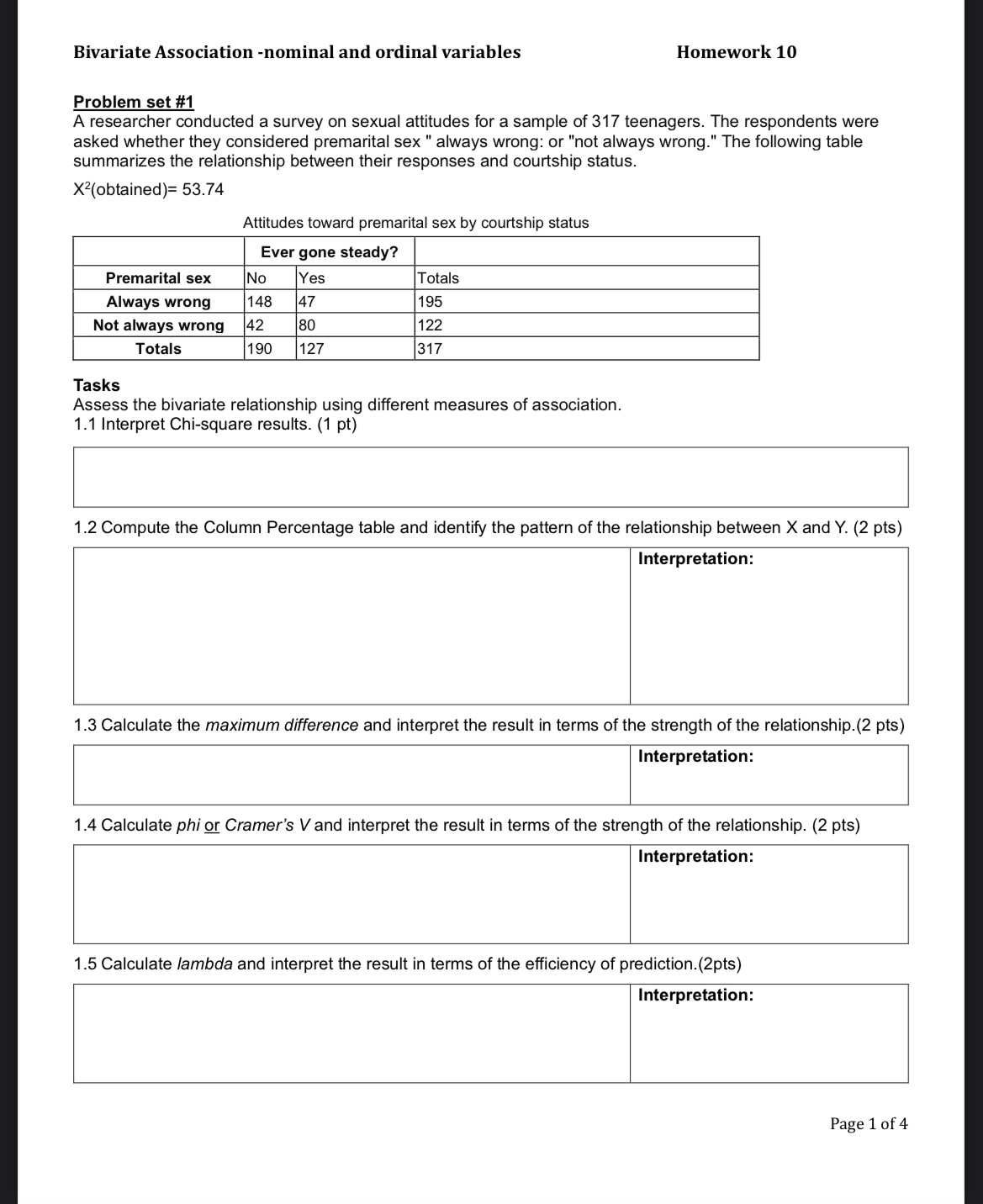
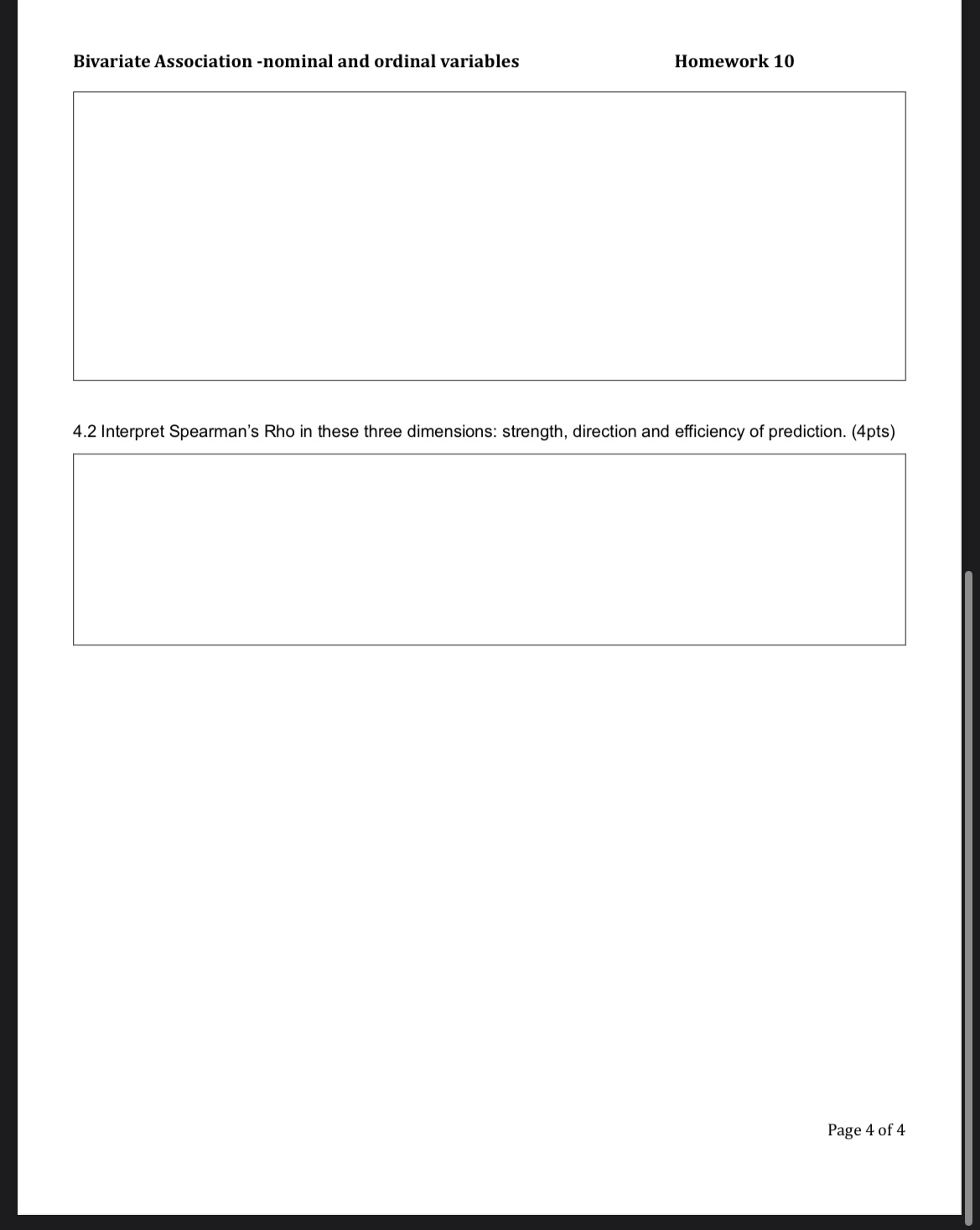
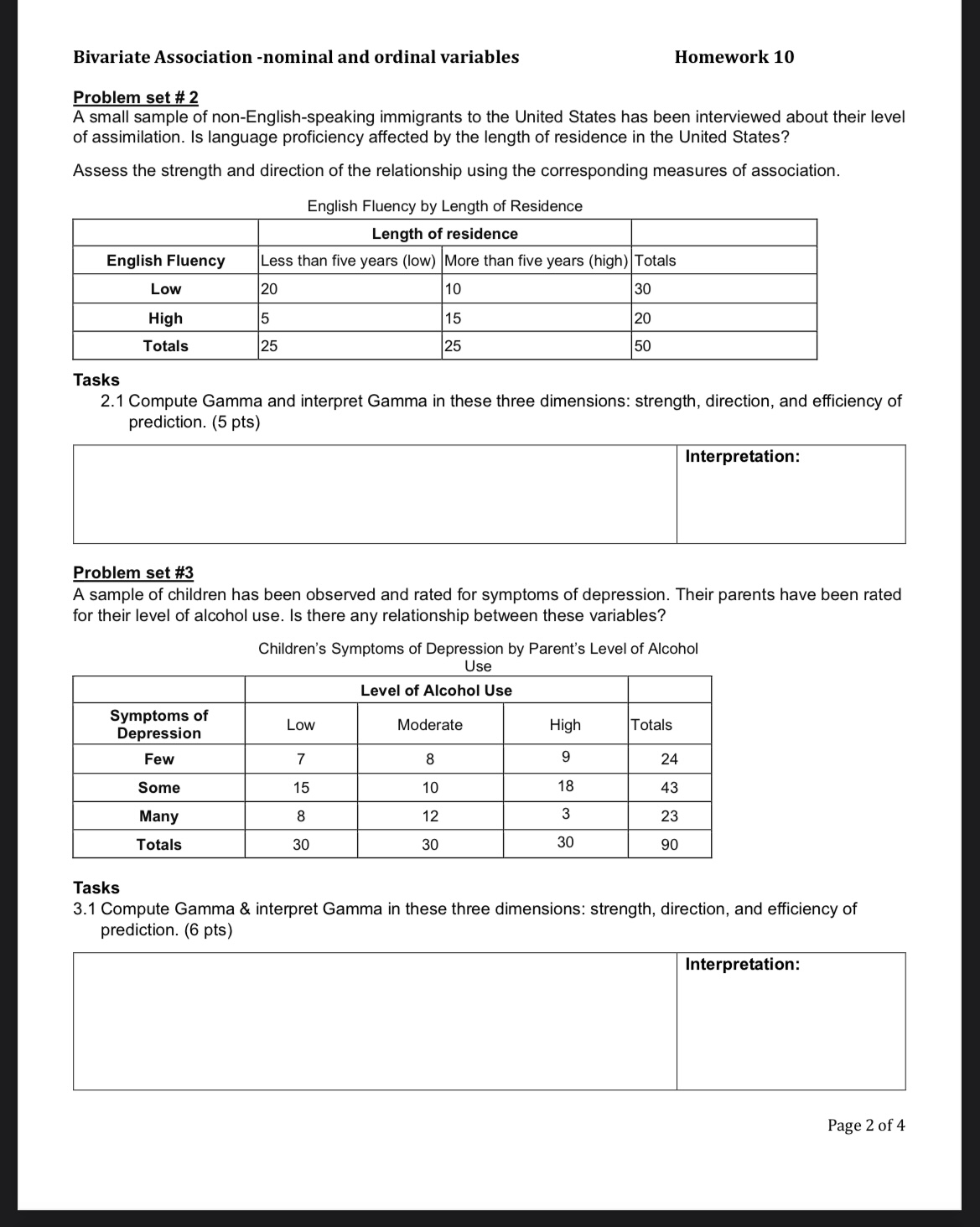
Bivariate Association -nominal and ordinal variables Problem set #4 Homework 10 Following the scores of a sample of 15 nations on a measure of ethnic diversity (the higher the number, the greater the diversity) and a measure of economic inequality (the higher the score, the greater the inequality). Are these variables related? Are ethnically diverse nations more economically unequal? Selected nations' levels of Diversity and Inequality Nation India Diversity 91 29.7 South Africa 87 58.4 Kenya 83 57.5 Canada 75 31.5 Malaysia 72 48.4 Kazakhstan 69 32.7 Egypt 65 32.0 United States 63 41.0 Sri Lanka 57 30.1 Mexico 50 50.3 Spain 44 32.5 Australia 31 33.7 Finland 16 25.6 Ireland 4 35.9 Poland 3 27.2 Tasks 4.1 Compute Spearman's Rho (6pts) Inequality Page 3 of 4 Bivariate Association -nominal and ordinal variables Homework 10 Problem set #1 A researcher conducted a survey on sexual attitudes for a sample of 317 teenagers. The respondents were asked whether they considered premarital sex " always wrong: or "not always wrong." The following table summarizes the relationship between their responses and courtship status. X2(obtained)= 53.74 Attitudes toward premarital sex by courtship status Ever gone steady? Premarital sex No Yes Totals Always wrong 148 47 195 Not always wrong 42 80 122 Totals 190 127 317 Tasks Assess the bivariate relationship using different measures of association. 1.1 Interpret Chi-square results. (1 pt) 1.2 Compute the Column Percentage table and identify the pattern of the relationship between X and Y. (2 pts) Interpretation: 1.3 Calculate the maximum difference and interpret the result in terms of the strength of the relationship. (2 pts) Interpretation: 1.4 Calculate phi or Cramer's V and interpret the result in terms of the strength of the relationship. (2 pts) Interpretation: 1.5 Calculate lambda and interpret the result in terms of the efficiency of prediction.(2pts) Interpretation: Page 1 of 4 Bivariate Association -nominal and ordinal variables Homework 10 4.2 Interpret Spearman's Rho in these three dimensions: strength, direction and efficiency of prediction. (4pts) Page 4 of 4 Bivariate Association -nominal and ordinal variables Problem set # 2 Homework 10 A small sample of non-English-speaking immigrants to the United States has been interviewed about their level of assimilation. Is language proficiency affected by the length of residence in the United States? Assess the strength and direction of the relationship using the corresponding measures of association. English Fluency by Length of Residence Length of residence English Fluency Less than five years (low) More than five years (high) Totals Low 20 10 30 High Totals 15 15 20 25 25 50 Tasks 2.1 Compute Gamma and interpret Gamma in these three dimensions: strength, direction, and efficiency of prediction. (5 pts) Interpretation: Problem set #3 A sample of children has been observed and rated for symptoms of depression. Their parents have been rated for their level of alcohol use. Is there any relationship between these variables? Children's Symptoms of Depression by Parent's Level of Alcohol Use Level of Alcohol Use Symptoms of Depression Low Moderate High Totals Few 7 8 9 24 Some 15 10 18 43 Many 8 12 3 23 Totals 30 30 30 90 Tasks 3.1 Compute Gamma & interpret Gamma in these three dimensions: strength, direction, and efficiency of prediction. (6 pts) Interpretation: Page 2 of 4
Step by Step Solution
There are 3 Steps involved in it

Get step-by-step solutions from verified subject matter experts
 Study Help