







Question: Bivariate data often arises from the use of two different techniques to measure the same quantity. As an example, the accompanying observations on x =
Bivariate data often arises from the use of two different techniques to measure the same quantity. As an example, the accompanying observations on hydrogen concentration ppm using a gas chromatography method and concentration using a new sensor method were read from a graph in an article.
table
Construct a scatterplot.
Does there appear to be a very strong relationship between the two types of concentration measurements? Do the two methods appear to be measuring roughly the same quantity? Explain your reasoning.
The points fall very close to a straight line with an intercept of approximately and a slope of about This suggests that the two methods are producing substantially the same concentration measurements.
The points fall very close to a quadratic line with intercepts of approximately and This suggests that the two methods are producing substantially different concentration measurements.
The points fall very close to a straight line with an intercept of approximately and a slope of about This suggests that the two methods are producing substantially the same concentration measurements.
The points fall very close to a quadratic line with intercepts of approximately and This suggests that the two methods are producing substantially the same concentration measurements.
The points fall very close to a straight line with an intercept of approximately and a slope of about This suggests that the two methods are producing substantially the same concentration measurements.
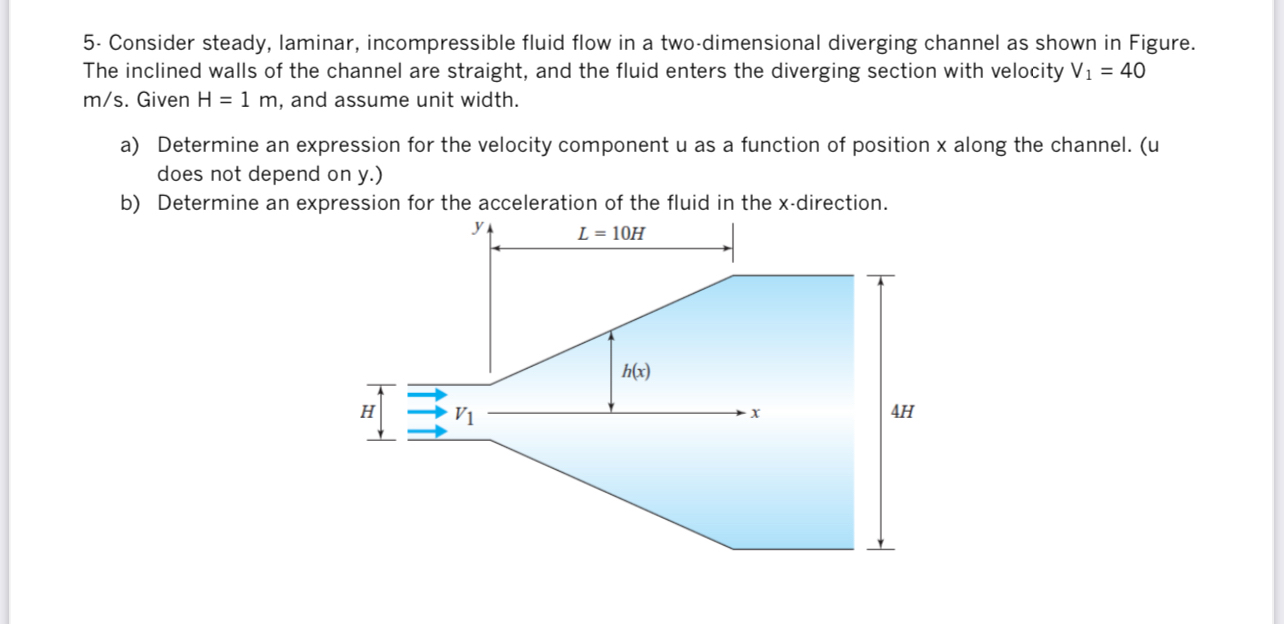
Consider steady, laminar, incompressible fluid flow in a twodimensional diverging channel as shown in Figure. The inclined walls of the channel are straight, and the fluid enters the diverging section with velocity Given and assume unit width.
a Determine an expression for the velocity component as a function of position along the channel. does not depend on y
b Determine an expression for the acceleration of the fluid in the direction.
Consider steady, laminar, incompressible fluid flow in a twodimensional diverging channel as shown in Figure. The inclined walls of the channel are straight, and the fluid enters the diverging section with velocity Given and assume unit width.
a Determine an expression for the velocity component as a function of position along the channel. does not depend on y
b Determine an expression for the acceleration of the fluid in the direction.
Step by Step Solution
There are 3 Steps involved in it
1 Expert Approved Answer
Step: 1 Unlock

Question Has Been Solved by an Expert!
Get step-by-step solutions from verified subject matter experts
Step: 2 Unlock
Step: 3 Unlock
 Study Help