







Question: bj Expected Value of a Discrete Random Variable In order to obtain a measure of the center of a probability distribution, we introduce the notion
bj
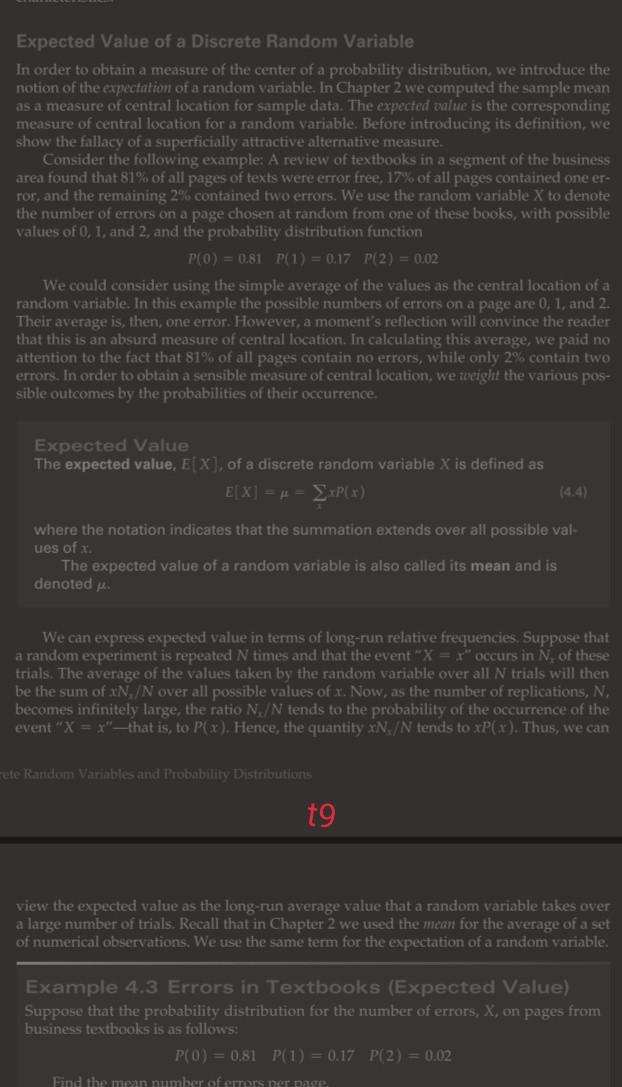
Expected Value of a Discrete Random Variable In order to obtain a measure of the center of a probability distribution, we introduce the notion of the expectation of a random variable, In Chapter 2 we computed the sample mean as a measure of central location for sample data. The expected value is the corresponding measure of central location for a random variable. Before introducing its definition, we show the fallacy of a superficially attractive alternative measure. Consider the following example: A review of textbooks in a segment of the business area found that 81% of all pages of texts were error free, 17% of all pages contained one er- ror, and the remaining 2% contained two errors. We use the random variable X to denote the number of errors on a page chosen at random from one of these books, with possible values of 0, 1, and 2, and the probability distribution function P(0) = 0.81 P(1) = 0.17 P(2) = 0.02 We could consider using the simple average of the values as the central location of a random variable. In this example the possible numbers of errors on a page are 0, 1, and 2 Their average is, then, one error. However, a moment's reflection will convince the reader that this is an absurd measure of central location. In calculating this average, we paid no attention to the fact that 81% of all pages contain no errors, while only 2% contain two errors. In order to obtain a sensible measure of central location, we weight the various pos- sible outcomes by the probabilities of their occurrence. Expected Value The expected value, E[X], of a discrete random variable X is defined as E[X] = = EXP(x) where the notation indicates that the summation extends over all possible val- ues of x. The expected value of a random variable is also called its mean and is denoted ki We can express expected value in terms of long-run relative frequencies. Suppose that a random experiment is repeated N times and that the event "X = r" occurs in N, of these trials. The average of the values taken by the random variable over all N trials will then be the sum of XN./N over all possible values of x. Now, as the number of replications, N, becomes infinitely large, the ratio N/N tends to the probability of the occurrence of the event "X = X"--that is, to P(x). Hence, the quantity XN:/N tends to xP(x). Thus, we can ete Random Variables and Probability Distributions t9 view the expected value as the long-run average value that a random variable takes over a large number of trials. Recall that in Chapter 2 we used the mean for the average of a set of numerical observations. We use the same term for the expectation of a random variable. Example 4.3 Errors in Textbooks (Expected Value) Suppose that the probability distribution for the number of errors, X, on pages from business textbooks is as follows: P(0) = 0.81 P(1) = 0.17 P(2) = 0.02 Find the mean number of errors per pagesStep by Step Solution
There are 3 Steps involved in it
1 Expert Approved Answer
Step: 1 Unlock

Question Has Been Solved by an Expert!
Get step-by-step solutions from verified subject matter experts
Step: 2 Unlock
Step: 3 Unlock
 Study Help