







Question: bj Previously, we showed that if two events are mutually exclusive, then the probability of their union is the sum of the probabilities of each
bj
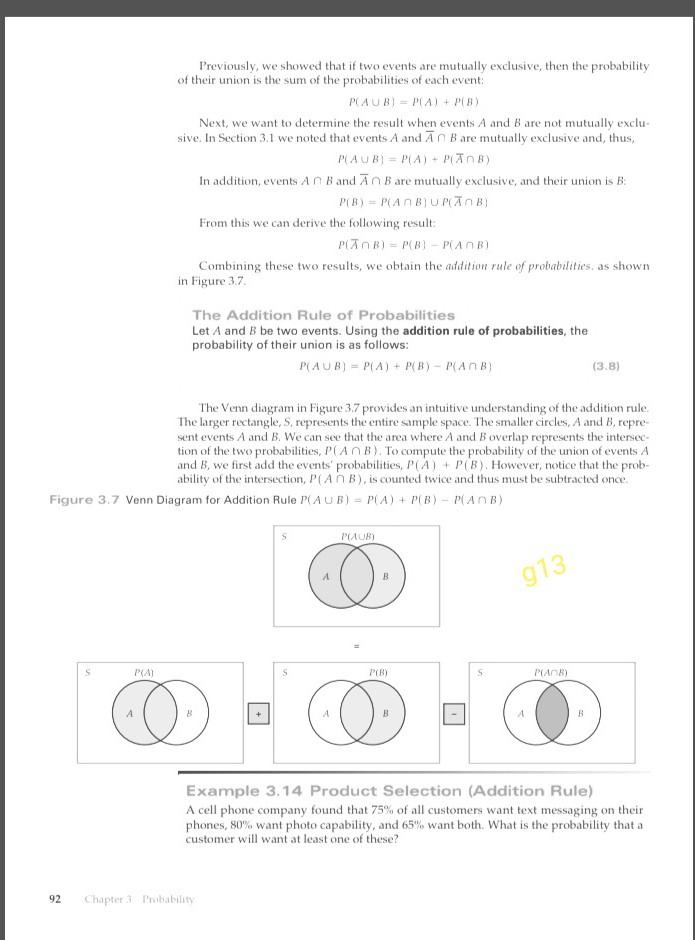
Previously, we showed that if two events are mutually exclusive, then the probability of their union is the sum of the probabilities of each event. POAUB) - PA+PB Next, we want to determine the result when events A and B are not mutually exclu- sive. In Section 3.1 we noted that events A and n Bare mutually exclusive and thus, PAUB = PLA) Pna) In addition, events in Band n Bare mutually exclusive, and their union is B. P(B) = PAN BU PB) From this we can derive the following result PAB) - PB - POBI Combining these two results, we obtain the addition rule of probabilities, as shown in Figure 3.7. The Addition Rule of Probabilities Let A and B be two events. Using the addition rule of probabilities, the probability of their union is as follows: PLAUB) = P(A) + PCB) - PAB (3.8) The Venn diagram in Figure 37 provides an intuitive understanding of the addition rule The larger rectangle, S. represents the entire simple space. The smaller circles, A and B repre sent events and B. We can see that the area where A and B overlap presents the intersec tion of the two probabilities, PAB). To compute the probability of the union of events A and B, we first add the events probabilities, PAI + P(B). However, notice that the prob- ability of the intersection, Plan B), is counted twice and thus must be subtracted once Figure 3.7 Venn Diagram for Addition Rule P(AUB) = PLA) + PLB) - PAB) PLAUB) 913 PA PBY PA + Q Example 3.14 Product Selection (Addition Rule) A cell phone company found that 75% of all customers want text messaging on their phones, 80% want photo capability, and 65% want both. What is the probability that a customer will want at least one of these? 92 Chapter ProbabilityStep by Step Solution
There are 3 Steps involved in it
1 Expert Approved Answer
Step: 1 Unlock

Question Has Been Solved by an Expert!
Get step-by-step solutions from verified subject matter experts
Step: 2 Unlock
Step: 3 Unlock
 Study Help