







Question: Blank 1 Options - 6.6% / 11.0% / 10.5% / 8.8% Blank 2 Options - Maximizes / Minimizes Blank 3 Options - Maximizes / Minimizes
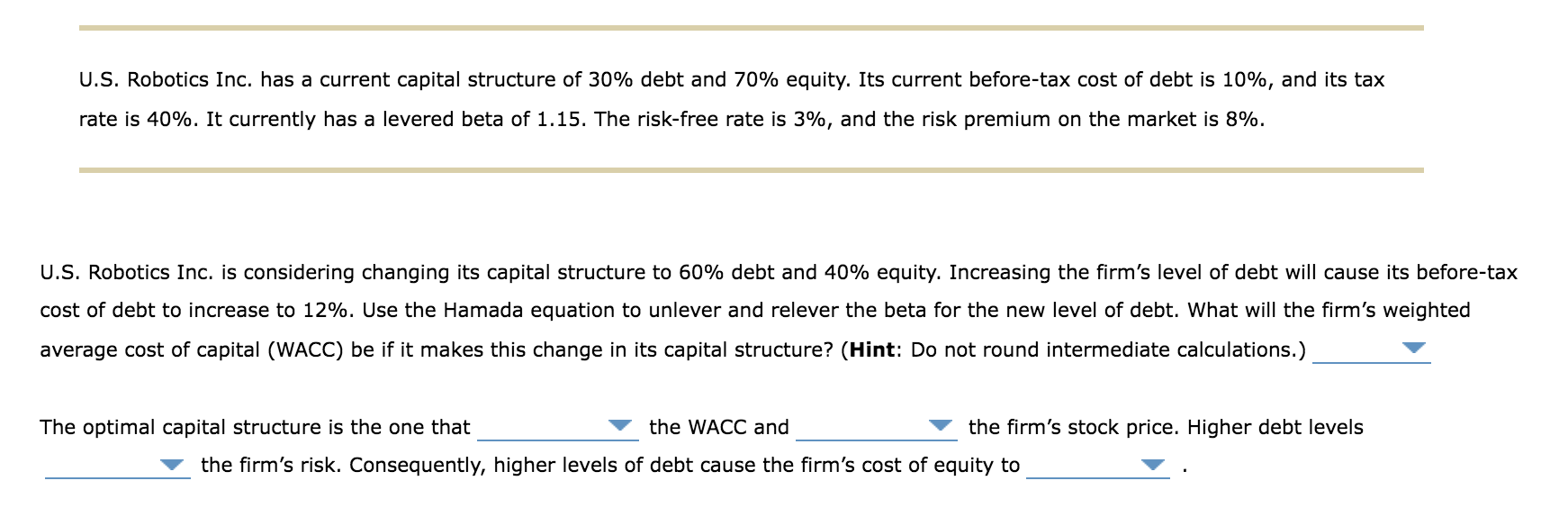
Blank 1 Options - 6.6% / 11.0% / 10.5% / 8.8%
Blank 2 Options - Maximizes / Minimizes
Blank 3 Options - Maximizes / Minimizes
Blank 4 Options - Increase / Decrease
Blank 5 Options - Increase / Decrease
Please provide detailed answers, Thank You
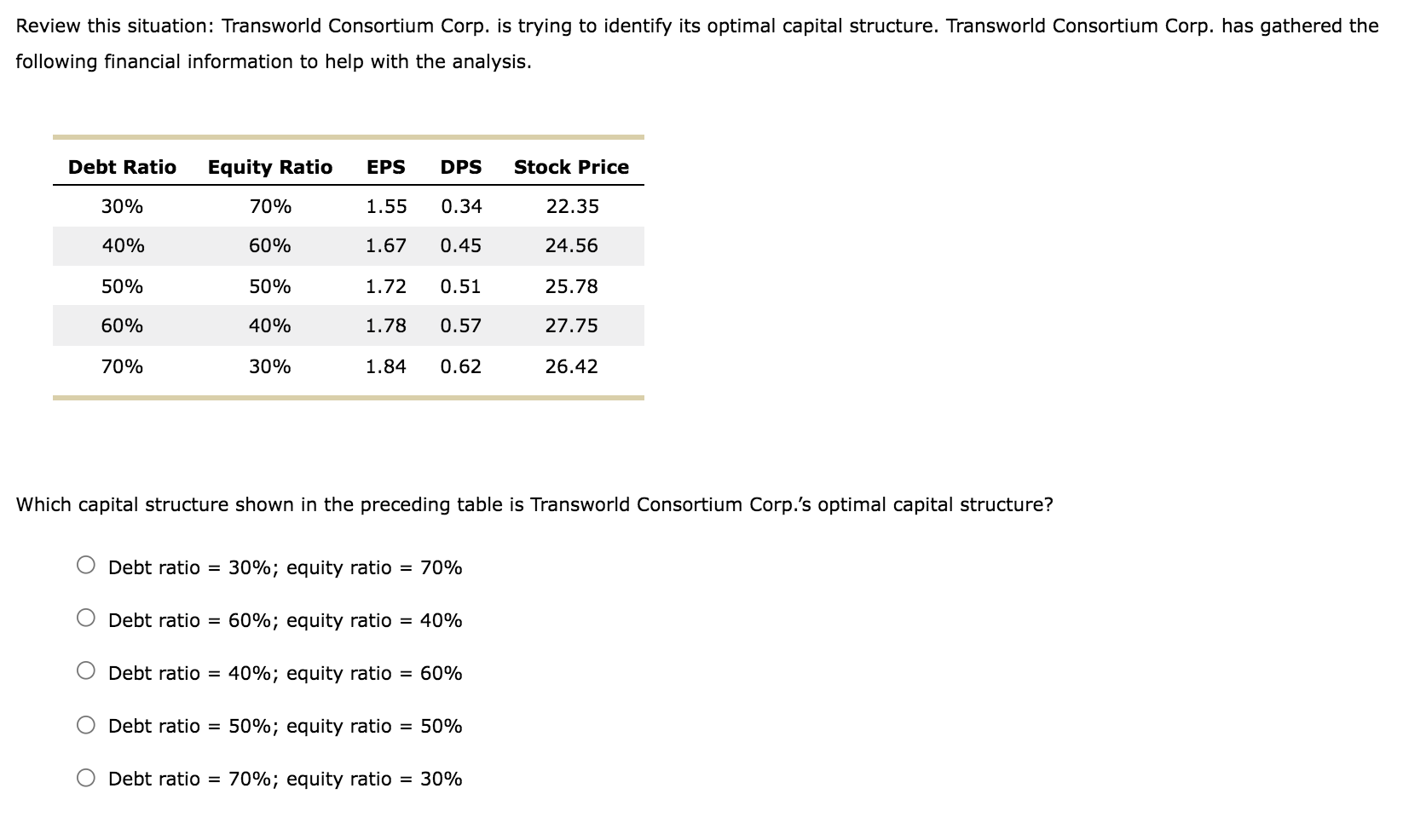
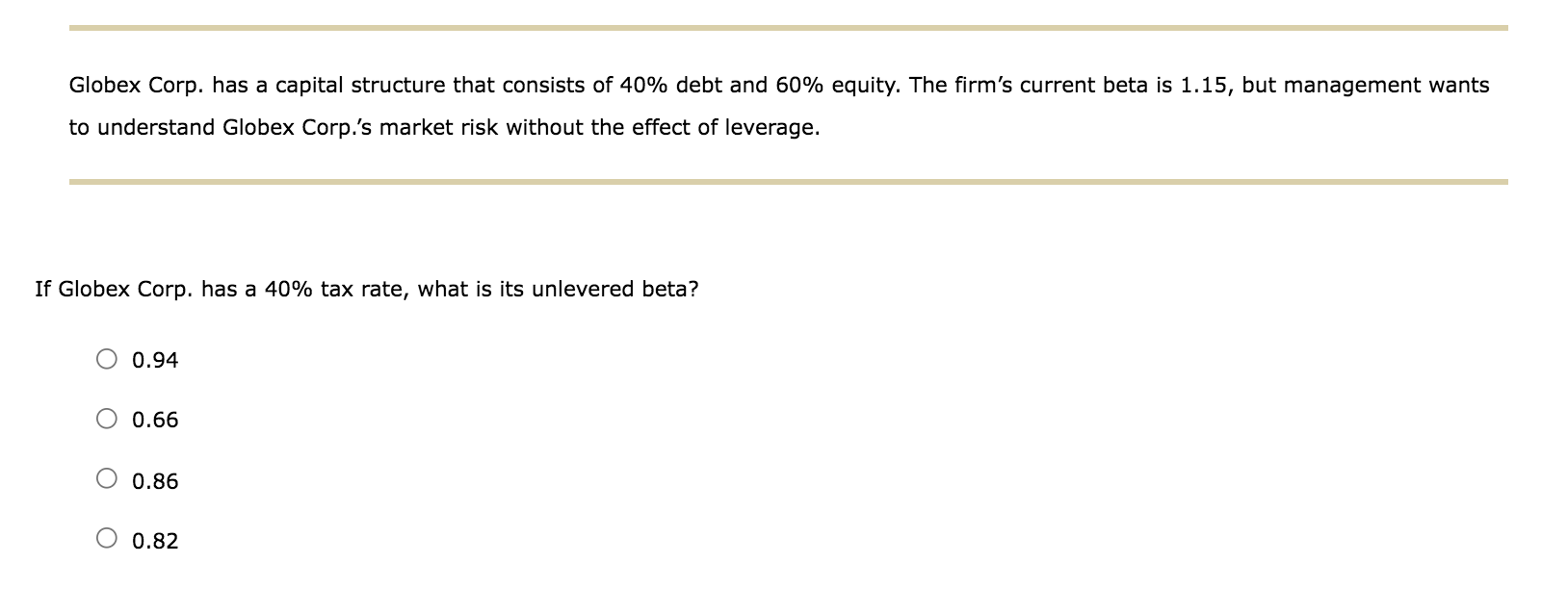
Review this situation: Transworld Consortium Corp. is trying to identify its optimal capital structure. Transworld Consortium Corp. has gathered the following financial information to help with the analysis. Debt Ratio Equity Ratio EPS DPS Stock Price 30% 70% 1.55 0.34 22.35 40% 60% 1.67 0.45 24.56 50% 50% 1.72 0.51 25.78 60% 40% 1.78 0.57 27.75 70% 30% 1.84 0.62 26.42 Which capital structure shown in the preceding table is Transworld Consortium Corp.'s optimal capital structure? Debt ratio = 30%; equity ratio = 70% Debt ratio = 60%; equity ratio = 40% Debt ratio = 40%; equity ratio = 60% Debt ratio = 50%; equity ratio = 50% Debt ratio = 70%; equity ratio = 30% Globex Corp. has a capital structure that consists of 40% debt and 60% equity. The firm's current beta is 1.15, but management wants to understand Globex Corp.'s market risk without the effect of leverage. If Globex Corp. has a 40% tax rate, what is its unlevered beta? O 0.94 0.66 0.86 0.82 U.S. Robotics Inc. has a current capital structure of 30% debt and 70% equity. Its current before-tax cost of debt is 10%, and its tax rate is 40%. It currently has a levered beta of 1.15. The risk-free rate is 3%, and the risk premium on the market is 8%. U.S. Robotics Inc. is considering changing its capital structure to 60% debt and 40% equity. Increasing the firm's level of debt will cause its before-tax cost of debt to increase to 12%. Use the Hamada equation to unlever and relever the beta for the new level of debt. What will the firm's weighted average cost of capital (WACC) be if it makes this change in its capital structure? (Hint: Do not round intermediate calculations.) The optimal capital structure is the one that the WACC and the firm's stock price. Higher debt levels the firm's risk. Consequently, higher levels of debt cause the firm's cost of equity to
Step by Step Solution
There are 3 Steps involved in it

Get step-by-step solutions from verified subject matter experts
 Study Help