







Question: Blending Problems: This is a large class of problems in which linear programming ( LP ) is applied extensively. Blending is concerned with mixing different
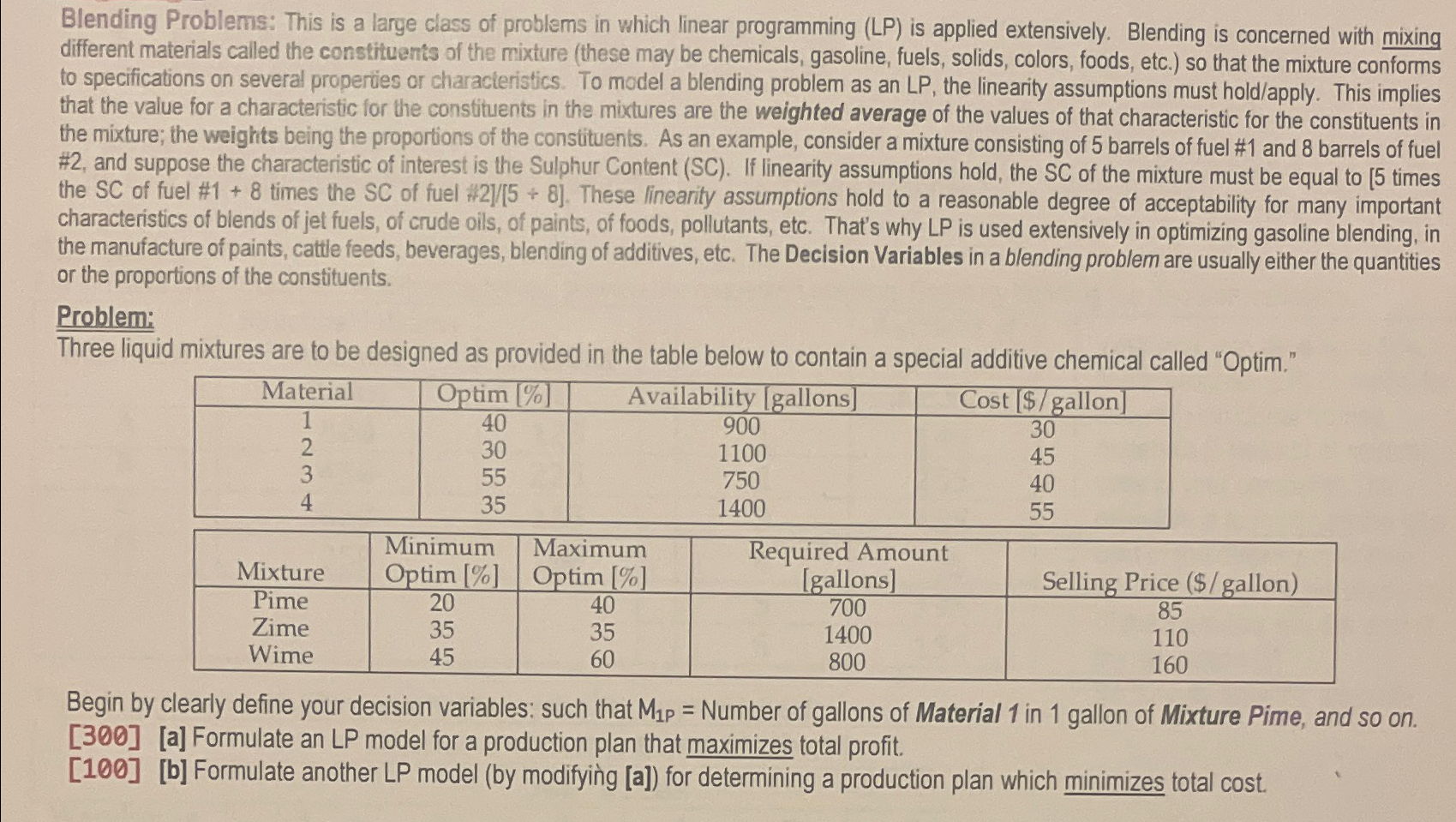
Blending Problems: This is a large class of problems in which linear programming LP is applied extensively. Blending is concerned with mixing different materials called the constituents of the mixture these may be chemicals, gasoline, fuels, solids, colors, foods, etc. so that the mixture conforms to specifications on several propervies or characleristics. To model a blending problem as an LP the linearity assumptions must holdapply This implies that the value for a characteristic for the constituents in the mixtures are the weighted average of the values of that characteristic for the constituents in the mixture; the weights being the proportions of the consuituents. As an example, consider a mixture consisting of barrels of fuel # and barrels of fuel # and suppose the characteristic of interest is the Sulphur Content SC If linearity assumptions hold, the SC of the mixture must be equal to times the SC of fuel # times the of fuel # characteristics of blends of jel fuels, of crude oils, of paints, of foods, pollutants, etc. That's why LP is used extensively in optimizing gasoline blending, in the manufacture of paints, cattle feeds, beverages, blending of additives, etc. The Decision Variables in a blending problem are usually either the quantities or the proportions of the constituents.
Problem:
Three liquid mixtures are to be designed as provided in the table below to contain a special additive chemical called "Optim."
Begin by clearly define your decision variables: such that Number of gallons of Material in gallon of Mixture Pime, and so ona Formulate an LP model for a production plan that maximizes total profit.
b Formulate another LP model by modifying a for determining a production plan which minimizes total cost.
Step by Step Solution
There are 3 Steps involved in it
1 Expert Approved Answer
Step: 1 Unlock

Question Has Been Solved by an Expert!
Get step-by-step solutions from verified subject matter experts
Step: 2 Unlock
Step: 3 Unlock
 Study Help