Question: BLOCKCHAIN: A NEW SOLUTION FOR SUPPLY INTEGRITY Min Pan wrote this case under the supervision of Professors Xin (Shane) Wang and Xin Xu solely to
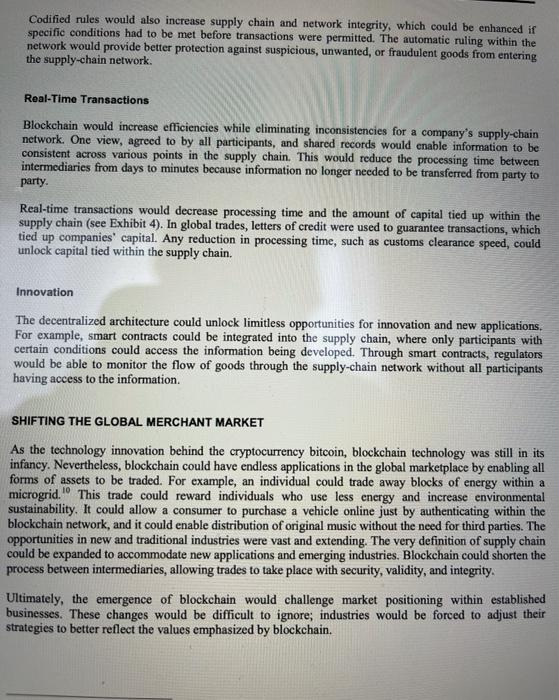
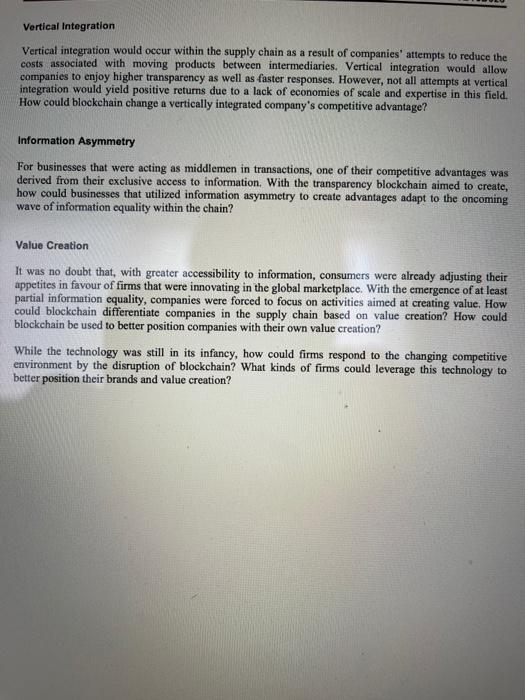
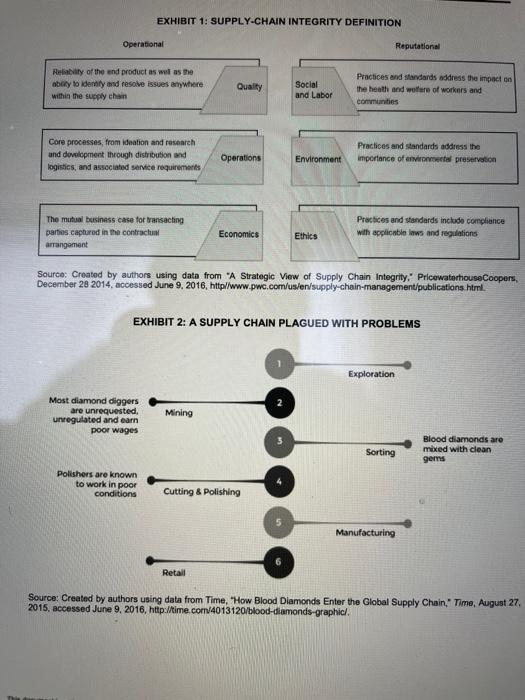
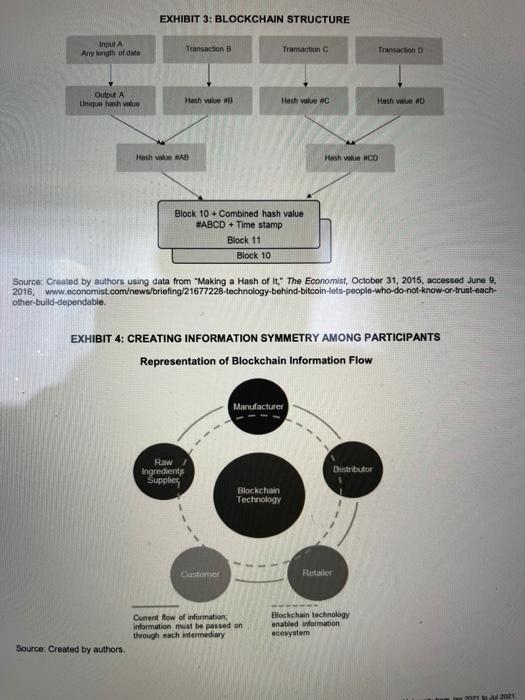
BLOCKCHAIN: A NEW SOLUTION FOR SUPPLY INTEGRITY Min Pan wrote this case under the supervision of Professors Xin (Shane) Wang and Xin Xu solely to provide material for class discussion. The authors do not intend to illustrate either effective or ineffective handling of a managerial Stuation. The authors may have disguised certain names and other identifying Information to protect confidentiality This publication may not be transmitted, photocopied, digitized or otherwise reproduced in any form or by any means without the permission of the copyright holder. Reproduction of this material is not covered under authorization by any reproduction rights organization. To order coples or request permission to reproduce materials, contact Ivey Publishing, Ivey Business School Westem University, London, Ontario, Canada, NBG ONT: () 519.661.3208; (e) cases@ivey.ca www.meycases.com Copyright 2016, Richard Wey School of Business Foundation Version: 2016-12-21 In 2014, blockchain, the technological innovation behind the cryptocurrency bitcoin, was beginning to gain traction as companies began integrating blockchain-based technology into their existing business models. Blockchain had the potential to transform the US$40 trillion global supply chain industry, which faced challenges from an increasing number of participants, toughening international regulations, and expanding geographical coverage. Supply chain integrity troubled people, companies, and regulators worldwide. With the increasing level of complexity of supply chains due to global trade liberalization, the challenges faced by the industry far surpassed physical protection from theft. Information security was expected to be the next high concem area as cyberattacks to supply chain databases were increasing in sophistication and the potential value loss was amounting in the hundreds of millions. In one of the largest known security breaches, Target's network was accessed through a small, third-party supplier vendor, which resulted in 110 million records lost and hundreds of millions in damages. The inability to protect information transfer in a supply chain was not only a security risk, but could potentially tarnish confidence and trust from producers, suppliers, and customers. Managing databases, communication, and information sharing were concerns that needed to be addressed as enterprises adopted record and transaction digitization. Supply chain integrity affected not only physical goods, but also information, and was becoming a prominent issue that companies faced in the ever-growing complexity of the global supply chain industry. While blockchain technology was still in its infancy, it was clear that it could have endless applications in the global marketplace: it could shorten the transaction process between intermediaries and allow trades to take place with security, validity, and integrity, and it could expand the definition of supply chain to include new applications in emerging industries. Ultimately, the emergence of blockchain would challenge market positioning in established businesses. Some advantages would become obsolete with the introduction of blockchain into the supply-chain network. How would vertically integrated companies compete with multiple participants that specialized This case has been written on the basis of published sources only All currency amounts are in U.S. dollars unless otherwise specified. Bill Zalud, "The Daily Challenges of Supply Chain Security Security Magazine, April 1, 2016, accessed October 3, 2016, www.securitymagazine.com/articles/87010-the-daily-challenges-of-supply-chain-security. in a particular task linked by blockchain? Would the key to future businesses be providing value-added services rather than soeking information asymmetry in the market? What kind of firms could leverage this technology to better position their brands and value creation? ISSUES WITH MANAGING A SUPPLY CHAIN The term "supply chain" described the process of extracting raw resources and delivering finished goods to customers. It was a dynamic system involving a complex network of companies, organizations, activities, technologies, information, and resources, The continuing shift towards global trade liberalization was increasing the demand for resiliency within companies' supply chains. Multinationals were vertically integrating as cost reduction and information management within the supply chain became a source of competitive advantage As an industry, the global supply chain was worth over $40 trillion every year. The complex international regulations that governed each step in the supply chain was costing companies millions in tied-up inventory and in overhead costs associated with seeking approvals and audits. The growth in participants and the increasing geographic coverage of the supply chain required companies to develop sophisticated supply-chain management systems. For example, the design for an iPhone originated in California; its sourcing came from suppliers in Europe, Asia, and the United States; and then the manufacturing and assembling took place in China before the product was finally delivered to customers worldwide through a network of warehouse and distribution centres. In some cases, the chain was physically integrated; however, information wasn't always available due to the lag between intermediaries. The existing supply chain faced three main issues: integrity of goods, trust, and tracking The emergence of blockchain-based solutions had the potential to address these issues. Integrity of Goods To preserve brand equity, high-end luxury companies had to ensure operational as well as reputational integrity (see Exhibit 1). Their customers were often affluent individuals who looked for more than the functionality of the product; they usually made their purchasing decisions based on the value proposition They decided to purchase products based on the status they represented. Therefore, many high-end companies physically integrated their entire supply chain from raw materials to storefront as a strategy to ensure that value was not destroyed during production or delivery of the product. However, there were obstacles to establishing supply chain integrity. For example, the value of diamonds was challenged by the presence of blood diamonds" diamonds mined in war zones and used to fund unethical military operations. Consumers who purchased these diamonds were indirectly funding military conflicts. Despite the establishment of the Kimberley Process to control and govern diamond sources, the definition of conflict diamonds was still too narrow to exclude sources where the diamonds Luke Parker, "Blockchain Tech Companies Focus on the $40 trillion Supply Chain Market. Brave New Coin, February 2. 2016, nocessed April 28, 2016, http://bravenewcoin.comews/blockchain tech-companion-focus-on-the-40-trillion-supply. chain-market. lan Barker, "The Global Supply Chain Behind the Phone 6, betanews, accessed June 8, 2016, http://botanews.com/2014/09/23/the global-supply-chain-behind-the-iphone-6/ A strategic view of supply chain integrity PricewaterhouseCoopers, accessed June 9, 2016, www.pwc.com/us/er/supply chain management publications.html Aryn Baker, "Blood Diamonds, Timo, accessed June 10, 2016, http://time.com blood diamonds This documents who AT were clearly unethical," and diamond companies still had no effective means to control their sources. Thus, they were unable to differentiate blood diamonds within their supply chains (see Exhibit 2). If a brand was unable to prove the source of its diamonds, socially responsible customers were less inclined to purchase their product and might choose to buy from competitors. Trust The Internet had increased consumers' awareness of issues of sustainability, and customers' stronger appetites for organic, fairly traded, or environmentally friendly products was causing companies to change their marketing strategies to cater to these markets. However, because supply chains were often opaque, it was difficult for consumers to verify the validity of these marketing claims. Even if a company chose to disclose information, it was often partial or incomplete. The lack of available information hindered the establishment of trustworthy relationships between companies and consumers. Supply Chain Tracking The time lag and barriers between supply-chain participants created obstacles for tracking specific transactions and goods, leading to information asymmetry between participants in the supply chain. It was difficult, if not impossible, to precisely follow the transfer of a specific batch of goods as information for previous transactions was often erased when goods were transferred. Even if previous records existed, the information was not always consistent. This made understanding the movement of goods particularly difficult as each participant only possessed partial information. Even if information was shared, it could take weeks to synchronize and process. BLOCKCHAIN Blockchain, which was seen as the main technological innovation behind bitcoin, was a record-keeping mechanism that allowed businesses to work together with authenticity and reliability. Bitcoin was a cryptocurrency developed in 2009 and quickly gaining acceptance; it could be traded for physical currencies on online currency exchanges. Bitcoin's value continued to appreciate against the dollar. Blockchain was a distributed public ledger that maintained a continuously growing list of information "blocks" (see Exhibit 3), each data block was linked to the previous block by a unique hash value calculated through a mathematical relationship known as a mathematical "trapdoor" function. The blocks were connected if the hash value matched the "trapdoor" function. One data block was made of individual transactions with a time stamp and information linked to the previous block. The trail of information was stored in Internet nodes, where no party had direct control. The nodes were anonymous and linked only to a few other nodes. The original data was permanent, leaving a public information trail or chain of transactions. This chain was visible to all users on the peer-to-peer network, so users could trace the history of a transaction chain based on one single transaction. Tara John and Heather Jones. "This Graphic Shows How Blood Diamonds Arrive in the U.S... Time, August 27, 2015, accessed June 10, 2016, http://time.com/4013120/blood-diamonds-graphic Jon Amerin Vorabustra Why Blockchain Is a Game Changer for Supply Chain Management LoadDelivered Logistics blog. January 28, 2016, accessed June 8, 2016, www.loaddelivered.com/blog/why-blockchain-is-a-game-changer-for- supply-chain-management Even if some users had malicious intentions, a consensus was required before any new information block could be added to an existing chain. Data was verified through the use of an elliptic curve digital signature algorithm that used a separate set of public and private key to ensure integrity and exclusivity in the verification process. Consensus was reached if the majority of the blocks agreed with the set of the transactions. New data had to be in full agreement with previous transactions; otherwise, the new data would never become part of a confirmed data set. SUPPLY CHAIN SECURED BY BLOCKCHAIN TECHNOLOGY Blockchain could fundamentally change supply-chain management. Many experts argued that blockchain could become the universal supply-chain operating system due to its wide range of applications. Blockchain was being used for the following applications: . It tracked the quantity, specification, and origin of containers, trailers, and pallets as they moved among participants in the supply chain. It recorded shipping documents, receipts, and other necessary documents for each transaction. It provided downstream participants with assembly processes, raw ingredients lists, and precautionary warnings specified to each customized product. It simplified the regulatory and auditing process by attaching insurance quotes, customs clearance, and duty information directly to each shipment. It monitored, accessed, and shared information to analyze real-time information for insights. . Transparency The ability to document a product's journey along the supply chain was seen as the key innovation behind blockchain. Blockchain technology could record the product's origin along with every transaction that occurred to take the product to its final destination. To customers, knowing where the raw ingredients came from, where the product was made, and who made the product could significantly impact their purchase decisions. This eliminated the trust issues associated with the existing supply chain because the data was accessible to all participants in the network. The reliability of the data was governed by all participants, which significantly decreased the chance of bias and fraud. A transparent network also meant that regulators could track key accountable parties without needing to access information through companies. Scalability Blockchain was theoretically infinitely scalable due to the database structure. The distributed nature meant that information was stored on Internet nodes instead of on a central server. This created an infinitely large database that was virtually accessible by any number of people at any given point in time. Security Blockchain would decrease cyber security risks compared to previous company databases. An indelible ledger with traceability for every transaction, combined with the prohibitively high cost to alter transaction history would deter participants with malicious intent from attacking the network Codified rules would also increase supply chain and network integrity, which could be enhanced if specific conditions had to be met before transactions were permitted. The automatic ruling within the network would provide better protection against suspicious, unwanted, or fraudulent goods from entering the supply chain network. Real-Time Transactions Blockchain would increase efficiencies while eliminating inconsistencies for a company's supply-chain network. One view, agreed to by all participants, and shared records would enable information to be consistent across various points in the supply chain. This would reduce the processing time between intermediaries from days to minutes because information no longer needed to be transferred from party to party, Real-time transactions would decrease processing time and the amount of capital tied up within the supply chain (see Exhibit 4). In global trades, letters of credit were used to guarantee transactions, which tied up companies' capital. Any reduction in processing time, such as customs clearance speed, could unlock capital tied within the supply chain. Innovation The decentralized architecture could unlock limitless opportunities for innovation and new applications, For example, smart contracts could be integrated into the supply chain, where only participants with certain conditions could access the information being developed. Through smart contracts, regulators would be able to monitor the flow of goods through the supply-chain network without all participants having access to the information SHIFTING THE GLOBAL MERCHANT MARKET As the technology innovation behind the cryptocurrency bitcoin, blockchain technology was still in its infancy. Nevertheless, blockchain could have endless applications in the global marketplace by enabling all forms of assets to be traded. For example, an individual could trade away blocks of energy within a microgrid. This trade could reward individuals who use less energy and increase environmental sustainability. It could allow a consumer to purchase a vehicle online just by authenticating within the blockchain network, and it could enable distribution of original music without the need for third parties. The opportunities in new and traditional industries were vast and extending. The very definition of supply chain could be expanded to accommodate new applications and emerging industries, Blockchain could shorten the process between intermediaries, allowing trades to take place with security, validity, and integrity. Ultimately, the emergence of blockchain would challenge market positioning within established businesses. These changes would be difficult to ignore; industries would be forced to adjust their strategies to better reflect the values emphasized by blockchain. Vertical Integration Vertical integration would occur within the supply chain as a result of companies' attempts to reduce the costs associated with moving products between intermediaries. Vertical integration would allow companies to enjoy higher transparency as well as faster responses. However, not all attempts at vertical integration would yield positive returns due to a lack of economies of scale and expertise in this field. How could blockchain change a vertically integrated company's competitive advantage? Information Asymmetry For businesses that were acting as middlemen in transactions, one of their competitive advantages was derived from their exclusive access to information. With the transparency blockchain aimed to create, how could businesses that utilized information asymmetry to create advantages adapt to the oncoming wave of information equality within the chain? Value Creation It was no doubt that, with greater accessibility to information, consumers were already adjusting their appetites in favour of firms that were innovating in the global marketplace. With the emergence of at least partial information equality, companies were forced to focus on activities aimed at creating value. How could blockchain differentiate companies in the supply chain based on value creation? How could blockchain be used to better position companies with their own value creation? While the technology was still in its infancy, how could firms respond to the changing competitive environment by the disruption of blockchain? What kinds of firms could leverage this technology to better position their brands and value creation? EXHIBIT 1: SUPPLY-CHAIN INTEGRITY DEFINITION Operational Reputational Reability of the end product as well as the bay to identity and resolve issues anywhere within the supply chain Quality Social and Labor Practices and standards address the impact on the health and were of workers and communities Core processes, from ideation and research and development through distribution and logistics, and associated service requirements Practices and standards address the importance of environmental preservation Operations Environment The mutual business case for transacting parties captured in the contractum arrangement Practices and standards include compliance with applicable laws and regulations Economics Ethics Source: Created by authors using data from 'A Strategic View of Supply Chain Integrity." PricewaterhouseCoopers, December 28 2014, accessed June 9, 2016. http//www.pwc.com/us/en/supply-chain-management publications.html EXHIBIT 2: A SUPPLY CHAIN PLAGUED WITH PROBLEMS Exploration Most diamond diggers are unrequested urvegulated and earn poor wages Mining Sorting Blood diamonds are mixed with clean gems Polishers are known to work in poor conditions Cutting & Polishing Manufacturing Retail Source: Created by authors using data from Time, "How Blood Diamonds Enter the Global Supply Chain." Time, August 27, 2015, accessed June 9, 2016, http://time.com/4013120/blood-diamonds-graphic Introduction - Describe the main problems/issues in the case. Explain what you will do to address these problems. Briefly describe why are you are taking these actions and what the expected outcome will be










 Study Help