







Question: Bloom Filters with Efficient Hash Functions ( 1 0 points ) In the Bloom filter analysis in class, we assume use of a fully independent
Bloom Filters with Efficient Hash Functions points
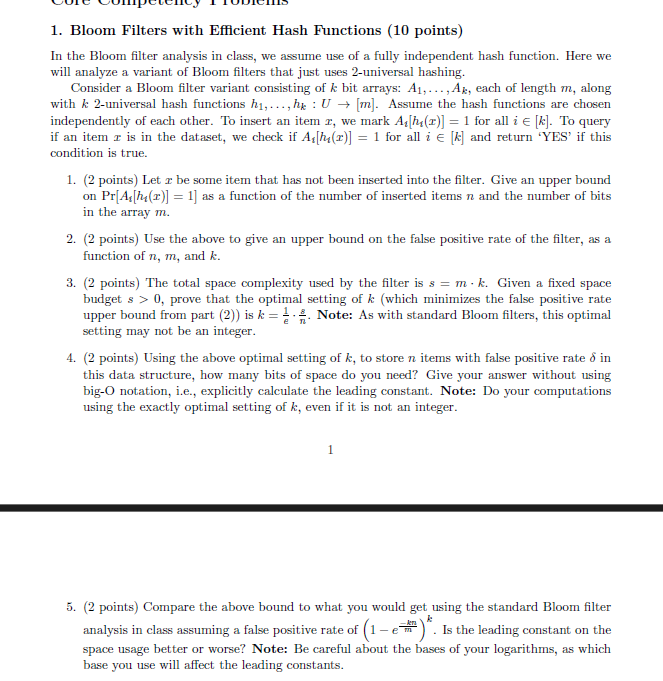
In the Bloom filter analysis in class, we assume use of a fully independent hash function. Here we
will analyze a variant of Bloom filters that just uses universal hashing.
Consider a Bloom filter variant consisting of bit arrays: dots, each of length along
with universal hash functions dots,: Assume the hash functions are chosen
independently of each other. To insert an item we mark for all iin To query
if an item is in the dataset, we check if for all iin and return 'YES' if this
condition is true.
points Let be some item that has not been inserted into the filter. Give an upper bound
on as a function of the number of inserted items and the number of bits
in the array
points Use the above to give an upper bound on the false positive rate of the filter, as a
function of and
points The total space complexity used by the filter is Given a fixed space
budget prove that the optimal setting of which minimizes the false positive rate
upper bound from part is Note: As with standard Bloom filters, this optimal
setting may not be an integer.
points Using the above optimal setting of to store items with false positive rate in
this data structure, how many bits of space do you need? Give your answer without using
bigO notation, ie explicitly calculate the leading constant. Note: Do your computations
using the exactly optimal setting of even if it is not an integer.
points Compare the above bound to what you would get using the standard Bloom filter
analysis in class assuming a false positive rate of Is the leading constant on the
space usage better or worse? Note: Be careful about the bases of your logarithms, as which
base you use will affect the leading constants.
Step by Step Solution
There are 3 Steps involved in it
1 Expert Approved Answer
Step: 1 Unlock

Question Has Been Solved by an Expert!
Get step-by-step solutions from verified subject matter experts
Step: 2 Unlock
Step: 3 Unlock
 Study Help