







Question: BME Application: Bones naturally have less dense material towards the center with more dense material towards the periphery. In this problem, we will mathematically analyze
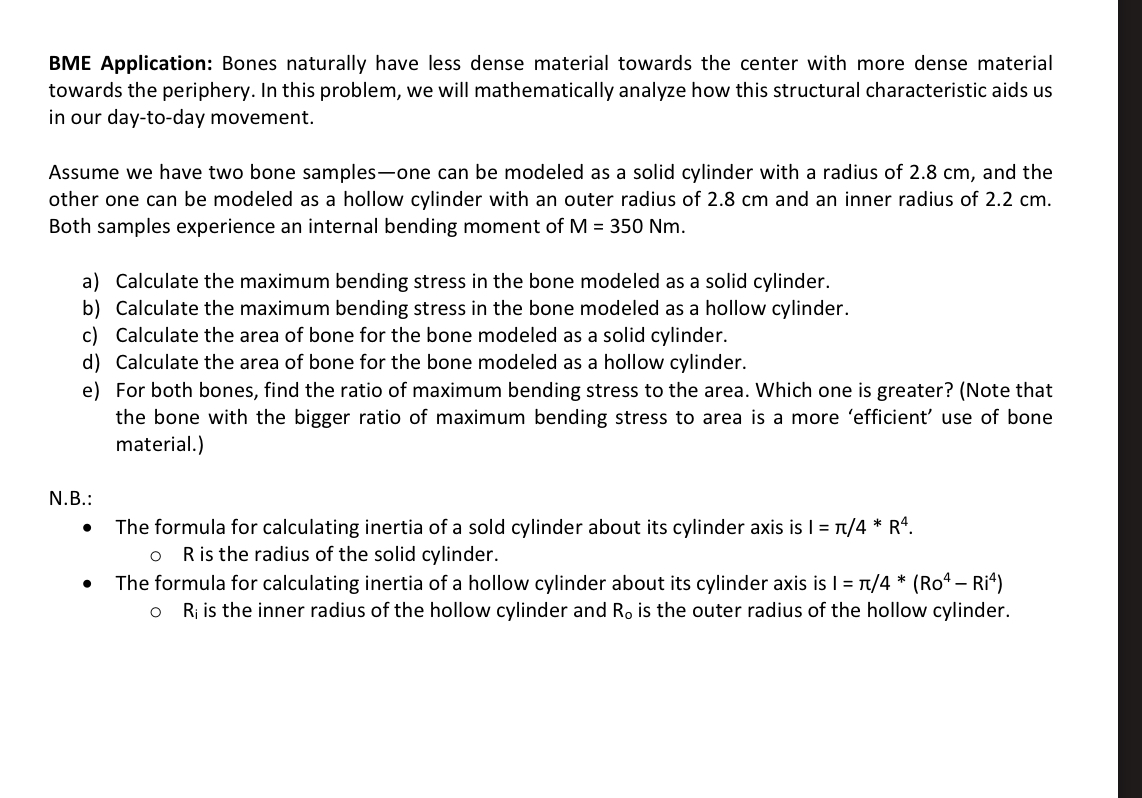
BME Application: Bones naturally have less dense material towards the center with more dense material towards the periphery. In this problem, we will mathematically analyze how this structural characteristic aids us in our daytoday movement.
Assume we have two bone samplesone can be modeled as a solid cylinder with a radius of cm and the other one can be modeled as a hollow cylinder with an outer radius of cm and an inner radius of cm Both samples experience an internal bending moment of mathrmMmathrmNm
a Calculate the maximum bending stress in the bone modeled as a solid cylinder.
b Calculate the maximum bending stress in the bone modeled as a hollow cylinder.
c Calculate the area of bone for the bone modeled as a solid cylinder.
d Calculate the area of bone for the bone modeled as a hollow cylinder.
e For both bones, find the ratio of maximum bending stress to the area. Which one is greater? Note that the bone with the bigger ratio of maximum bending stress to area is a more 'efficient' use of bone material.
NB:
The formula for calculating inertia of a sold cylinder about its cylinder axis is Ipi R
R is the radius of the solid cylinder.
The formula for calculating inertia of a hollow cylinder about its cylinder axis is mathrmIpi leftmathrmRomathrmRiright
Ri is the inner radius of the hollow cylinder and Ro is the outer radius of the hollow cylinder.
Step by Step Solution
There are 3 Steps involved in it
1 Expert Approved Answer
Step: 1 Unlock

Question Has Been Solved by an Expert!
Get step-by-step solutions from verified subject matter experts
Step: 2 Unlock
Step: 3 Unlock
 Study Help