







Question: Bob designs a rainfall sensor. It uses symbols from the alphabet S={x,y,z,w}. He wants to use blocks of two symbols for his encoding. He
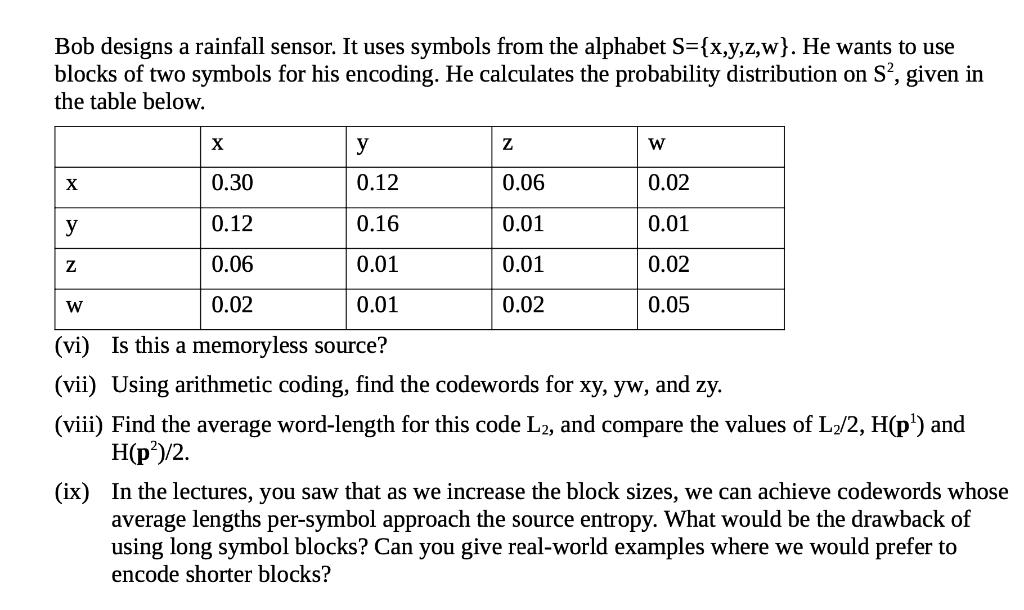
Bob designs a rainfall sensor. It uses symbols from the alphabet S={x,y,z,w}. He wants to use blocks of two symbols for his encoding. He calculates the probability distribution on S, given in the table below. X y Z W X 0.30 0.12 0.06 0.02 y 0.12 0.16 0.01 0.01 Z 0.06 0.01 0.01 0.02 W 0.02 0.01 0.02 0.05 (vi) Is this a memoryless source? (vii) Using arithmetic coding, find the codewords for xy, yw, and zy. (viii) Find the average word-length for this code L2, and compare the values of L/2, H(p) and H(p)/2. (ix) In the lectures, you saw that as we increase the block sizes, we can achieve codewords whose average lengths per-symbol approach the source entropy. What would be the drawback of using long symbol blocks? Can you give real-world examples where we would prefer to encode shorter blocks?
Step by Step Solution
3.41 Rating (157 Votes )
There are 3 Steps involved in it
vi No this is not a memoryless source because the probability of each symbol depends on the pre... View full answer

Get step-by-step solutions from verified subject matter experts
 Study Help