







Question: Bond value and time - Constant required returns Pecos Manufacturing has just issued a 15-year, 12% coupon interest rate, $1,000-par bond that pays interest annually.
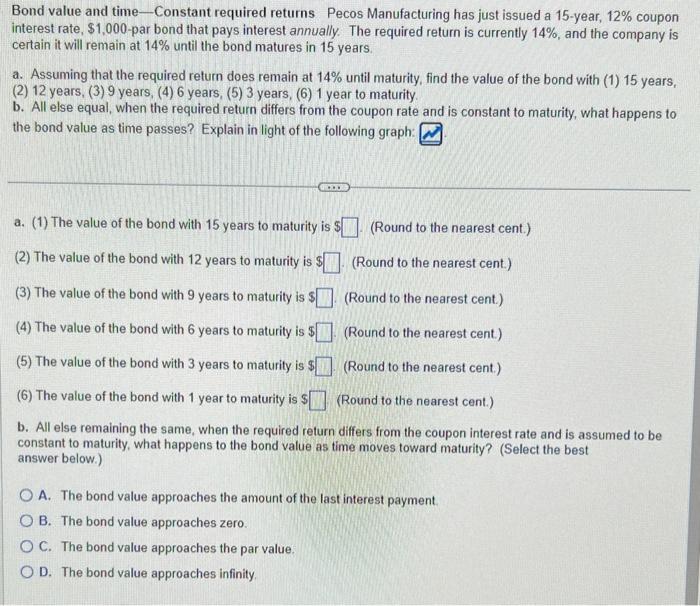
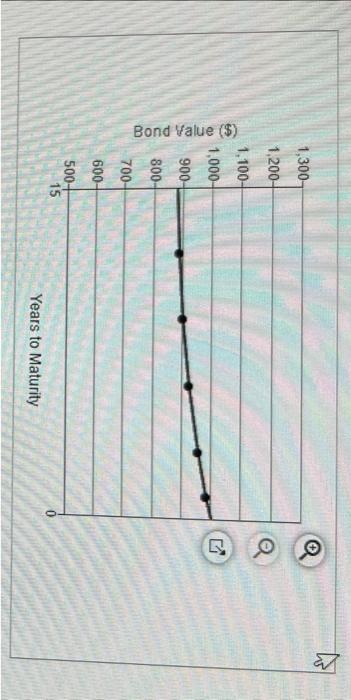
Bond value and time - Constant required returns Pecos Manufacturing has just issued a 15-year, 12\% coupon interest rate, $1,000-par bond that pays interest annually. The required return is currently 14%, and the company is certain it will remain at 14% until the bond matures in 15 years. a. Assuming that the required return does remain at 14% until maturity, find the value of the bond with (1) 15 years, (2) 12 years, (3) 9 years, (4) 6 years, (5) 3 years, (6) 1 year to maturity. b. All else equal, when the required return differs from the coupon rate and is constant to maturity, what happens to the bond value as time passes? Explain in light of the following graph: a. (1) The value of the bond with 15 years to maturity is $ (Round to the nearest cent.) (2) The value of the bond with 12 years to maturity is \& (Round to the nearest cent.) (3) The value of the bond with 9 years to maturity is $ (Round to the nearest cent.) (4) The value of the bond with 6 years to maturity is $ (Round to the nearest cent) (5) The value of the bond with 3 years to maturity is $ (Round to the nearest cent.) (6) The value of the bond with 1 year to maturity is $ (Round to the nearest cent.) b. All else remaining the same, when the required return differs from the coupon interest rate and is assumed to be constant to maturity, what happens to the bond value as time moves toward maturity? (Select the best answer below.) A. The bond value approaches the amount of the last interest payment. B. The bond value approaches zero. C. The bond value approaches the par value. D. The bond value approaches infinity. Years to Maturity
Step by Step Solution
There are 3 Steps involved in it

Get step-by-step solutions from verified subject matter experts
 Study Help