







Question: Bonus problem 2 : ( 6 points ) Give an LP formulation of this process model. Explain the variables with clear definitions and a diagram.
Bonus problem : points Give an LP formulation of this process model. Explain the variables with clear definitions and a diagram. Make the objective function and constraints clear.
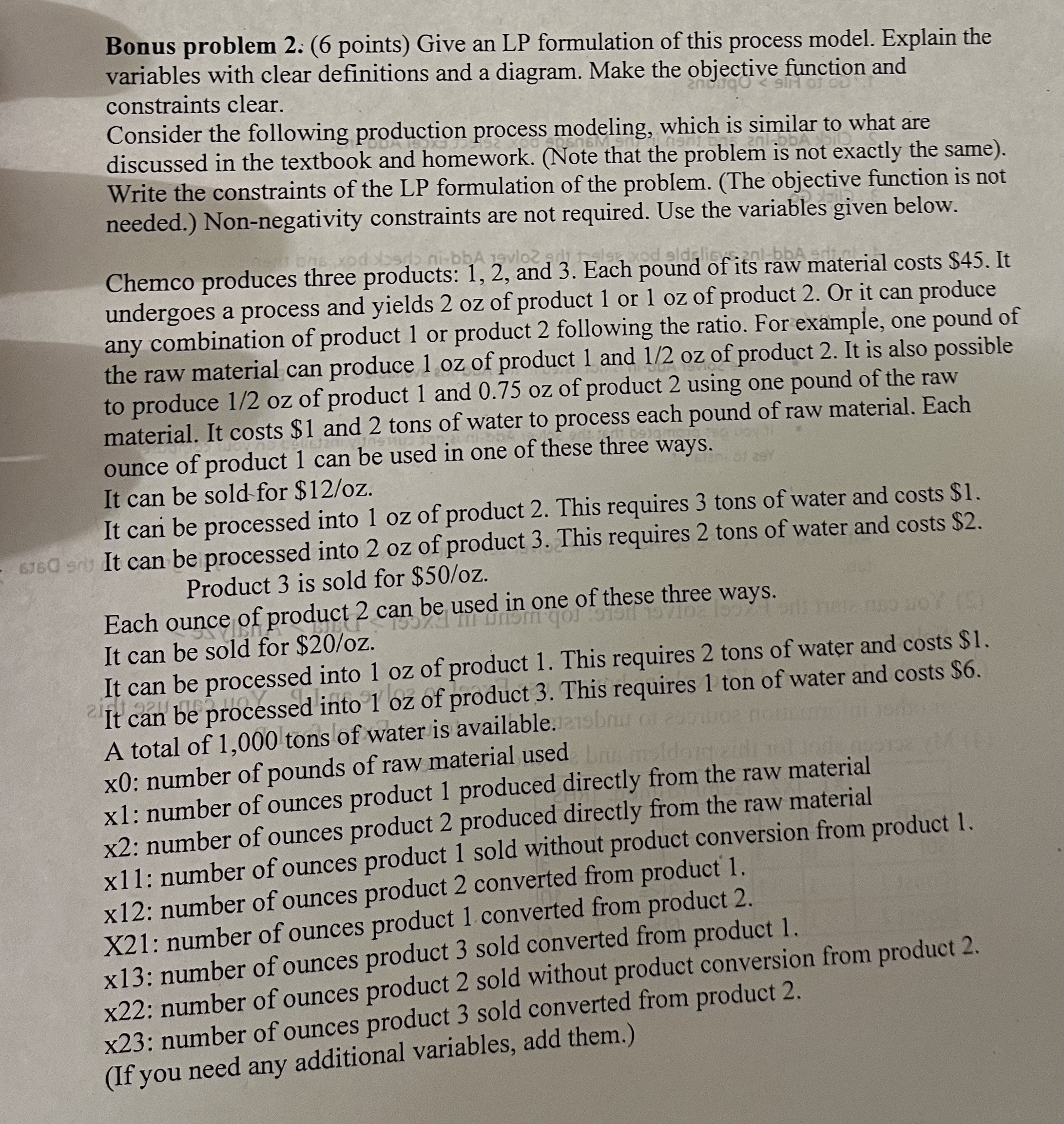
Consider the following production process modeling, which is similar to what are discussed in the textbook and homework. Note that the problem is not exactly the same Write the constraints of the LP formulation of the problem. The objective function is not needed. Nonnegativity constraints are not required. Use the variables given below.
Chemco produces three products: and Each pound of its raw material costs $ It undergoes a process and yields oz of product or oz of product Or it can produce any combination of product or product following the ratio. For example, one pound of the raw material can produce oz of product and of product It is also possible to produce oz of product and oz of product using one pound of the raw material. It costs $ and tons of water to process each pound of raw material. Each ounce of product can be used in one of these three ways.
It can be sold for $
It can be processed into oz of product This requires tons of water and costs $
It can be processed into oz of product This requires tons of water and costs $
Product is sold for $
Each ounce of product can be used in one of these three ways.
It can be sold for $
It can be processed into oz of product This requires tons of water and costs $
It can be processed into oz of product This requires ton of water and costs $
A total of tons of water is available.
x : number of pounds of raw material used
x : number of ounces product produced directly from the raw material
x : number of ounces product produced directly from the raw material
x : number of ounces product sold without product conversion from product
x : number of ounces product converted from product
X : number of ounces product converted from product
x : number of ounces product sold converted from product
x : number of ounces product sold without product conversion from product
: number of ounces product sold converted from product
If you need any additional variables, add them.
Step by Step Solution
There are 3 Steps involved in it
1 Expert Approved Answer
Step: 1 Unlock

Question Has Been Solved by an Expert!
Get step-by-step solutions from verified subject matter experts
Step: 2 Unlock
Step: 3 Unlock
 Study Help