







Question: Bonus problem! 25 possible bonus points Note: This problem requires the use of Excel or similar spreadsheet software. It is potentially more time-consuming than other
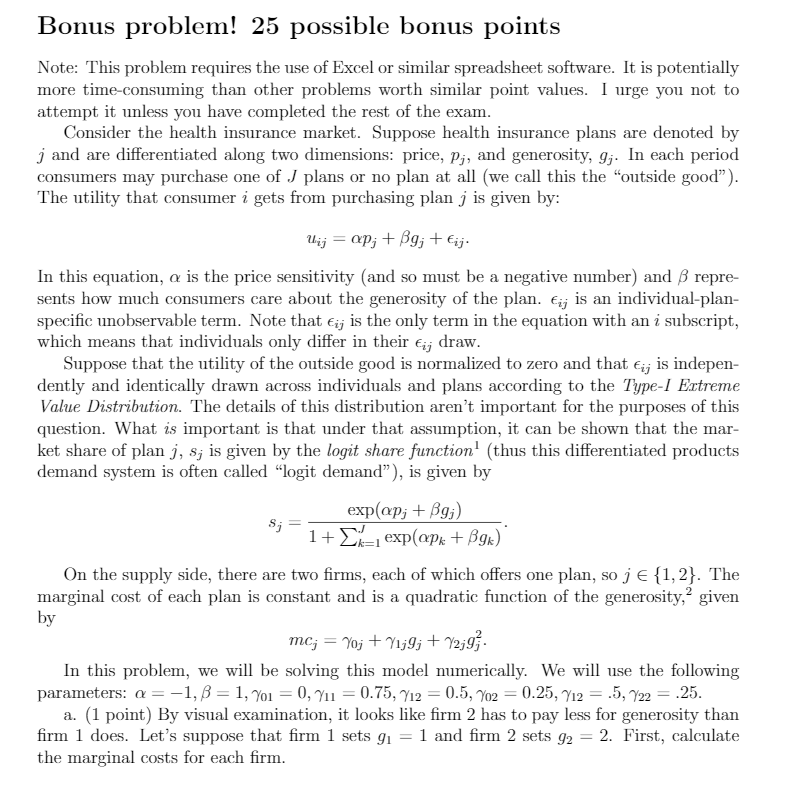
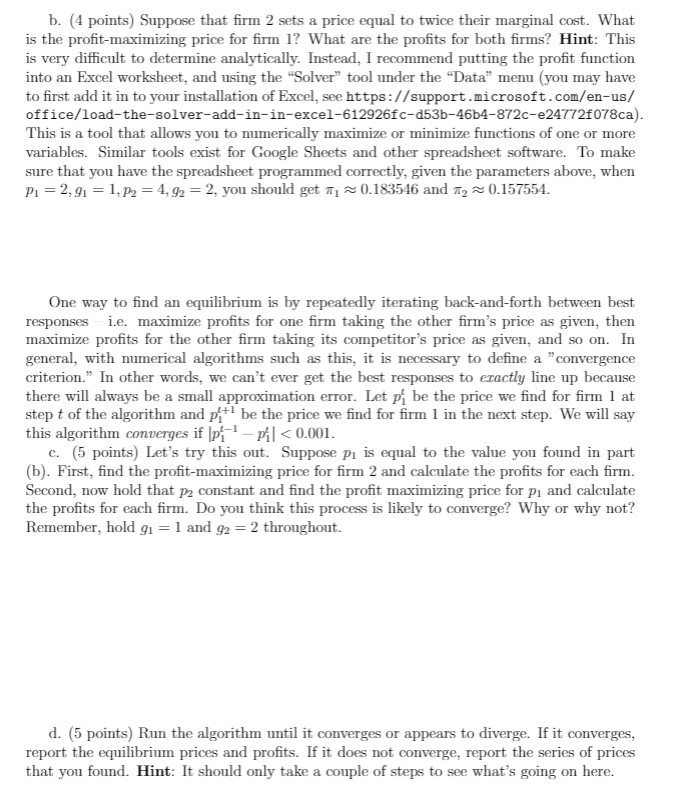
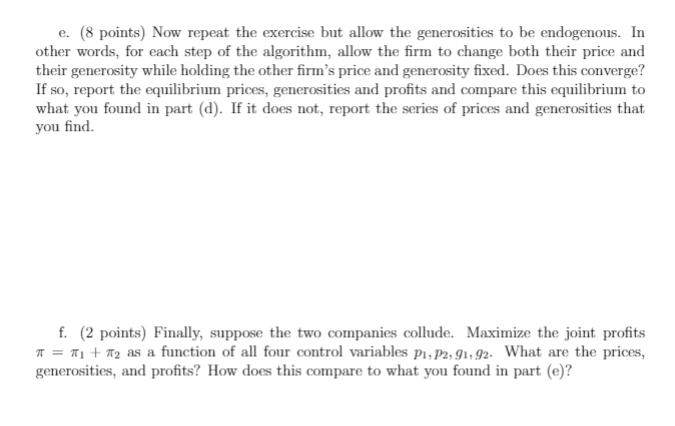
Bonus problem! 25 possible bonus points Note: This problem requires the use of Excel or similar spreadsheet software. It is potentially more time-consuming than other problems worth similar point values. I urge you not to attempt it unless you have completed the rest of the exam. Consider the health insurance market. Suppose health insurance plans are denoted by j and are differentiated along two dimensions: price, Pj, and generosity, 9j. In each period consumers may purchase one of J plans or no plan at all (we call this the "outside good). The utility that consumer i gets from purchasing plan j is given by: Wij = ap; + Bg; + tij. In this equation, a is the price sensitivity (and so must be a negative number) and B repre- sents how much consumers care about the generosity of the plan. Ei; is an individual-plan- specific unobservable term. Note that tij is the only term in the equation with an i subscript, which means that individuals only differ in their bij draw. Suppose that the utility of the outside good is normalized to zero and that ei; is indepen- dently and identically drawn across individuals and plans according to the Type-1 Extreme Value Distribution. The details of this distribution aren't important for the purposes of this question. What is important is that under that assumption, it can be shown that the mar- ket share of plan j, s; is given by the logit share function' (thus this differentiated products demand system is often called "logit demand), is given by exp(ap; + B9) 1+ Ek=, exp(apk + Bgk) On the supply side, there are two firms, each of which offers one plan, so j {1, 2}. The marginal cost of each plan is constant and is a quadratic function of the generosity, given by me; = 70; + %1j9; + 12;9. In this problem, we will be solving this model numerically. We will use the following parameters: a = -1, B = 1, Y1 = 0,711 = 0.75, 712 = 0.5, 702 = 0.25, 712 = .5, V22 = -25. a. (1 point) By visual examination, it looks like firm 2 has to pay less for generosity than firm 1 does. Let's suppose that firm 1 sets 91 = 1 and firm 2 sets 92 = 2. First, calculate the marginal costs for each firm. b. (4 points) Suppose that firm 2 sets a price equal to twice their marginal cost. What is the profit-maximizing price for firm 1? What are the profits for both firms? Hint: This is very difficult to determine analytically. Instead, I recommend putting the profit function into an Excel worksheet, and using the Solver tool under the Data" menu (you may have to first add it in to your installation of Excel, see https://support.microsoft.com/en-us/ office/load-the-solver-add-in-in-excel-612926fc-d53b-46b4-872c-e24772f078ca). This is a tool that allows you to numerically maximize or minimize functions of one or more variables. Similar tools exist for Google Sheets and other spreadsheet software. To make sure that you have the spreadsheet programmed correctly, given the parameters above, when P1 = 2,91 = 1, P2 = 4,92 = 2, you should get 1, 0.183546 and 12 -0.157554. One way to find an equilibrium is by repeatedly iterating back-and-forth between best responses i.e. maximize profits for one firm taking the other firm's price as given, then maximize profits for the other firm taking its competitor's price as given, and so on. In general, with numerical algorithms such as this, it is necessary to define a "convergence criterion." In other words, we can't ever get the best responses to eractly line up because there will always be a small approximation error. Let p be the price we find for firm 1 at step t of the algorithm and p+! be the price we find for firm l in the next step. We will say this algorithm converges if p-pil
Step by Step Solution
There are 3 Steps involved in it

Get step-by-step solutions from verified subject matter experts
 Study Help