







Question: BONUS Question 6. MCMC algorithm 5. Implement an MCMC algorithm to sample the posterior distribution of the ef- fective population size Ne given the tree
BONUS Question 6. MCMC algorithm
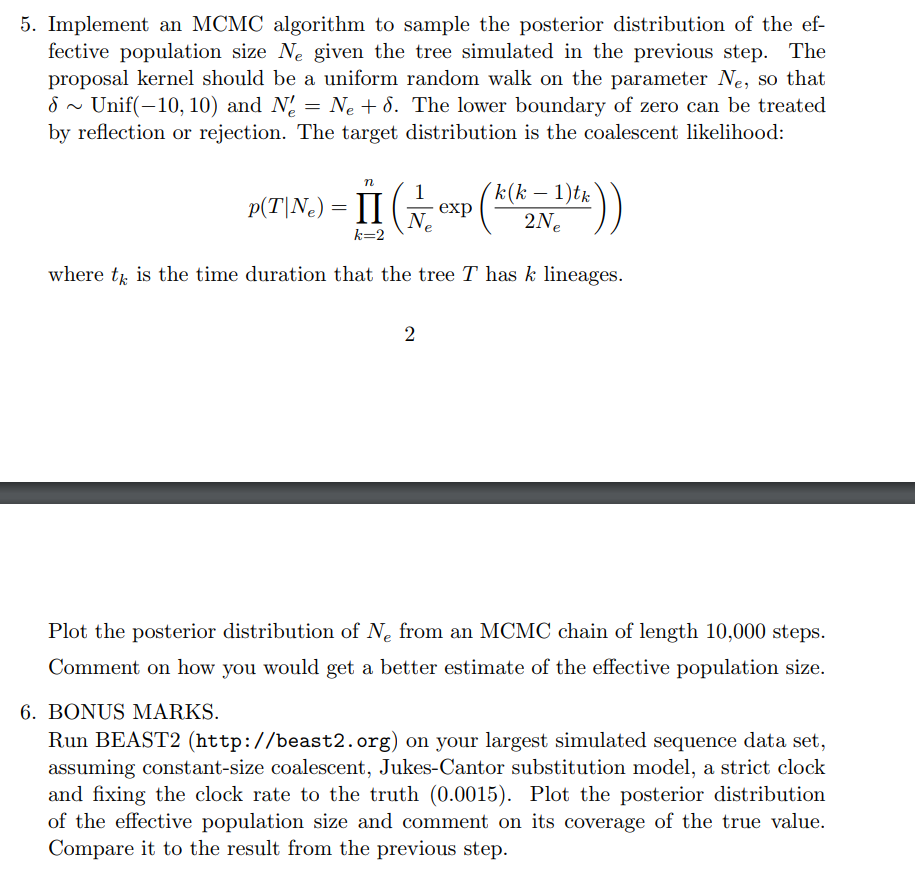
5. Implement an MCMC algorithm to sample the posterior distribution of the ef- fective population size Ne given the tree simulated in the previous step. The proposal kernel should be a uniform random walk on the parameter Ne, so that 6Unif-10, 10) and N-Ne + 6. The lower boundary of zero can be treated by reflection or rejection. The target distribution is the coalescent likelihood k(k - 1)tk where tk is the time duration that the tree T has k lineages Plot the posterior distribution of Ne from an MCMC chain of length 10,000 steps. Comment on how you would get a better estimate of the effective population size. 6. BONUS MARKS. Run BEAST2 (http://beast2.org) on your largest simulated sequence data set, assuming constant-size coalescent, Jukes-Cantor substitution model, a strict clock and fixing the clock rate to the truth (0.0015). Plot the posterior distribution of the effective population size and comment on its coverage of the true value. Compare it to the result from the previous step 5. Implement an MCMC algorithm to sample the posterior distribution of the ef- fective population size Ne given the tree simulated in the previous step. The proposal kernel should be a uniform random walk on the parameter Ne, so that 6Unif-10, 10) and N-Ne + 6. The lower boundary of zero can be treated by reflection or rejection. The target distribution is the coalescent likelihood k(k - 1)tk where tk is the time duration that the tree T has k lineages Plot the posterior distribution of Ne from an MCMC chain of length 10,000 steps. Comment on how you would get a better estimate of the effective population size. 6. BONUS MARKS. Run BEAST2 (http://beast2.org) on your largest simulated sequence data set, assuming constant-size coalescent, Jukes-Cantor substitution model, a strict clock and fixing the clock rate to the truth (0.0015). Plot the posterior distribution of the effective population size and comment on its coverage of the true value. Compare it to the result from the previous step
Step by Step Solution
There are 3 Steps involved in it

Get step-by-step solutions from verified subject matter experts
 Study Help