







Question: Bonus Question - Discrete-Time Wavelet Series - 2 points In addition to Fourier bases (ie., bases of sinusoidal signals), there are many other useful ways
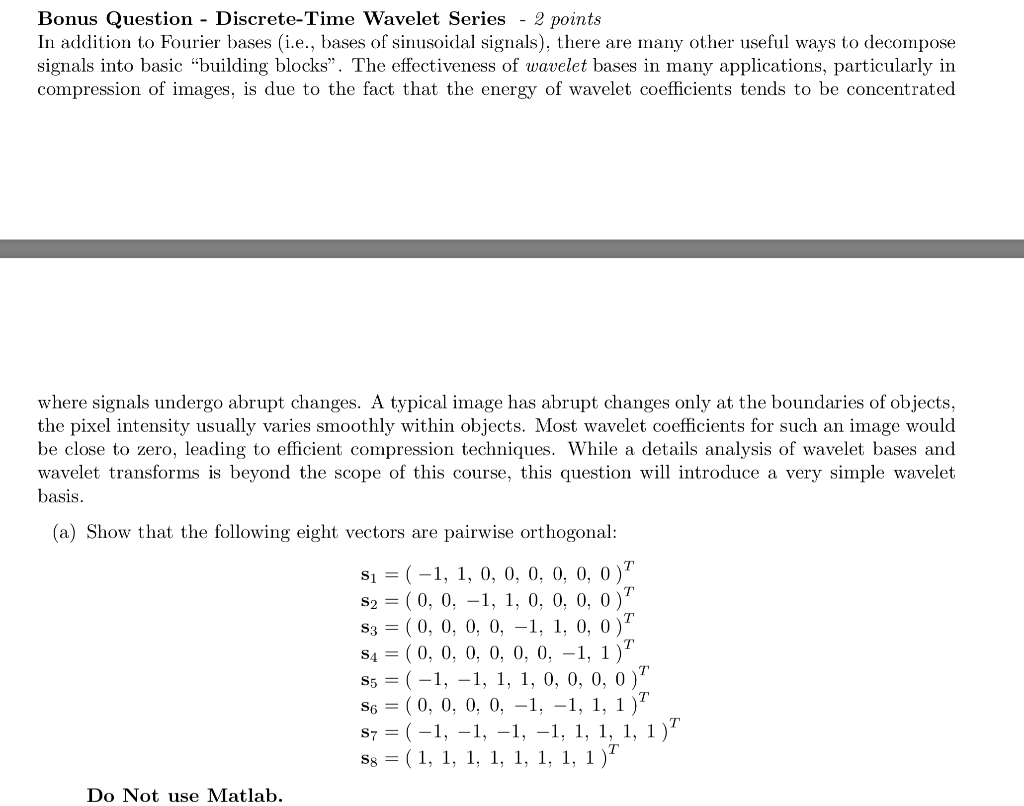
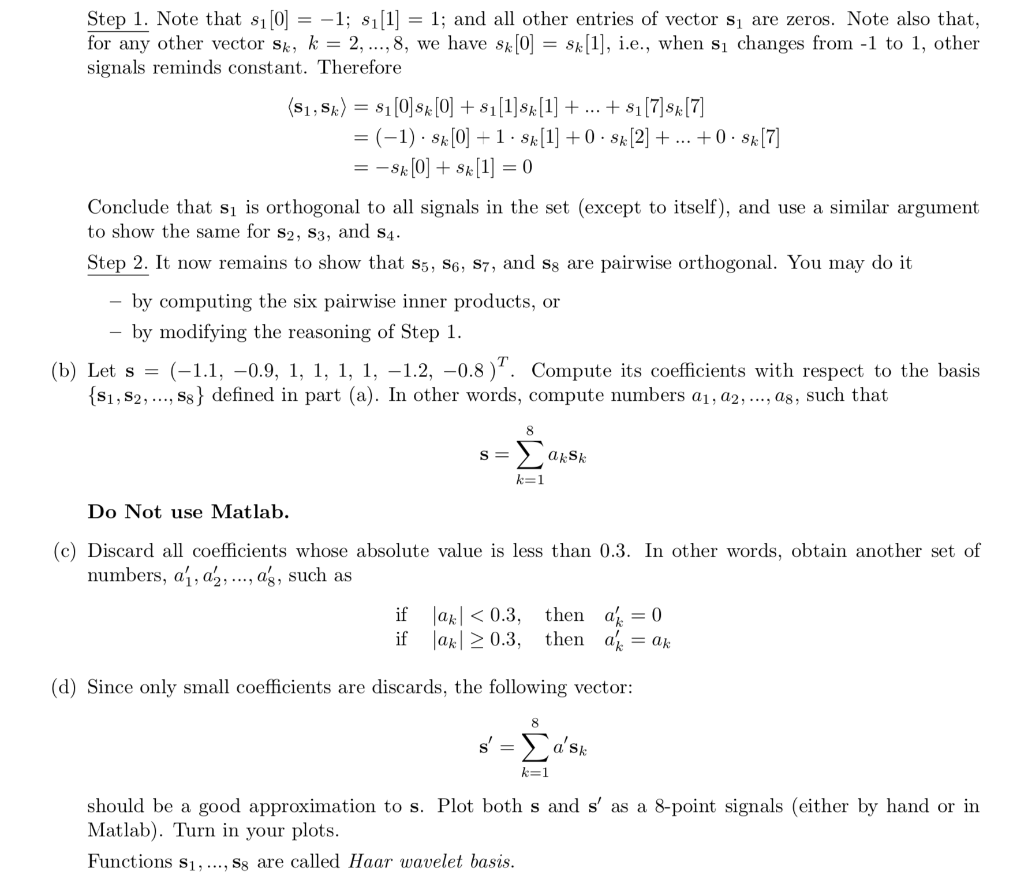
Bonus Question - Discrete-Time Wavelet Series - 2 points In addition to Fourier bases (ie., bases of sinusoidal signals), there are many other useful ways to decompose signals into basic "building blocks". The effectiveness of wavelet bases in many applications, particularly in compression of images, is due to the fact that the energy of wavelet coefficients tends to be concentrated where signals undergo abrupt changes. A typical image has abrupt changes only at the boundaries of objects, the pixel intensity usually varies smoothly within objects. Most wavelet coefficients for such an image would be close to zero, leading to efficient compression techniques. While a details analysis of wavelet bases and wavelet transforms is beyond the scope of this course, this question will introduce a very simple wavelet basis. (a) Show that the following eight vectors are pairwise orthogonal: S1 = (-1, 1, 0, 0, 0, 0, 0, 0 T S2 = (0, 0, -1, 1, 0, 0, 0, 0 ) S3 = (0, 0, 0, 0, -1, 1, 0, 0) S4 = (0, 0, 0, 0, 0, 0, -1, 1)? = (-1, -1, 1, 1, 0, 0, 0, 0 ) S6 = (0, 0, 0, 0, -1, -1, 1, 1)? S7 = (-1, -1, -1, -1, 1, 1, 1, 1 T Sg = (1, 1, 1, 1, 1, 1, 1, 1) Do Not use Matlab. Step 1. Note that s10 = -1; s[1] = 1; and all other entries of vector si are zeros. Note also that, for any other vector Sk, k = 2, ...,8, we have sk [0] = sk[1], i.e., when s changes from -1 to 1, other signals reminds constant. Therefore (S1, Sk) = si[O]Sk[0] + $1[1]sk [1] + ... + 81[7]sk[7] = (-1) .sk [0] +1.sk [1] +0.sk [2] + ... +0. Sk[7] = -8k [0] + sk[1] = 0 Conclude that s is orthogonal to all signals in the set (except to itself), and use a similar argument to show the same for S2, S3, and S4. Step 2. It now remains to show that s5, S6, S7, and so are pairwise orthogonal. You may do it - by computing the six pairwise inner products, or by modifying the reasoning of Step 1. (b) Let s = (-1.1, -0.9, 1, 1, 1, 1, -1.2, -0.8). Compute its coefficients with respect to the basis {S1, S2, ..., 58} defined in part (a). In other words, compute numbers aj, a2, ..., 08, such that 8 S = Sk k= 1 Do Not use Matlab. (c) Discard all coefficients whose absolute value is less than 0.3. In other words, obtain another set of numbers, a, a, ..., a's, such as if if lakl 0.3, then as = 0 ak = ak (d) Since only small coefficients are discards, the following vector: 8 s' => a'sk k=1 should be a good approximation to s. Plot both s and s' as a 8-point signals (either by hand or in Matlab). Turn in your plots. Functions S1, ..., Sg are called Haar wavelet basis. Bonus Question - Discrete-Time Wavelet Series - 2 points In addition to Fourier bases (ie., bases of sinusoidal signals), there are many other useful ways to decompose signals into basic "building blocks". The effectiveness of wavelet bases in many applications, particularly in compression of images, is due to the fact that the energy of wavelet coefficients tends to be concentrated where signals undergo abrupt changes. A typical image has abrupt changes only at the boundaries of objects, the pixel intensity usually varies smoothly within objects. Most wavelet coefficients for such an image would be close to zero, leading to efficient compression techniques. While a details analysis of wavelet bases and wavelet transforms is beyond the scope of this course, this question will introduce a very simple wavelet basis. (a) Show that the following eight vectors are pairwise orthogonal: S1 = (-1, 1, 0, 0, 0, 0, 0, 0 T S2 = (0, 0, -1, 1, 0, 0, 0, 0 ) S3 = (0, 0, 0, 0, -1, 1, 0, 0) S4 = (0, 0, 0, 0, 0, 0, -1, 1)? = (-1, -1, 1, 1, 0, 0, 0, 0 ) S6 = (0, 0, 0, 0, -1, -1, 1, 1)? S7 = (-1, -1, -1, -1, 1, 1, 1, 1 T Sg = (1, 1, 1, 1, 1, 1, 1, 1) Do Not use Matlab. Step 1. Note that s10 = -1; s[1] = 1; and all other entries of vector si are zeros. Note also that, for any other vector Sk, k = 2, ...,8, we have sk [0] = sk[1], i.e., when s changes from -1 to 1, other signals reminds constant. Therefore (S1, Sk) = si[O]Sk[0] + $1[1]sk [1] + ... + 81[7]sk[7] = (-1) .sk [0] +1.sk [1] +0.sk [2] + ... +0. Sk[7] = -8k [0] + sk[1] = 0 Conclude that s is orthogonal to all signals in the set (except to itself), and use a similar argument to show the same for S2, S3, and S4. Step 2. It now remains to show that s5, S6, S7, and so are pairwise orthogonal. You may do it - by computing the six pairwise inner products, or by modifying the reasoning of Step 1. (b) Let s = (-1.1, -0.9, 1, 1, 1, 1, -1.2, -0.8). Compute its coefficients with respect to the basis {S1, S2, ..., 58} defined in part (a). In other words, compute numbers aj, a2, ..., 08, such that 8 S = Sk k= 1 Do Not use Matlab. (c) Discard all coefficients whose absolute value is less than 0.3. In other words, obtain another set of numbers, a, a, ..., a's, such as if if lakl 0.3, then as = 0 ak = ak (d) Since only small coefficients are discards, the following vector: 8 s' => a'sk k=1 should be a good approximation to s. Plot both s and s' as a 8-point signals (either by hand or in Matlab). Turn in your plots. Functions S1, ..., Sg are called Haar wavelet basis
Step by Step Solution
There are 3 Steps involved in it

Get step-by-step solutions from verified subject matter experts
 Study Help