







Question: Book : understanding cryptography (PLEASE ANSWER A & B) The modulus of RSA has been enlarged over the years in order to thwart improved attacks.
Book : understanding cryptography (PLEASE ANSWER A & B)
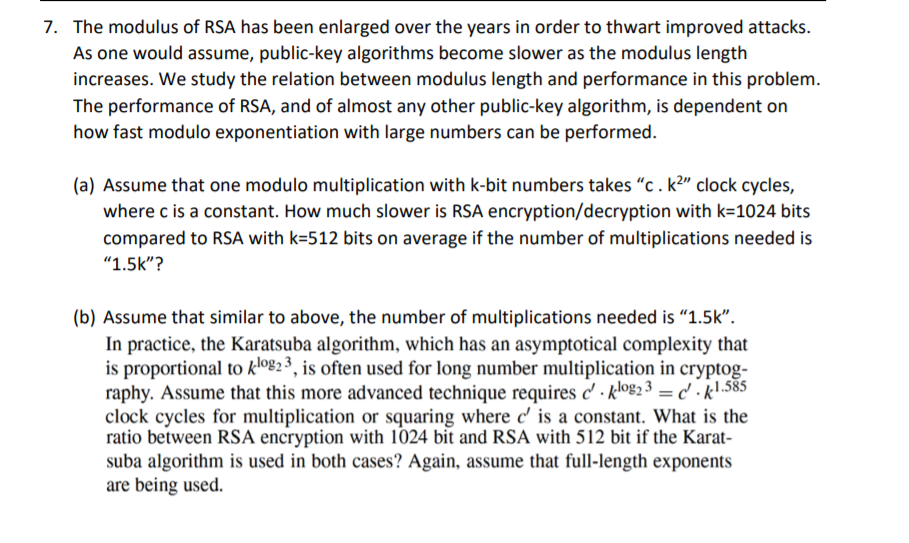
The modulus of RSA has been enlarged over the years in order to thwart improved attacks. As one would assume, public-key algorithms become slower as the modulus length increases. we study the relation between modulus length and performance in this problem. The performance of RSA, and of almost any other public-key algorithm, is dependent on how fast modulo exponentiation with large numbers can be performed. 7. (a) Assume that one modulo multiplication with k-bit numbers takes "c . k2" clock cycles, where c is a constant. How much slower is RSA encryption/decryption with k-1024 bits compared to RSA with k-512 bits on average if the number of multiplications needed is "1.5k"? (b) Assume that similar to above, the number of multiplications needed is "1.5k" In practice, the Karatsuba algorithm, which has an asymptotical complexity that is proportional to klog23, is often used for long number multiplication in cryptog- raphy. Assume that this more advanced technique requires '. klog3k1585 clock cycles for multiplication or squaring where c' is a constant. What is the ratio between RSA encryption with 1024 bit and RSA with 512 bit if the Karat- suba algorithm is used in both cases? Again, assume that full-length exponents are being used The modulus of RSA has been enlarged over the years in order to thwart improved attacks. As one would assume, public-key algorithms become slower as the modulus length increases. we study the relation between modulus length and performance in this problem. The performance of RSA, and of almost any other public-key algorithm, is dependent on how fast modulo exponentiation with large numbers can be performed. 7. (a) Assume that one modulo multiplication with k-bit numbers takes "c . k2" clock cycles, where c is a constant. How much slower is RSA encryption/decryption with k-1024 bits compared to RSA with k-512 bits on average if the number of multiplications needed is "1.5k"? (b) Assume that similar to above, the number of multiplications needed is "1.5k" In practice, the Karatsuba algorithm, which has an asymptotical complexity that is proportional to klog23, is often used for long number multiplication in cryptog- raphy. Assume that this more advanced technique requires '. klog3k1585 clock cycles for multiplication or squaring where c' is a constant. What is the ratio between RSA encryption with 1024 bit and RSA with 512 bit if the Karat- suba algorithm is used in both cases? Again, assume that full-length exponents are being used
Step by Step Solution
There are 3 Steps involved in it

Get step-by-step solutions from verified subject matter experts
 Study Help