





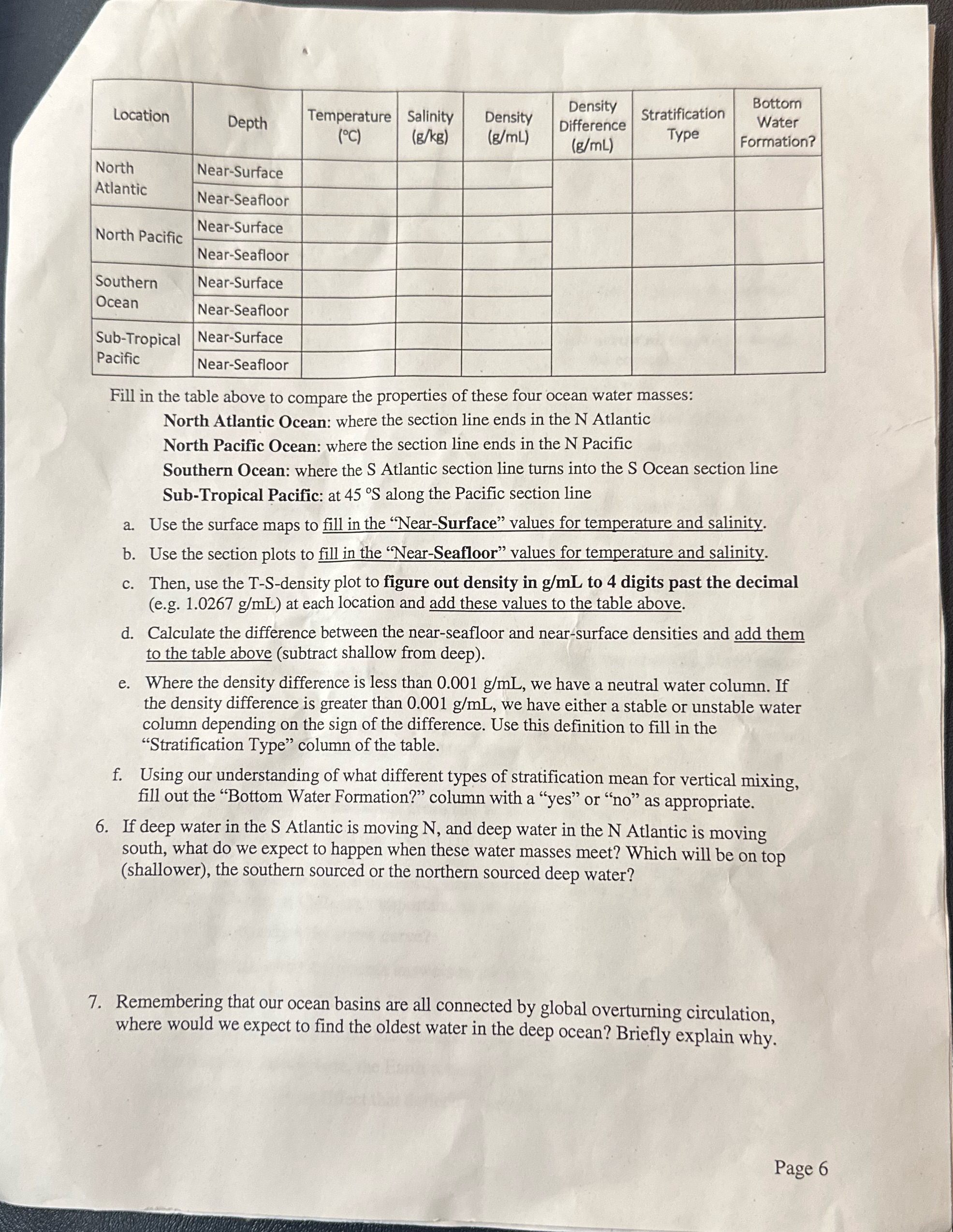
Question: Bottom Water Formation? Stratification Location Depth Temperature | Salinity ; Density ey Difference (e/mL) (g/mL) North Atlantic Near-Surface Nerseatonr || I North Pacific Nesrsutocs ||
Bottom Water Formation? Stratification Location
Bottom Water Formation? Stratification Location Depth Temperature | Salinity ; Density ey Difference (e/mL) (g/mL) North Atlantic Near-Surface Nerseatonr || I North Pacific Nesrsutocs || Near-Surface -- - Fascssioor i~ | PR o Fill in the table above to compare the properties of these four ocean water masses: North Atlantic Ocean: where the section line ends in the N Atlantic North Pacific Ocean: where the section line ends in the N Pacific Southern Ocean: where the S Atlantic section line turns into the S Ocean section line Sub-Tropical Pacific; at 45 S along the Pacific section line a. Use the surface maps to fill in the \"Near-Surface\" values for temperature and salinity. Southern Ocean Sub-Tropical Pacific fill in the \"Near-Seafloor\" values for temperature and salinity. g Use the section plots to Then, use the T-S-density plot to figure out density in g/mL to 4 digits past the decimal (e.g. 1.0267 g/mL) at each location and add these values to the table above. 2 d. Calculate the difference between the near-seafloor and near-surface densities and add them to the table above (subtract shallow from deep). e. Where the density difference is less than 0.001 g/mL, we have a neutral water column. If the density difference is greater than 0.001 g/mL, we have either a stable or unstable water column depending on the sign of the difference. Use this definition to fill in the \"Stratification Type\" column of the table. f. Using our understanding of what different types of stratification mean for vertical mixing, fill out the \"Bottom Water Formation?\" column with a \"yes\" or \"no\" as appropriate. 6. If deep water in the S Atlantic is moving N, and deep water in the N Atlantic is moving south, what do we expect to happen when these water masses meet? Which will be on top (shallower), the southern sourced or the northern sourced deep water? 7. Remembering that our ocean basins are all connected b y global overturnine ci 3 where would we expect to find the oldest water in the & Gichlation, deep ocean? Briefly explain why., Page 6

Step by Step Solution

There are 3 Steps involved in it

1 Expert Approved Answer
Step: 1 Unlock blur-text-image

Question Has Been Solved by an Expert!

Get step-by-step solutions from verified subject matter experts

Step: 2 Unlock
Step: 3 Unlock

Students Have Also Explored These Related Law Questions!