







Question: Brain fun. This problem is about a programming language known as in polite company.1 It was invented in 1964, in one of the foundational
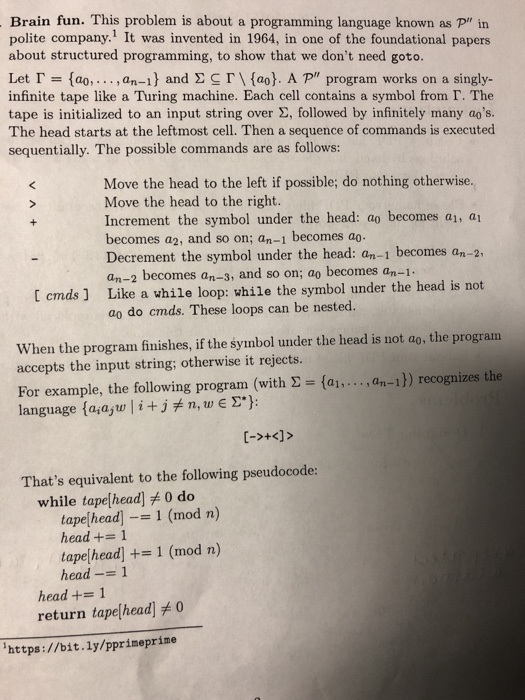

Brain fun. This problem is about a programming language known as " in polite company.1 It was invented in 1964, in one of the foundational papers about structured programming, to show that we don't need goto. Let ? = {ao, . . . , an-1) and ? ? ? \ {ao). A P" prograrn works on a singly- infinite tape like a Turing machine. Each cell contains a symbol from I. The tape is initialized to an input string over , followed by infinitely many ao's The head starts at the leftmost cell. Then a sequence of commands is executed sequentially. The possible commands are as follows: Move the head to the left if possible; do nothing otherwise. Move the head to the right. Increment the symbol under the head: ao becomes a1,a becomes 2, and so on; an-1 becomes ao. Decrement the symbol under the head: an-1 becomesa an-2 becomes an-3, and so on; ao becomes Like a while loop: while the symbol under the head is not ao do cmds. These loops can be nested. n-2 C cmds J When the program finishes, if the symbol under the head is not ao, the program accepts the input string; otherwise it rejects. For example, the following program (with ?-(a,.. , an-1)) recognizes the language {aajtu I i + j?n, w E ?*) : That's equivalent to the following pseudocode: while tapel[head] 0 do tapelhead] -1 (mod n) head + 1 tapelhead] +1 (mod n) head-= 1 head += 1 return tapelhead #o https://bit.1y/pprimeprime Brain fun. This problem is about a programming language known as " in polite company.1 It was invented in 1964, in one of the foundational papers about structured programming, to show that we don't need goto. Let ? = {ao, . . . , an-1) and ? ? ? \ {ao). A P" prograrn works on a singly- infinite tape like a Turing machine. Each cell contains a symbol from I. The tape is initialized to an input string over , followed by infinitely many ao's The head starts at the leftmost cell. Then a sequence of commands is executed sequentially. The possible commands are as follows: Move the head to the left if possible; do nothing otherwise. Move the head to the right. Increment the symbol under the head: ao becomes a1,a becomes 2, and so on; an-1 becomes ao. Decrement the symbol under the head: an-1 becomesa an-2 becomes an-3, and so on; ao becomes Like a while loop: while the symbol under the head is not ao do cmds. These loops can be nested. n-2 C cmds J When the program finishes, if the symbol under the head is not ao, the program accepts the input string; otherwise it rejects. For example, the following program (with ?-(a,.. , an-1)) recognizes the language {aajtu I i + j?n, w E ?*) : That's equivalent to the following pseudocode: while tapel[head] 0 do tapelhead] -1 (mod n) head + 1 tapelhead] +1 (mod n) head-= 1 head += 1 return tapelhead #o https://bit.1y/pprimeprime
Step by Step Solution
There are 3 Steps involved in it

Get step-by-step solutions from verified subject matter experts
 Study Help