



Question: Brass Cylinder Plastic Cylinder N/A N/A Data Table 1 Object Length (cm) Radius (cm) Area Volume (cm) (cm) Displaced volume % Diff 78.9% Aluminum
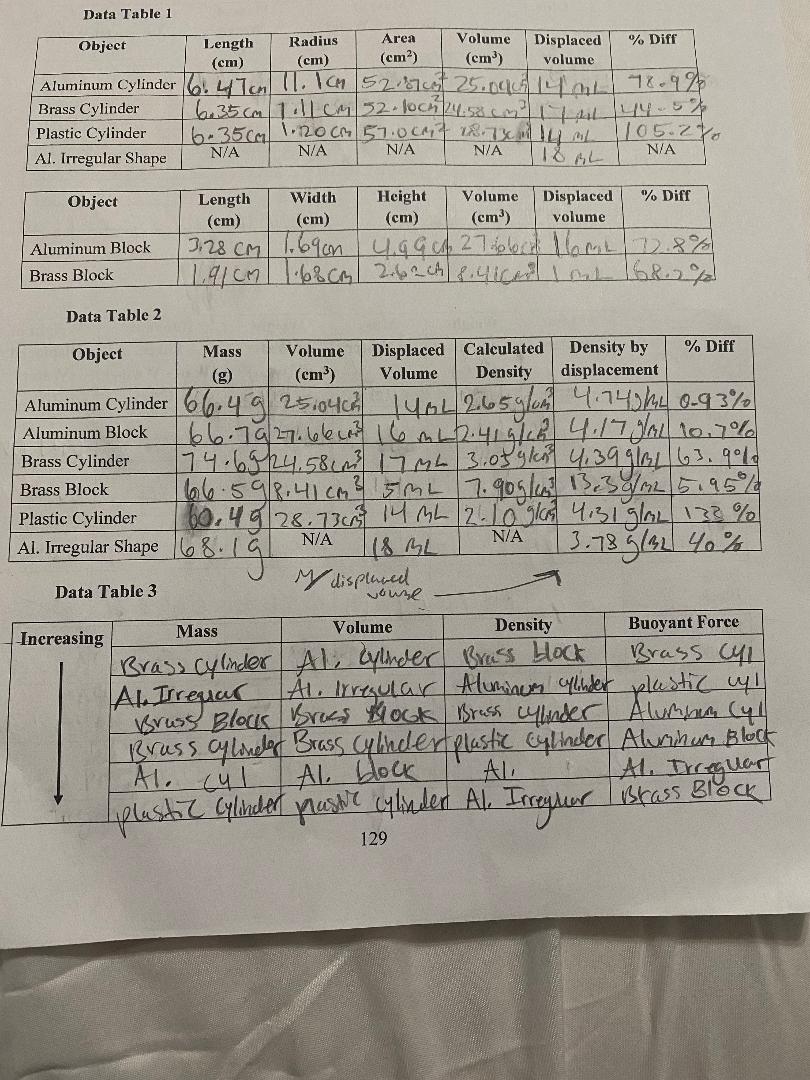
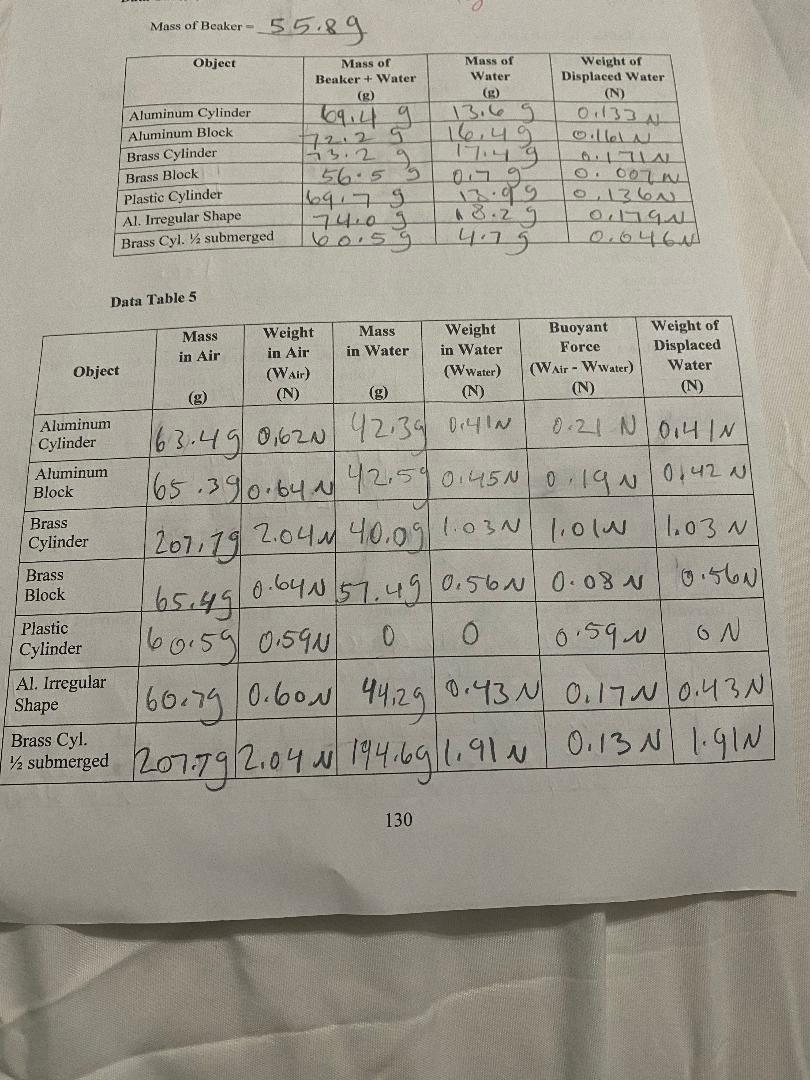
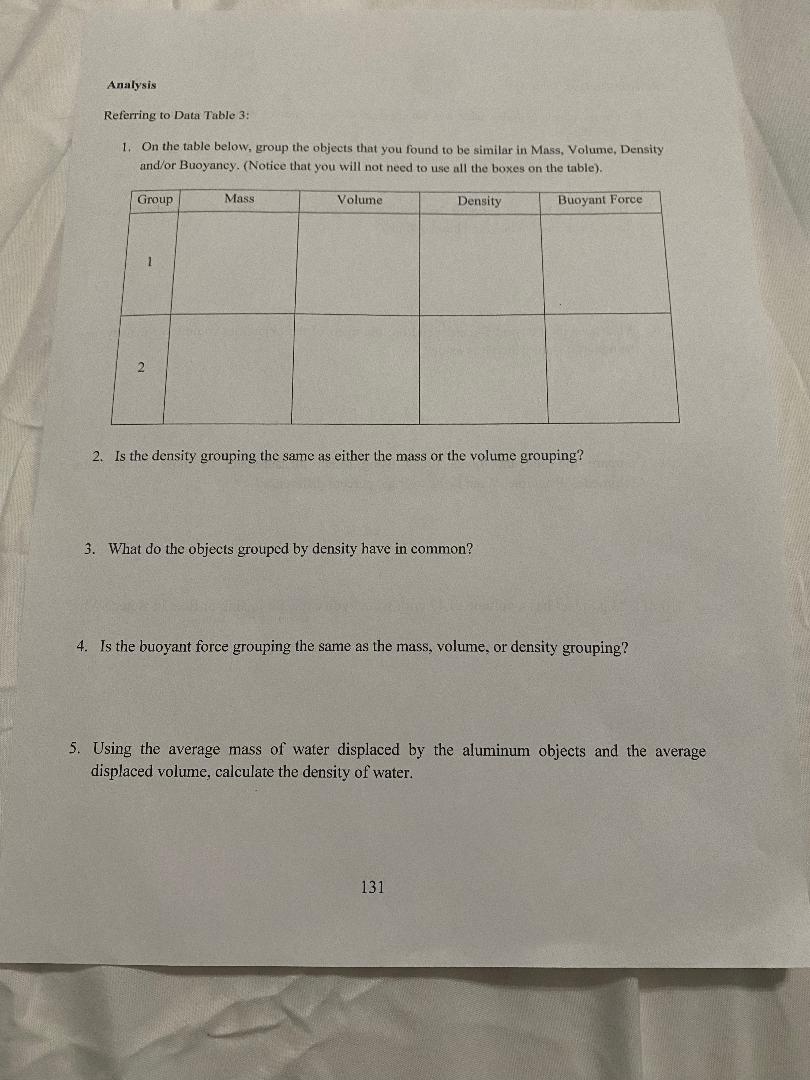
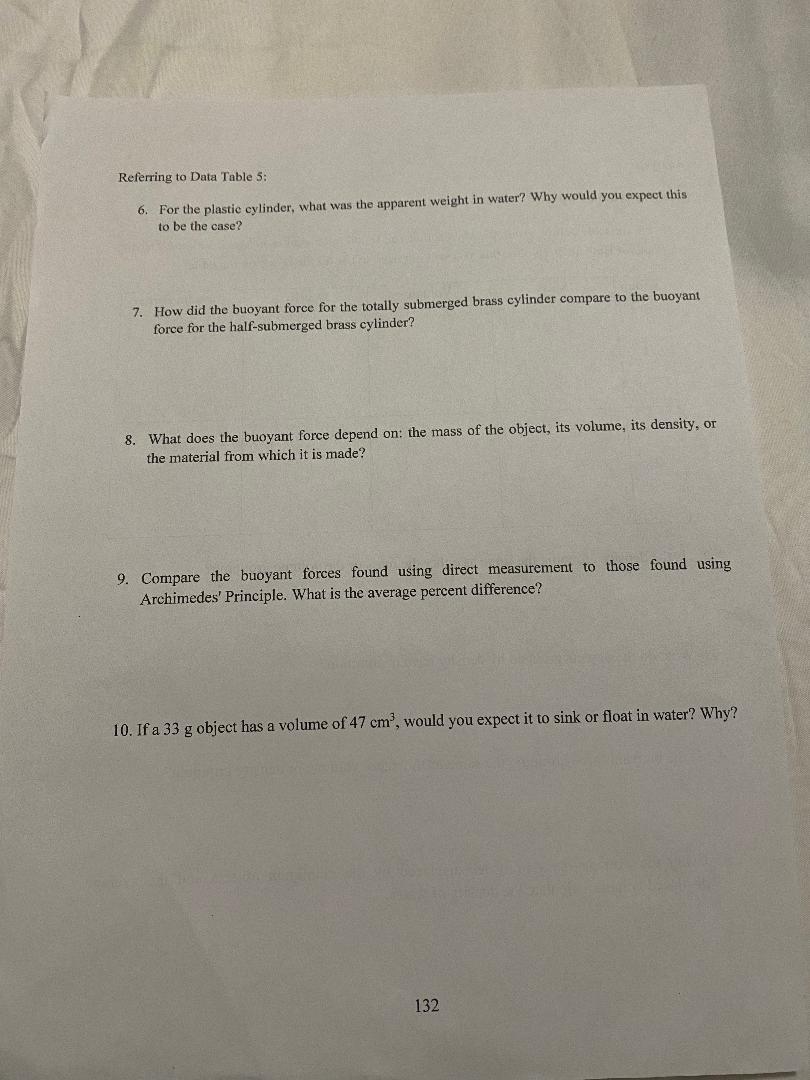
Brass Cylinder Plastic Cylinder N/A N/A Data Table 1 Object Length (cm) Radius (cm) Area Volume (cm) (cm) Displaced volume % Diff 78.9% Aluminum Cylinder 6.47cm 11.1cm 5287 25.09 14 6.35cm 1.11 CM 32.10cm 24.58 cm 172 44-5% 6.35cm 1.120cm 57.0 CM7 18.7M 14 ML N/A N/A 105.270 N/A Al. Irregular Shape 18 AL Object Length (cm) Width (cm) Height (cm) Volume (cm) Displaced volume % Diff Aluminum Block Brass Block 3.28 CM 1.690 4.99cm 27 mm 7.8% 1.9/CM 1.68cm 2.628.41 168.2% Data Table 2 Mass (g) Volume Displaced Calculated (cm) Volume Density Density by % Diff displacement Object Aluminum Cylinder 66.4 25.04C 14ML 265g/om Aluminum Block Brass Cylinder Brass Block Plastic Cylinder 4.745ML 0-93% 66.79/27.6643 16 L 2.419/16 4.170/11/10.7% 74.6524.58 cm 17 ML 3.05 g/m 4.399/31 63.901 66.598.41CM 5ML 7.909/133 13.3g/m2 5.95% 60.49 28.73 14 ML 2.10 glam 4:31 g/mL 133 % Al. Irregular Shape 68.19 Data Table 3 Increasing Mass N/A 18 ML displaced. vousl Volume N/A Density 3.785/32 40% Buoyant Force Brass CL Brass cylinder Al, Cylinder Brass block Al. Trea Al. Irregular Aluminum cylinder plastic cyl Bruss Block Brass Book Brass Cylinder Aluminum Cyl Brass Cylinder Brass Cylinder plastic cylinder Aluminum Block Al. cul Al. Irregular Al. block Al plastic cylinder plastic cylinder Al. Irreglur Brass Block 129 Mass of Beaker- Object Aluminum Cylinder Aluminum Block Brass Cylinder Brass Block 55.89 Mass of Beaker + Water (g) 69.49 72.25 3.2 Mass of Water (g) Weight of Displaced Water (N) 13.69 0.133 N 16.49 1160 9 17.49 0.171NL 56.5 5 0.79 0.007N 13.99 01360 18.29 Plastic Cylinder Al. Irregular Shape Brass Cyl. submerged 69.79 74.09 60.59 0.6464 Data Table 5 Mass Weight in Air Object (g) in Air (WAir) (N) Mass in Water Weight in Water (WWater) Buoyant Force Weight of Displaced (g) (N) (WAir - WWater). (N) Water (N) Aluminum Cylinder 63.49 0,620 42.39 0.41N Aluminum Block Brass Cylinder 207.19 2.04 40.09 1.03 1.01 65.390.64N 0.21 N 014 |N 42.59 0.45 0.19N 0142N 1.03 N Brass Block 65.49 Plastic Cylinder 60.59 0.59N 0.64 57.49 0.56N 0.08 0.560 0 0 ON 0.590 Al. Irregular Shape Brass Cyl. submerged 160.79 0.60N 44.29 0.43N 0.17 0.43N N 207.79 2.04 N 194.69 1.91 0.13 1.91N 194.6g|1.91N 130 Analysis Referring to Data Table 3: 1. On the table below, group the objects that you found to be similar in Mass, Volume, Density and/or Buoyancy. (Notice that you will not need to use all the boxes on the table). Group 2 Mass Volume Density Buoyant Force 2. Is the density grouping the same as either the mass or the volume grouping? 3. What do the objects grouped by density have in common? 4. Is the buoyant force grouping the same as the mass, volume, or density grouping? 5. Using the average mass of water displaced by the aluminum objects and the average displaced volume, calculate the density of water. 131 Referring to Data Table 5: 6. For the plastic cylinder, what was the apparent weight in water? Why would you expect this to be the case? 7. How did the buoyant force for the totally submerged brass cylinder compare to the buoyant force for the half-submerged brass cylinder? 8. What does the buoyant force depend on: the mass of the object, its volume, its density, or the material from which it is made? 9. Compare the buoyant forces found using direct measurement to those found using Archimedes' Principle. What is the average percent difference? 10. If a 33 g object has a volume of 47 cm, would you expect it to sink or float in water? Why? 132
Step by Step Solution
There are 3 Steps involved in it

Get step-by-step solutions from verified subject matter experts