







Question: Brief explanations... Question 3 In class we studied two types of commodity: what we called private and public goods. It's not difficult to think, however,
Brief explanations...
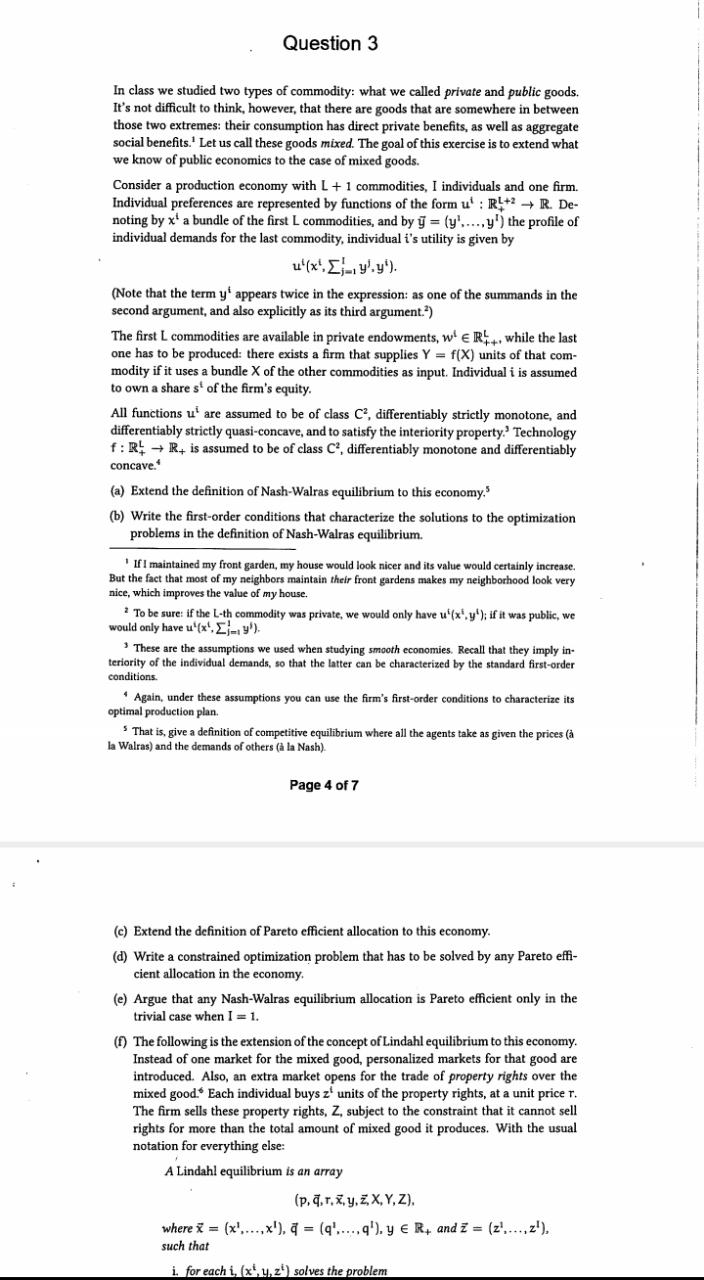
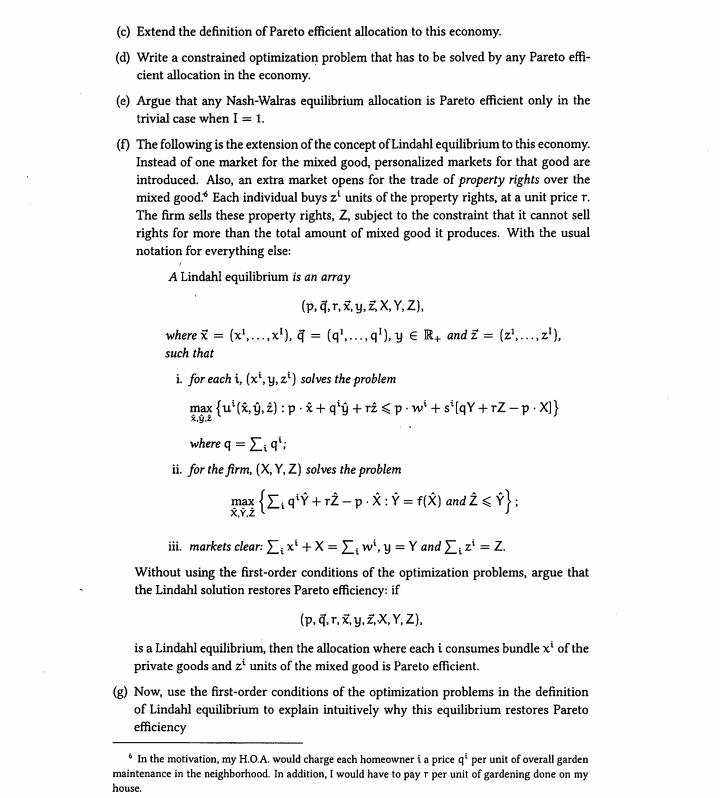
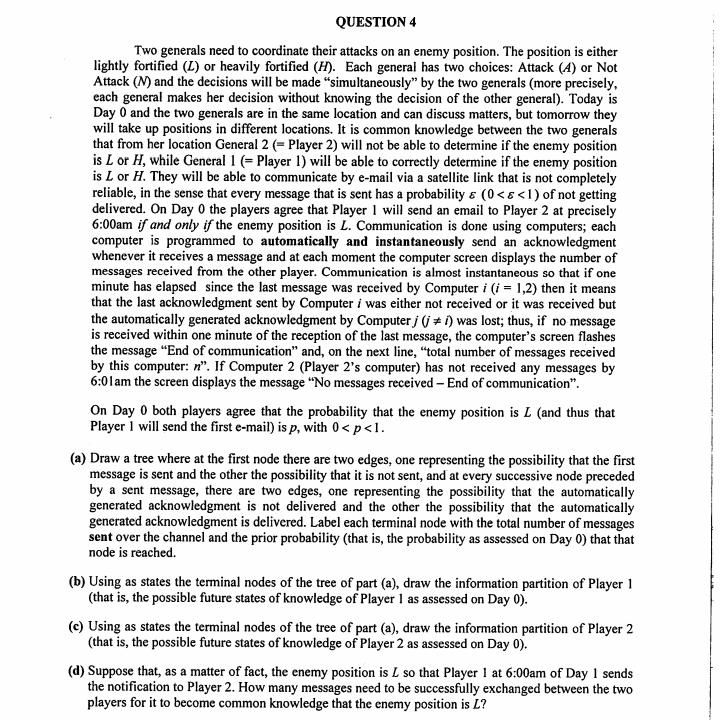
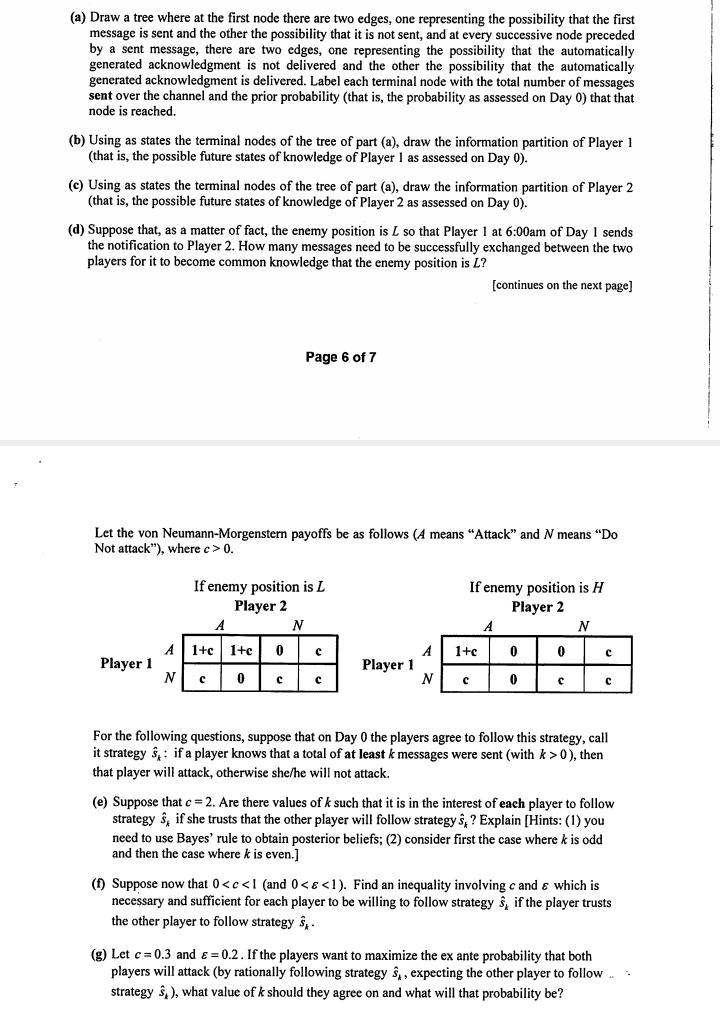
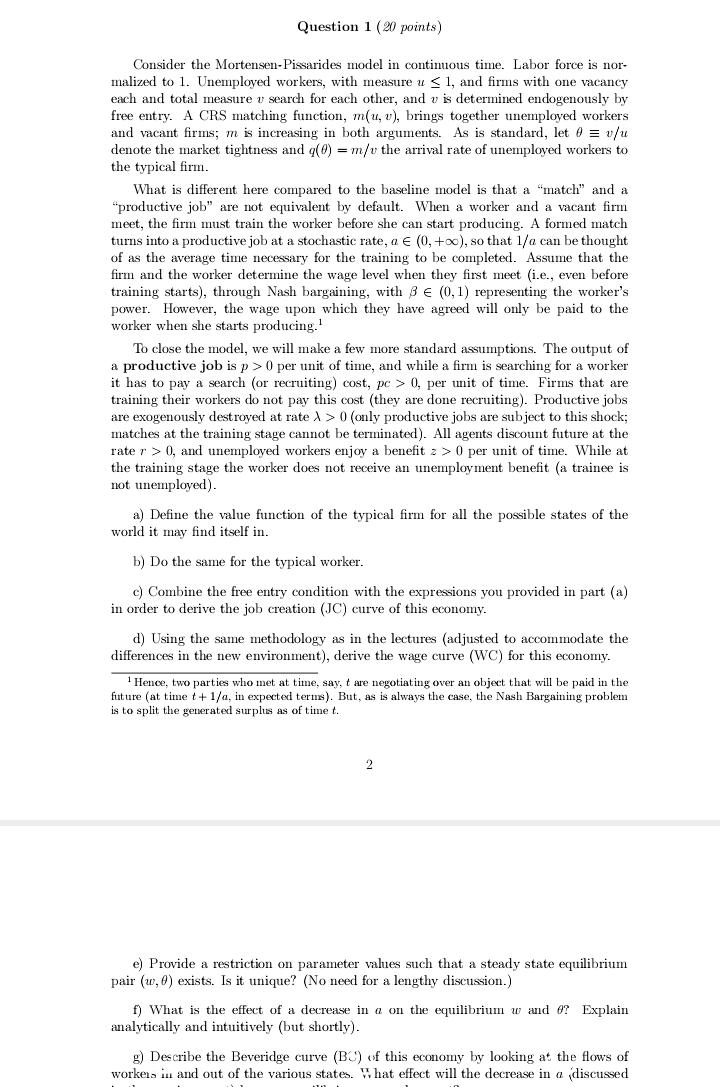
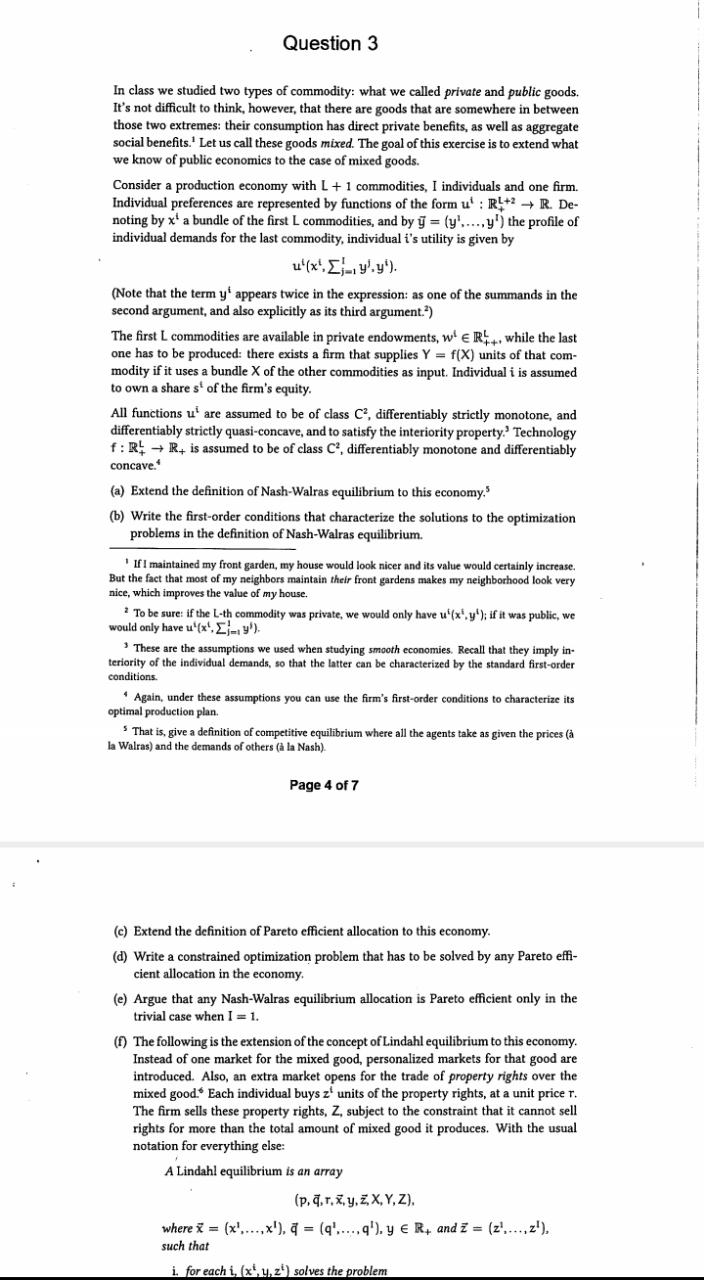
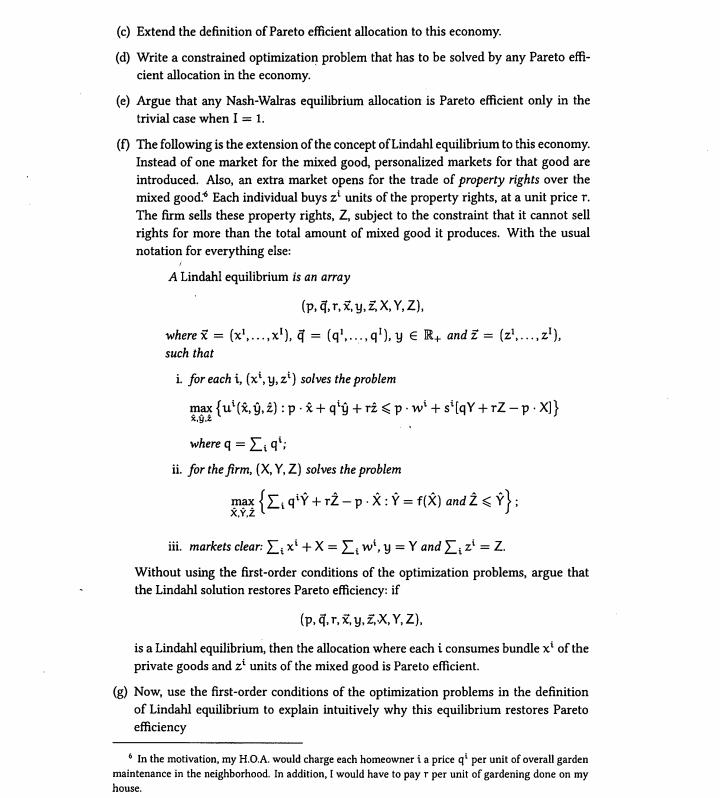
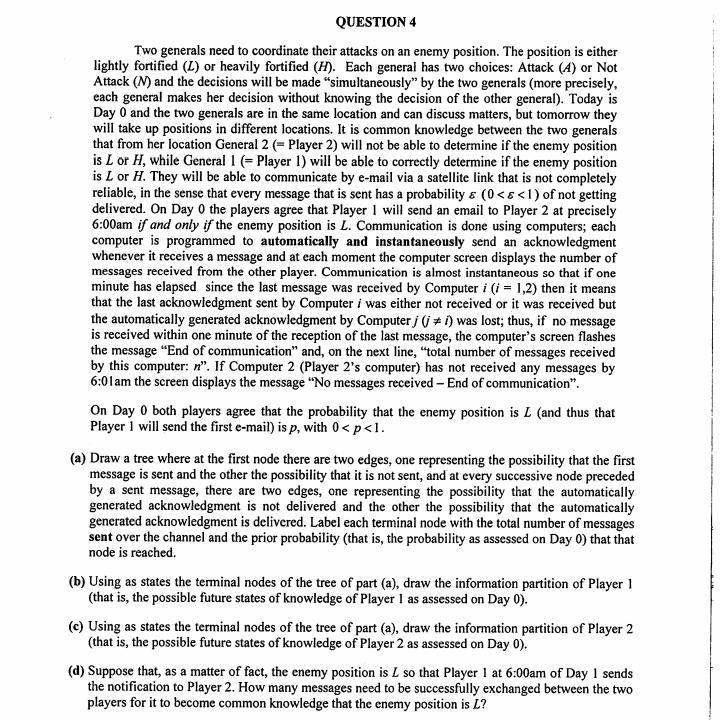
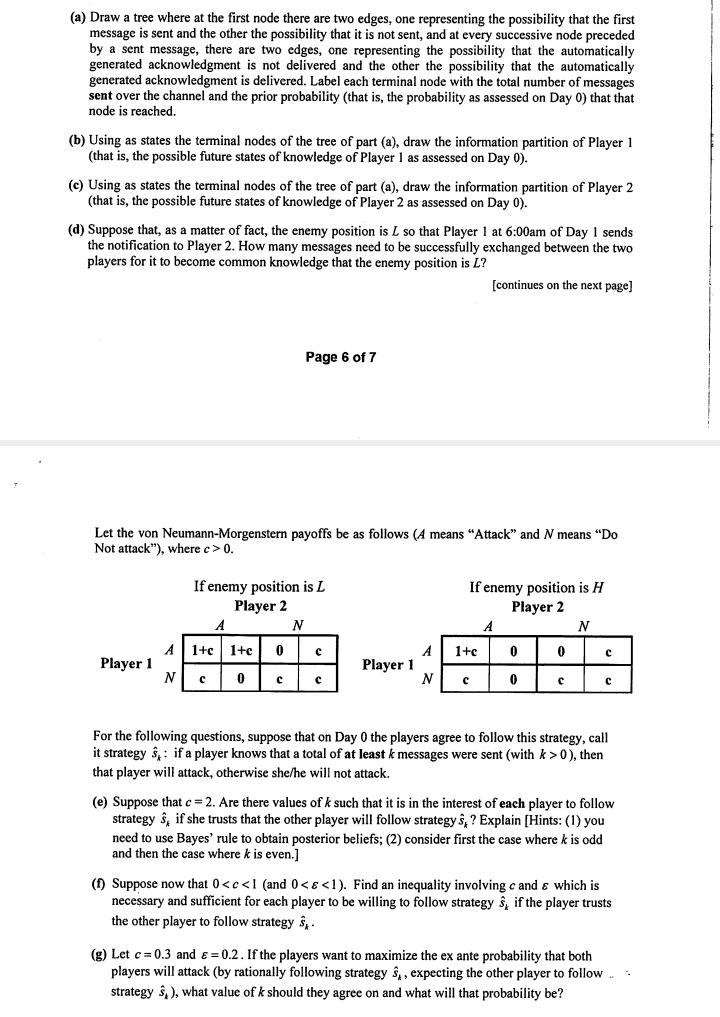
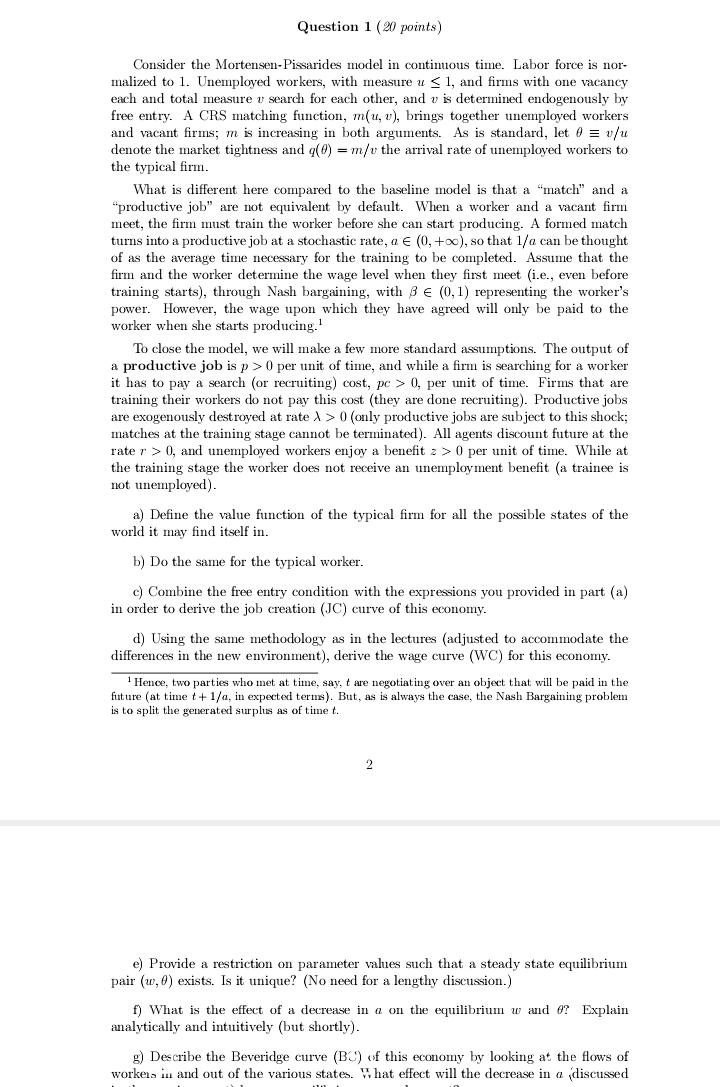
Question 3 In class we studied two types of commodity: what we called private and public goods. It's not difficult to think, however, that there are goods that are somewhere in between those two extremes: their consumption has direct private benefits, as well as aggregate social benefits.' Let us call these goods mixed. The goal of this exercise is to extend what we know of public economics to the case of mixed goods. Consider a production economy with L + 1 commodities, I individuals and one firm. Individual preferences are represented by functions of the form u' ; R\\+? - R. De- noting by x' a bundle of the first L commodities, and by y = (y'....,y') the profile of individual demands for the last commodity, individual i's utility is given by u' ( x ' , [) _ y'.y'). (Note that the term y' appears twice in the expression: as one of the summands in the second argument, and also explicitly as its third argument.") The first L commodities are available in private endowments, we R, while the last one has to be produced: there exists a firm that supplies Y = f(X) units of that com- modity if it uses a bundle X of the other commodities as input. Individual i is assumed to own a share s' of the firm's equity. All functions ul are assumed to be of class C', differentiably strictly monotone, and differentiably strictly quasi-concave, and to satisfy the interiority property.' Technology f : R4 + R+ is assumed to be of class C', differentiably monotone and differentiably concave." (a) Extend the definition of Nash-Walras equilibrium to this economy." (b) Write the first-order conditions that characterize the solutions to the optimization problems in the definition of Nash-Walras equilibrium. If I maintained my front garden, my house would look nicer and its value would certainly increase. But the fact that most of my neighbors maintain their front gardens makes my neighborhood look very nice, which improves the value of my house. To be sure: if the L-th commodity was private, we would only have u'(x. y' ); if it was public, we would only have u" (x', [j=. y'). These are the assumptions we used when studying smooth economies. Recall that they imply in- teriority of the individual demands, so that the latter can be characterized by the standard first-order conditions. * Again, under these assumptions you can use the firm's first-order conditions to characterize its optimal production plan. That is, give a definition of competitive equilibrium where all the agents take as given the prices (a la Walras) and the demands of others (a la Nash). Page 4 of 7 (c) Extend the definition of Pareto efficient allocation to this economy. (d) Write a constrained optimization problem that has to be solved by any Pareto effi- cient allocation in the economy. (e) Argue that any Nash-Walras equilibrium allocation is Pareto efficient only in the trivial case when I = 1. (f) The following is the extension of the concept of Lindahl equilibrium to this economy. Instead of one market for the mixed good, personalized markets for that good are introduced. Also, an extra market opens for the trade of property rights over the mixed good. Each individual buys z' units of the property rights, at a unit price T. The firm sells these property rights, Z, subject to the constraint that it cannot sell rights for more than the total amount of mixed good it produces. With the usual notation for everything else: A Lindahl equilibrium is an array (p, q, r. X. y. Z, X, Y, Z). where * = (x'.....x'), q = (q'..... q'). y e R. and Z = (2'.....z'). such that for each i. (x1, y, z') solves the problem(c) Extend the definition of Pareto efficient allocation to this economy. (d) Write a constrained optimization problem that has to be solved by any Pareto effi- cient allocation in the economy. (e) Argue that any Nash-Walras equilibrium allocation is Pareto efficient only in the trivial case when I = 1. (f) The following is the extension of the concept of Lindahl equilibrium to this economy. Instead of one market for the mixed good, personalized markets for that good are introduced. Also, an extra market opens for the trade of property rights over the mixed good. Each individual buys z' units of the property rights, at a unit price r. The firm sells these property rights, Z, subject to the constraint that it cannot sell rights for more than the total amount of mixed good it produces. With the usual notation for everything else: A Lindahl equilibrium is an array (p. q, r, X, y. z, X, Y, Z), where x = (x',...,x'), q = (q'. .... q'), y e R, and Z = (z'. ...,z'), such that i for each i, (x', y, z') solves the problem max { u' (x, y.2 ) : p . * + q'g + rip . w'+ s'[qY+rZ-p . x]} where q = [ q'; ii. for the firm, (X, Y, Z) solves the problem { [,q'v+ 12 -p. x : Y= f(X ) and Z 0. If enemy position is _ If enemy position is H Player 2 Player 2 N N 1+ 1+ 0 1+c Player 1 Player 1 N N For the following questions, suppose that on Day 0 the players agree to follow this strategy, call it strategy s, : if a player knows that a total of at least & messages were sent (with * > 0 ), then that player will attack, otherwise she/he will not attack (e) Suppose that c = 2. Are there values of & such that it is in the interest of each player to follow strategy s, if she trusts that the other player will follow strategy s, ? Explain [Hints: (1) you need to use Bayes' rule to obtain posterior beliefs; (2) consider first the case where k is odd and then the case where * is even.] (f) Suppose now that 0 0 per unit of time, and while a firm is searching for a worker it has to pay a search (or recruiting) cost, pc > 0, per unit of time. Firms that are training their workers do not pay this cost (they are done recruiting). Productive jobs are exogenously destroyed at rate A > 0 (only productive jobs are subject to this shock; matches at the training stage cannot be terminated). All agents discount future at the rate r > 0, and unemployed workers enjoy a benefit > > 0 per unit of time. While at the training stage the worker does not receive an unemployment benefit (a trainee is not unemployed). a) Define the value function of the typical firm for all the possible states of the world it may find itself in. b) Do the same for the typical worker. c) Combine the free entry condition with the expressions you provided in part (a) in order to derive the job creation (JC) curve of this economy. d) Using the same methodology as in the lectures (adjusted to accommodate the differences in the new environment), derive the wage curve (WC) for this economy. 1 Hence, two parties who met at time, say, t are negotiating over an object that will be paid in the future (at time t + 1/a, in expected terms). But, as is always the case, the Nash Bargaining problem is to split the generated surplus as of time t. 2 e) Provide a restriction on parameter values such that a steady state equilibrium pair (w, 0) exists. Is it unique? (No need for a lengthy discussion.) f) What is the effect of a decrease in a on the equilibrium w and o? Explain analytically and intuitively (but shortly). g) Describe the Beveridge curve (BU) of this economy by looking at the flows of workers in and out of the various states. What effect will the decrease in a discussed
Step by Step Solution
There are 3 Steps involved in it

Get step-by-step solutions from verified subject matter experts
 Study Help