







Question: Brief Presentations - Budget , Implementation, Risks & Controls PLUS Metrics, Analysis and Conclusions of Mkt Research Survey Selected brand: Tesla Product: Smart Glasses I
Brief Presentations -
Budget, Implementation, Risks & Controls PLUS Metrics, Analysis and Conclusions of Mkt Research Survey
Selected brand: Tesla
Product: Smart Glasses
I searched the website, it shows that "Tesla's research and development spending increased to almost 1.5 billion U.S. dollars in 2020. The intensity of investment in recent years has made Tesla the leading electric vehicle manufacturer in the United States. Globally, the company sold just under half a million vehicles in 2020."
Book For How To Set Up The Budget:
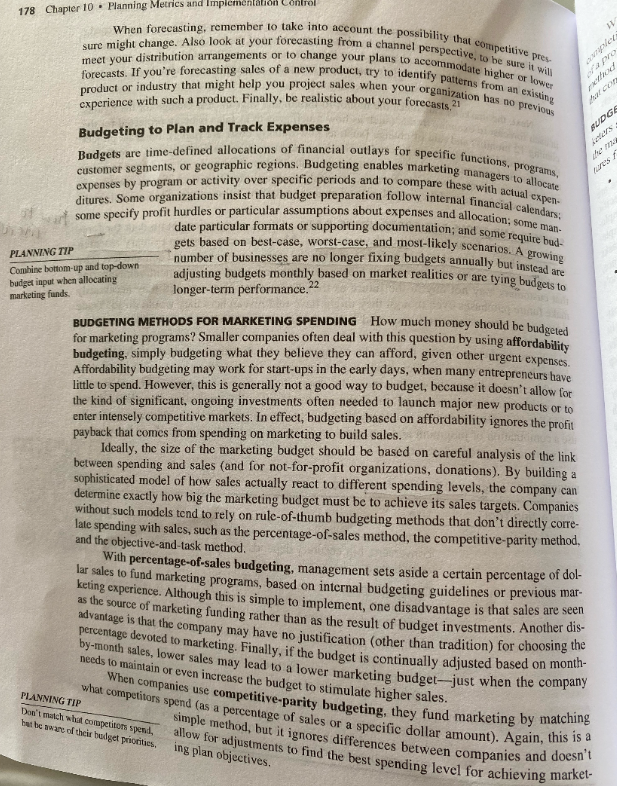
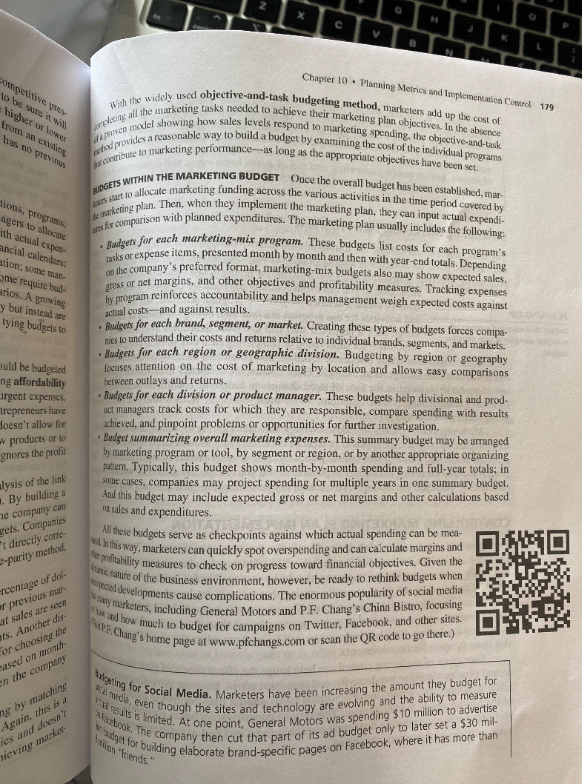
I predict that this product will cost approximately $300 million.
However, I don't know how to use this $300 million on this product?
Please use budget base on the textbook expectations (I am not sure $300 million is a good number) for the product of smart glasses.
Thanks for your help!
178 Chapter 10 . Planning Metrics and Implementation Control sure might change. Also look at your forecasting from a channel perspective, to be sure it will When forecasting, remember to take into account the possibility that competitive pres meet your distribution arrangements or to change your plans to accommodate higher or lower forecasts. If you're forecasting sales of a new product, try to identify patterns from an existing product or industry that might help you project sales when your organization has to previous with such a product. Finally, be realistic about Budgeting to Plan and Track Expenses BUDGE Budgets are time-defined allocations of financial outlays for specific functions, programs, customer segments, or geographic regions. Budgeting enables marketing managers to allocate expenses by program or activity over specific periods and to compare these with actual expen- ditures. Some organizations insist that budget preparation follow internal financial calendars, some specify profit hurdles or particular assumptions about expenses and allocation, som man date particular formats or supporting documentation, and some require bud- gets based on best-case, worst-case, and most likely scenarios. A growing PLANNING TIP Combine bottom-up and top-down budget input when allocating longer-term performance.22 number of businesses are no longer fixing budgets annually but instead are adjusting budgets monthly based on market realities or are tying budgets te marketing funds BUDGETING METHODS FOR MARKETING SPENDING How much money should be budgeted for marketing programs? Smaller companies often deal with this question by using affordability budgeting, simply budgeting what they believe they can afford, given other urgent expenses Affordability budgeting may work for start-ups in the early days, when many entrepreneurs have little to spend. However, this is generally not a good way to budget, because it doesn't allow for the kind of significant, ongoing investments often needed to launch major new products or to enter intensely competitive markets. In effect, budgeting based on affordability ignores the profit payback that comes from spending on marketing to build sales. Ideally, the size of the marketing budget should be based on careful analysis of the link between spending and sales and for not-for-profit organizations, donations). By building a sophisticated model of how sales actually react to different spending levels, the company can determine exactly how big the marketing budget must be to achieve its sales targets. Companies without such models tend to rely on rule-of-thumb budgeting methods that don't directly corre- late spending with sales, such as the percentage-of-sales method, the competitive-parity method, and the objective-and-task method. With percentage-of-sales budgeting, management sets aside a certain percentage of dol- lar sales to fund marketing programs, based on internal budgeting guidelines or previous mar- keting experience. Although this is simple to implement, one disadvantage is that sales are seen as the source of marketing funding rather than as the result of budget investments. Another dis- advantage is that the company may have no justification (other than tradition) for choosing the percentage devoted to marketing. Finally, if the budget is continually adjusted based on month- by-month sales, lower sales may lead to a lower marketing budget-just when the company needs to maintain or even increase the budget to stimulate higher sales. PLANNING TIP Don't match w corepetitors spend, but be ware of their bulget priorities, When companies use competitive-parity budgeting, they fund marketing by matching what competitors spend (as a percentage of sales or a specific dollar amount). Again, this is a allow for adjustments to find the best spending level for achieving market- simple method, but it ignores differences between companies and doesn't ing plan objectives X Chapter 10. Planning Metrics and implementation Cord 179 competitive e be sure higher or lowes from an existing basso pre petad provides fo tions, programs agers to allocate ith acl expen ancial calendars ation, som man me require bud arios. A growing y but instead are lying budgets to + ould be budgeted With the widely used objective-and-task budgeting method, marketers add up the cost of en plein all the marketing tasks needed to achieve their marketing plan objectives. In the absence en model showing how sales levels respond to marketing spending, the objective-and-lask a reasonable way to build a budget by examining the cost of the individual programs antibute to marketing performance as long as the appropriate objectives have been set. UDGETS WITHIN THE MARKETING BUDGET Once the overall budget has been established, mar- er stutto allocate marketing funding across the various activities in the time period covered by ar comparison with planned expenditures. The marketing plan usually includes the following: le marketing plan. Then, when they implement the marketing plan, they can input actual expendi- tasks or expense items, presented month by month and then with year-end totals. Depending be the company's preferred format, marketing-mix budgets also may show expected sales, gross or net margins, and other objectives and profitability measures. Tracking expenses by program reinforces accountability and helps management weigh expected costs against actual costs-and against results. Budgets for each brand, segment, or market . Creating these types of budgets forces compa nies to understand their costs and returns relative to individual brands, segments, and markets. Budgets for each region or geographic division. Budgeting by region or geography focuses attention on the cost of marketing by location and allows easy comparisons between outlays and returns. Budgets for each division or product manager. These budgets help divisional and prod- uct managers track costs for which they are responsible, compare spending with results achieved, and pinpoint problems or opportunities for further investigation. Budget summarizing overall marketing expenses. This summary budget may be arranged by marketing program or tool, by segment or region, or by another appropriate organizing pattern. Typically, this budget shows month-by-month spending and full-year totals; in some cases, companies may project spending for multiple years in one summary budget. And this budget may include expected gross or net margins and other calculations based on sales and expenditures All these budgets serve as checkpoints against which actual spending can be mea- the profitability measures to check on progress toward financial objectives. Given the de la his way, marketers can quickly spot overspending and can calculate margins and Wansare of the business environment, however, be ready to rethink budgets when sed developments cause complications. The enormous popularity of social media w marketers, including General Motors and P.F. Chang's China Bistro, focusing ad how much to budget for campaigns on Twitter, Facebook, and other sites. F.Chang's home page at www.pfchangs.com or scan the QR code to go there.) ng affordability urgent expenses. trepreneurs have doesn't allow for - products or to gnores the profil alysis of the link By building a he company can gets. Companies 1 directly corre -purity method. centage of do or previous ar sales are seen 5. Another dir or choosing the ased on month en the company ng by matching Again, this is Garcia for Social Media. Marketers have been increasing the amount they budget for ede, even though the sites and technology are evolving and the ability to measure is is limited. At one point, General Motors was spending $ 10 million to advertise Alarkook. The company then cut that part of its ad budget only to later set a $30 mil- for building elaborate brand-specific pages on Facebook, where it has more than wieving marker riends 178 Chapter 10 . Planning Metrics and Implementation Control sure might change. Also look at your forecasting from a channel perspective, to be sure it will When forecasting, remember to take into account the possibility that competitive pres meet your distribution arrangements or to change your plans to accommodate higher or lower forecasts. If you're forecasting sales of a new product, try to identify patterns from an existing product or industry that might help you project sales when your organization has to previous with such a product. Finally, be realistic about Budgeting to Plan and Track Expenses BUDGE Budgets are time-defined allocations of financial outlays for specific functions, programs, customer segments, or geographic regions. Budgeting enables marketing managers to allocate expenses by program or activity over specific periods and to compare these with actual expen- ditures. Some organizations insist that budget preparation follow internal financial calendars, some specify profit hurdles or particular assumptions about expenses and allocation, som man date particular formats or supporting documentation, and some require bud- gets based on best-case, worst-case, and most likely scenarios. A growing PLANNING TIP Combine bottom-up and top-down budget input when allocating longer-term performance.22 number of businesses are no longer fixing budgets annually but instead are adjusting budgets monthly based on market realities or are tying budgets te marketing funds BUDGETING METHODS FOR MARKETING SPENDING How much money should be budgeted for marketing programs? Smaller companies often deal with this question by using affordability budgeting, simply budgeting what they believe they can afford, given other urgent expenses Affordability budgeting may work for start-ups in the early days, when many entrepreneurs have little to spend. However, this is generally not a good way to budget, because it doesn't allow for the kind of significant, ongoing investments often needed to launch major new products or to enter intensely competitive markets. In effect, budgeting based on affordability ignores the profit payback that comes from spending on marketing to build sales. Ideally, the size of the marketing budget should be based on careful analysis of the link between spending and sales and for not-for-profit organizations, donations). By building a sophisticated model of how sales actually react to different spending levels, the company can determine exactly how big the marketing budget must be to achieve its sales targets. Companies without such models tend to rely on rule-of-thumb budgeting methods that don't directly corre- late spending with sales, such as the percentage-of-sales method, the competitive-parity method, and the objective-and-task method. With percentage-of-sales budgeting, management sets aside a certain percentage of dol- lar sales to fund marketing programs, based on internal budgeting guidelines or previous mar- keting experience. Although this is simple to implement, one disadvantage is that sales are seen as the source of marketing funding rather than as the result of budget investments. Another dis- advantage is that the company may have no justification (other than tradition) for choosing the percentage devoted to marketing. Finally, if the budget is continually adjusted based on month- by-month sales, lower sales may lead to a lower marketing budget-just when the company needs to maintain or even increase the budget to stimulate higher sales. PLANNING TIP Don't match w corepetitors spend, but be ware of their bulget priorities, When companies use competitive-parity budgeting, they fund marketing by matching what competitors spend (as a percentage of sales or a specific dollar amount). Again, this is a allow for adjustments to find the best spending level for achieving market- simple method, but it ignores differences between companies and doesn't ing plan objectives X Chapter 10. Planning Metrics and implementation Cord 179 competitive e be sure higher or lowes from an existing basso pre petad provides fo tions, programs agers to allocate ith acl expen ancial calendars ation, som man me require bud arios. A growing y but instead are lying budgets to + ould be budgeted With the widely used objective-and-task budgeting method, marketers add up the cost of en plein all the marketing tasks needed to achieve their marketing plan objectives. In the absence en model showing how sales levels respond to marketing spending, the objective-and-lask a reasonable way to build a budget by examining the cost of the individual programs antibute to marketing performance as long as the appropriate objectives have been set. UDGETS WITHIN THE MARKETING BUDGET Once the overall budget has been established, mar- er stutto allocate marketing funding across the various activities in the time period covered by ar comparison with planned expenditures. The marketing plan usually includes the following: le marketing plan. Then, when they implement the marketing plan, they can input actual expendi- tasks or expense items, presented month by month and then with year-end totals. Depending be the company's preferred format, marketing-mix budgets also may show expected sales, gross or net margins, and other objectives and profitability measures. Tracking expenses by program reinforces accountability and helps management weigh expected costs against actual costs-and against results. Budgets for each brand, segment, or market . Creating these types of budgets forces compa nies to understand their costs and returns relative to individual brands, segments, and markets. Budgets for each region or geographic division. Budgeting by region or geography focuses attention on the cost of marketing by location and allows easy comparisons between outlays and returns. Budgets for each division or product manager. These budgets help divisional and prod- uct managers track costs for which they are responsible, compare spending with results achieved, and pinpoint problems or opportunities for further investigation. Budget summarizing overall marketing expenses. This summary budget may be arranged by marketing program or tool, by segment or region, or by another appropriate organizing pattern. Typically, this budget shows month-by-month spending and full-year totals; in some cases, companies may project spending for multiple years in one summary budget. And this budget may include expected gross or net margins and other calculations based on sales and expenditures All these budgets serve as checkpoints against which actual spending can be mea- the profitability measures to check on progress toward financial objectives. Given the de la his way, marketers can quickly spot overspending and can calculate margins and Wansare of the business environment, however, be ready to rethink budgets when sed developments cause complications. The enormous popularity of social media w marketers, including General Motors and P.F. Chang's China Bistro, focusing ad how much to budget for campaigns on Twitter, Facebook, and other sites. F.Chang's home page at www.pfchangs.com or scan the QR code to go there.) ng affordability urgent expenses. trepreneurs have doesn't allow for - products or to gnores the profil alysis of the link By building a he company can gets. Companies 1 directly corre -purity method. centage of do or previous ar sales are seen 5. Another dir or choosing the ased on month en the company ng by matching Again, this is Garcia for Social Media. Marketers have been increasing the amount they budget for ede, even though the sites and technology are evolving and the ability to measure is is limited. At one point, General Motors was spending $ 10 million to advertise Alarkook. The company then cut that part of its ad budget only to later set a $30 mil- for building elaborate brand-specific pages on Facebook, where it has more than wieving marker riends
Step by Step Solution
There are 3 Steps involved in it

Get step-by-step solutions from verified subject matter experts
 Study Help