







Question: Briefly discuss the interrelation between the UN Charter, US Constitution and Local laws in light of the Sei Fujii v. State of California Case. CASE
Briefly discuss the interrelation between the UN Charter, US Constitution and Local laws in light of the Sei Fujii v. State of California Case.
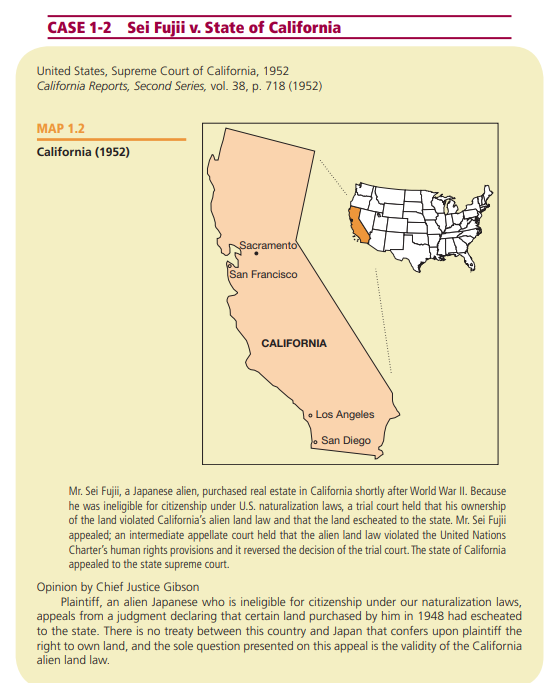
CASE 1-2 Sei Fujii v. State of California United States, Supreme Court of California, 1952 California Reports, Second Series, vol. 38, p. 718 (1952) MAP 1.2 California (1952) Sacramento San Francisco CALIFORNIA Los Angeles San Diego Mr. Sei Fujii, a Japanese alien, purchased real estate in California shortly after World War II. Because he was ineligible for citizenship under U.S. naturalization laws, a trial court held that his ownership of the land violated California's alien land law and that the land escheated to the state. Mr. Sei Fujii appealed; an intermediate appellate court held that the alien land law violated the United Nations Charter's human rights provisions and it reversed the decision of the trial court. The state of California appealed to the state supreme court. Opinion by Chief Justice Gibson Plaintiff, an alien Japanese who is ineligible for citizenship under our naturalization laws, appeals from a judgment declaring that certain land purchased by him in 1948 had escheated to the state. There is no treaty between this country and Japan that confers upon plaintiff the right to own land, and the sole question presented on this appeal is the validity of the California alien land law. United Nations Charter It is first contended that the land law has been invalidated and superseded by the provisions of the United Nations Charter pledging the member nations to promote the observance of human rights and fundamental freedoms without distinction as to race. Plaintiff relies on statements in the preamble and in Articles 1, 55, and 56 of the Charter... It is not disputed that the Charter is a treaty, and our federal Constitution provides that treaties made under the authority of the United States are part of the supreme law of the land and that the judges in every state are bound thereby. A treaty, however, does not automatically supersede local laws which are inconsistent with it unless the treaty provisions are self-executing. In the words of Chief Justice Marshall: a treaty is to be regarded in the courts of justice as equivalent to an act of the Legislature, whenever it operates of itself, without the aid of any legislative provision. But when the terms of the stipulation import a contractwhen either of the parties engages to perform a particular act, the treaty addresses itself to the political, not the judicial department, and the Legislature must execute the contract, before it can become a rule for the court." In determining whether a treaty is self-executing, courts look to the intent of the signatory parties as manifested by the language of the instrument, and, if the instrument is uncertain, recourse may be had to the circumstances surrounding its execution. ... In order for a treaty provision to be operative without the aid of implementing legislation and to have the force and effect of a statute, it must appear that the framers of the treaty intended to prescribe a rule that, standing alone, would be enforceable in the courts.... It is clear that the provisions of the preamble and of Article 1 of the Charter which are claimed to be in conflict with the alien land law are not self-executing. They state general pur- poses and objectives of the United Nations Organization and do not purport to impose legal obligations on the individual member nations or to create rights in private persons. It is equally clear that none of the other provisions relied on by plaintiff is self-executing. Article 55 declares that the United Nations "shall promote . . . universal respect for all without distinction as to race, sex, language, or religion," and in Article 56, the member nations "pledge themselves to take joint and separate action in cooperation with the Organization for the achievement of the purposes set forth in Article 55." Although the member nations have obligated themselves to cooperate with the international organization in promoting respect for, and observance of, human rights, it is plain that it was contemplated that future legislative action by the several nations would be required to accomplish the declared objectives, and there is nothing to indicate that these provisions were intended to become rules of law for the courts of this country upon the ratification of the Charter. The language used in Articles 55 and 56 is not of the type customarily employed in trea- ties which have been held to be self-executing and to create rights and duties in individuals. For example, [in many cases considered by the U.S. Supreme Court) ... treaty provisions were enforced without implementing legislation where they prescribed in detail the rules governing rights and obligations of individuals or specifically provided that citizens of one nation shall have the same rights while in the other country as are enjoyed by that country's own citizens. It is significant to note that when the framers of the Charter intended to make certain provi- sions effective without the aid of implementing legislation they employed language which is clear and definite and manifests that intention. For example, Article 104 provides: "The organization shall enjoy in the territory of each of its members such legal capacity as may be necessary for the exercise of its functions and the fulfillment of its purposes." Article 105 provides: "1. The organization shall enjoy in the territory of each of its members such privileges and immunities as are necessary for the fulfillment of its purposes. 2. Representatives of the members of the United Nations and officials of the organization shall similarly enjoy such privileges and immunities as are necessary for the independent exercise of their functions in connection with the organization." In Curran v. City of New York, these articles were treated as being self-executory.... The provisions in the Charter pledging cooperation in promoting observance of fundamental freedoms lack the mandatory quality and definiteness which would indicate an intent to create justiciable rights in private persons immediately upon ratification. Instead, they are framed as a promise of future action by the member nations. Secretary of State Stettinius, Chairman of the United States delegation at the San Francisco Conference where the Charter was drafted, stated in his report to President Truman that Article 56 "pledges the various countries to cooperate with the organization by joint and separate action in the achievement of the economic and social CHAPTER 1 INTRODUCTION TO INTERNATIONAL AND COMPARATIVE LAW tate objectives of the organization without infringing upon their right to order their national affairs according to their own best ability, in their own way, and in accordance with their own political and economic institutions and processes." The same view was repeatedly expressed by delegates of other nations in the debates attending the drafting of Article 56.... The humane and enlightened objectives of the United Nations Charter are, of course, enti- tled to respectful consideration by the courts and Legislatures of every member nation, since that document expresses the universal desire of thinking men for peace and for equality of rights and opportunities. The Charter represents a moral commitment of foremost importance, and we must not permit the spirit of our pledge to be compromised or disparaged in either our domestic or foreign affairs. We are satisfied, however, that the Charter provisions relied on by Plaintiff were not intended to supersede existing domestic legislation, and we cannot hold that they operate to invalidate the alien land law. political entity com- rising a territory, a opulation, a govern- ment capable of entering ato international rele Fourteenth Amendment of the Federal Constitution The next question is whether the alien land law violates the due process and equal protection clauses of the Fourteenth Amendment [of the United States Constitution).... ... The California alien land law is obviously designed and administered as an instrument for effectuating racial discrimination, and the most searching examination discloses no circumstances justifying classification on that basis. There is nothing to indicate that those alien residents who are racially ineligible for citizenship possess characteristics which are dangerous to the legitimate interests of the state, or that they, as a class, might use the land for purposes injurious to public morals, safety or welfare. Accordingly, we hold that the alien land law is invalid as in violation of the Fourteenth Amendment. The judgment of the intermediate appellate court was reversed in part and affirmed in part. Although the United Nations Charter established no rights that applied directly to the plaintiff, the due process and equal protection clauses of the four- teenth Amendment of the U.S. Constitution forbade racial discrimination of the kind contained in the California alien land law. Casepoint (1) A U.S. state law that invalidates a land purchase by a noncitizen violates the goals and aspirations of the UN Charter (especially the principle of nondiscrimination based on national origin); but the UN Charter itself is not "self-executing" that is, it does not automatically become part of U.S. law because it requires additional imple- menting legislation. (2) But the land does not become the property of the State of California through "escheat" because the California law is based on racial discrimination, and this violates the U.S. ConstitutionStep by Step Solution
There are 3 Steps involved in it
1 Expert Approved Answer
Step: 1 Unlock

Question Has Been Solved by an Expert!
Get step-by-step solutions from verified subject matter experts
Step: 2 Unlock
Step: 3 Unlock
 Study Help