







Question: Briefly discuss the sourcing decision cycle framework. How did it impact the outsourcing decisions made by Kellwood? Kellwood's Excerpt from reading: After 13 years, Kellwood,
Briefly discuss the sourcing decision cycle framework. How did it impact the outsourcing decisions made by Kellwood?
Kellwood's Excerpt from reading:
"After 13 years, Kellwood, an American apparel maker, ended its soups?to?nuts IS outsourcing arrangement with EDS. The primary focus of the original outsourcing contract was to integrate 12 individually acquired units with different systems into one system. Kellwood had been satisfied enough with EDS's performance to renegotiate the contract in 2002 and 2008, even though at each renegotiation point, Kellwood had considered bringing the IS operations back in?house or backsourcing. The 2008 contract iteration resulted in a more flexible $105 million contract that EDS estimated would save Kellwood $2 million in the first year and $9 million over the remaining contract years. But the situation at Kellwood had changed drastically.
In 2008, Kellwood had been purchased by Sun Capital Partners and taken private. The chief operating officer (COO), who was facing a mountain of debt and Kellwood's possible bankruptcy, wanted to consolidate and bring the operations back in?house to give some order to the current situation and reduce costs. Kellwood was suffering from a lack of IS standardization as a result of its many acquisitions. The chief information officer (CIO) recognized the importance of IS standardization and costs, but she was concerned that the transition from outsourcing to insourcing would cause serious disruption to IS service levels and project deadlines if it went poorly.
Kellwood hired a third?party consultant to help it explore the issues and decided that backsourcing would save money and respond to changes caused by both the market and internal forces. Kellwood decided to backsource and started the process in late 2009. It carefully planned for the transition, and the implementation went smoothly. By performing streamlined operations in?house, it was able to report an impressive $3.6 million savings, or about 17% of annual IS expenses after the first year.1
Then in 2016, Kellwood was purchased by new owners who decided to close the data center and move the insourced operations to the cloud. The cloud provider enables Kellwood high scalability?to be able to adjust their IT costs upward and downward according to their monthly needs. As the clothing industry has high seasonal fluctuation, that flexibility can increase management's ability to control spending.2
Kellwood's decisions to outsource IS operations, then to bring them back in?house, and finally move them to the cloud were based on a series of factors. These factors, similar to those used by many companies in their sourcing decisions, are discussed later in this chapter.
The global outsourcing market has been growing steadily. Companies of all sizes pursue outsourcing arrangements, and many multimillion?dollar deals have been widely publicized. As more companies adopt outsourcing as a means of controlling IS costs and acquiring "best?of?breed" capabilities, managing these supplier relationships has become increasingly important. IS departments must maximize the benefit of these relationships to the enterprise and pre?empt problems that might occur. Failure in this regard could result in deteriorating quality of service, loss of competitive advantage, costly contract disputes, low morale, and loss of key personnel.
How IS services are provided to a firm has become an important strategic, as well as tactical, discussion. As briefly mentioned in Chapter 6, there are numerous alternatives to sourcing computing power, applications, and infrastructure. This chapter examines the sourcing cycle to consider the full range of decisions related to who should perform the IS work of an organization. The cycle begins with a decision to make or buy information services and products. Once the decision to make or buy has been finalized, a series of questions must be answered about where and how these services should be delivered or products developed. The discussion in this chapter is built around the Sourcing Decision Cycle framework discussed in the next section. Considering the answers to sourcing questions can help explain a number of terms associated with sourcing: insourcing, outsourcing, cloud computing, full outsourcing, selective outsourcing, crowdsourcing, multisourcing, onshoring, offshoring, nearshoring, farshoring, and backsourcing. For each type of sourcing decision, the risks, or likelihood of something negative occurring as a result of the decision, are discussed, and some steps that can be taken to manage the risks are proposed."
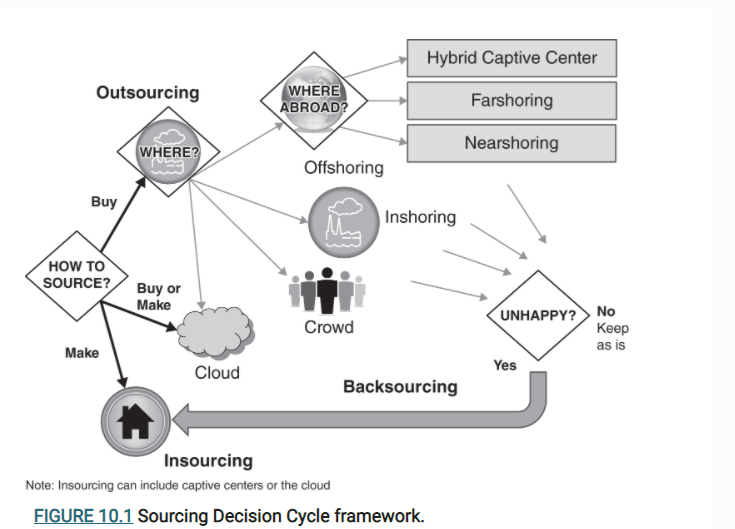
Hybrid Captive Center Outsourcing WHERE ABROAD? Farshoring WHERE? Nearshoring Offshoring Buy Inshoring HOW TO SOURCE? Buy or Make No Crowd UNHAPPY? Keep as is Make Cloud Yes Backsourcing Insourcing Note: Insourcing can include captive centers or the cloud FIGURE 10.1 Sourcing Decision Cycle framework
Step by Step Solution
There are 3 Steps involved in it

Get step-by-step solutions from verified subject matter experts
 Study Help