







Question: Briefly explain the difference between shareholder value added and accounting value added (earnings). The following formula is often used to value shares: Value of equity
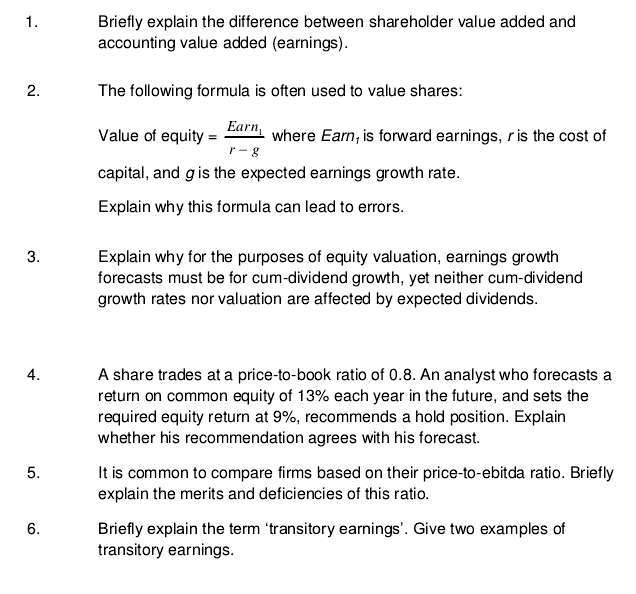
Briefly explain the difference between shareholder value added and accounting value added (earnings). The following formula is often used to value shares: Value of equity = Earn_1/r - g where Earn_1 is forward earnings, r is the cost of capital, and g is the expected earnings growth rate. Explain why this formula can lead to errors. Explain why for the purposes of equity valuation, earnings growth forecasts must be for cum-dividend growth, yet neither cum-dividend growth rates nor valuation are affected by expected dividends. A share trades at a price-to-book ratio of 0.8. An analyst who forecasts a return on common equity of 13% each year in the future, and sets the required equity return at 9%, recommends a hold position. Explain whether his recommendation agrees with his forecast. It is common to compare firms based on their price-to-ebitda ratio. Briefly explain the merits and deficiencies of this ratio. Briefly explain the term 'transitory earnings'. Give two examples of transitory earnings
Step by Step Solution
There are 3 Steps involved in it

Get step-by-step solutions from verified subject matter experts
 Study Help