Bscom/350T
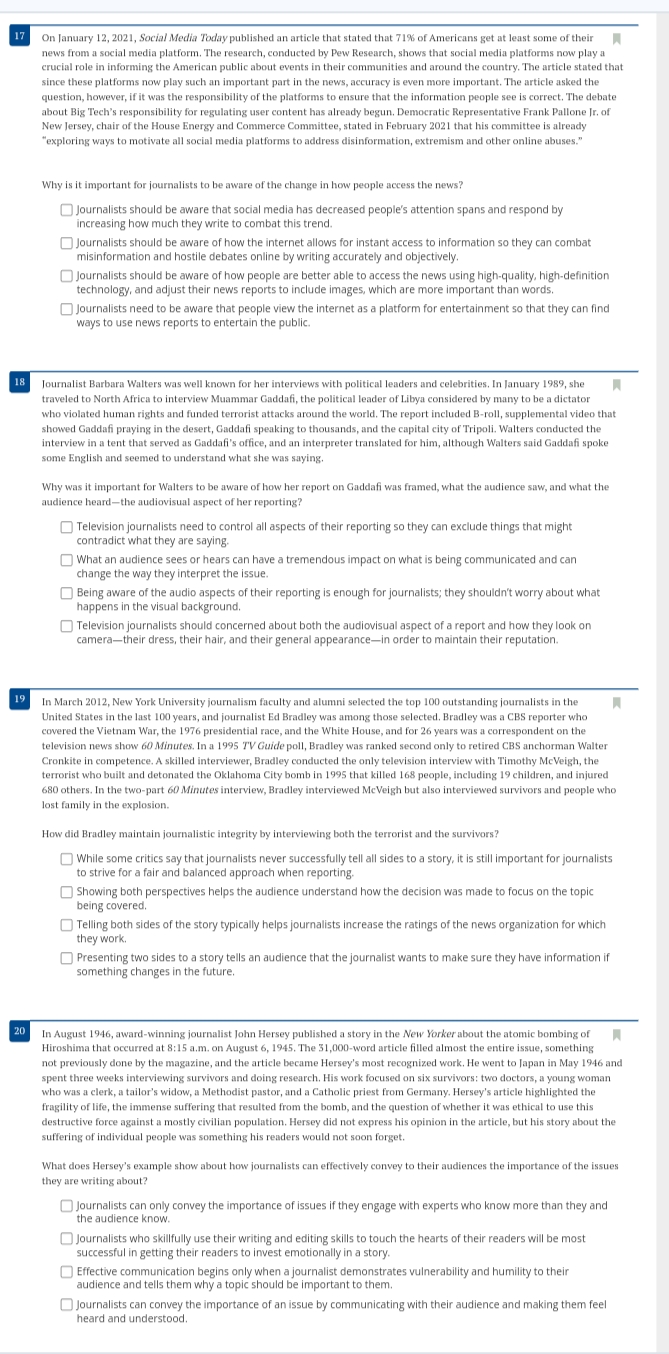
58 N N N N . 0 LTE Back to my LMS Week 4 Summative Assessment Choose the best answer for each question. You will have two attempts for this assessment. Points: 100 v Your Submission: Started on May 28 at 10:34 On April 14, 1912, the steamship Titanic sank after hitting an iceberg in the North Atlantic. Information about this event was released quickly, but it was often wrong. Incorrect headlines included the Detroit News's "1,241 Missing, 868 Saved"; the New York Herald's "The Titanic Sinks with 1,800 on Board; only 675, Mostly Women and Children, Saved"; and the New York Tribune's "340 Perish as Titanic Sinks; Only 886, Mostly Women and Children, Rescued." Based on fake telegraphs, some reports also stated the Titanic was making its way under its own power to Halifax. "Unfortunately, America is full of amateur wireless telegraphists who have put up their own installations. Some of these men are held for the bogus messages," the New York Times reported. Why should journalists be more concerned about accurately reporting the news rather than being the first to report it, as several newspapers did when reporting on the Titanic? Reporting the news accurately should always be the goal of journalists because they want their audience to like them. )A journalist who accurately reports the news is more likely to win awards for their news organization. Getting things right is the foundation on which news organizations build trust with their audiences. )Journalists should be concerned about telling the truth in their reporting in order to decrease partisanship and polarization among their audience. In February 2014, reporter Ben Adler addressed a problem about old stories going viral on social media because readers mistakenly think the stories, which they missed the first time around, are breaking news. Adler explained that internet users were sharing a year-old report that New York City was going to get 30 inches of snow during the upcoming weekend. People didn't check the date of the report, and even Gawker, the New York City-based blog that ran the report the year before, erroneously linked it again after seeing all the traffic the article was getting- What journalistic practice could Gawker have used to prevent the confusion? O)Journalists at Gawkers should archive their articles as news develops as evidence in case of lawsuits against the organization. )Journalists at Gawker should remove all old articles from the web to ensure that people know what news is current. )Journalists at Gawker should timestamp articles to keep readers accurately informed about what is current news and what is in the past. Journalists at Gawker should be more considerate of the language they use in articles in order to preserve relevance for future readers. 3 In February 2020, the Daily Camera, a daily newspaper in Boulder, Colorado, reported that several police departments in Colorado began to encrypt the messages on its radios and police scanners so that the public, including news organizations, did not have access to details of events as they were happening. Journalists have used police scanners to gather information on breaking news for many years. The new encryption meant that the public could no longer listen in, which is something a shooter had done in 2015 when he killed three people and injured nine others at a Planned Parenthood clinic in Colorado Springs. A bill, which has not yet passed, to allow journalists access to equipment to decrypt the messages was presented in the Colorado House of Representatives. In the meantime, police departments and media in some areas have reached verbal agreements that allow news organizations access to equipment so they can monitor what's happening in communities. There are inherent risks to using information from police scanners in a news report. What should a journalist do when they have gained information via a police scanner to mitigate these risks? O)The information should be sent to other news organizations immediately to ensure free access to information. [) The information should be tracked to the police officer who said it to ensure the reliability of the source. The journalist should post the information on social media and provide updates with each new message over the scanner to ensure timeliness. O) The journalist should confirm the truth of the information before reporting it to ensure accuracy. On April 5, 2015, Rolling Stone retracted a story published on November 19, 2014, titled "A Rape on Campus." The original article stated that a University of Virginia (UVA) student, Jackie Coakley, was gang raped at a Phi Kappa Phi fraternity party as part of a fraternity initiation ritual. Following the release of the news article, written by reporter Sabrina Erdely, the Charlottesville, VA, police told the university in January 2015 that they had failed to find any corroborating evidence for the rape. Other news organizations, most notably the Washington Post, also investigated the claims and found that Erdely did not contact any of the men accused in the rape and did not speak to friends of the accused, although she attributed dialogue to them. Since then, reports have been released that Jackie may have lied about parts of the story to try to get the attention and affection of a fellow student. The Poynter Institute gave the article the "Error of the Year" award in journalism. Based on the facts surrounding Rolling Stone's retracted story, why should a journalist thoroughly investigate whether sources are credible before using information from them in news articles? "To report in an honest and balanced manner, it is a journalist's responsibility to identify whether a source is credible and information from them is reliable. A journalist should thoroughly investigate sources so that they can determine if they advance the social agenda of the news organization. Investigating a source enables a journalist to access confidential records that were perhaps not available to witnesses of an event. )Checking to make sure a source is credible gives a journalist additional time to write an article while waiting for confirmation of the source's veracity.5 In August 2014, the Dutch newspaper Volksrant wrote a fake news article announcing the death of Johan Cruyff, a well- known team manager and soccer player. The article was written to test a new app, and, unfortunately, it was published in error. The editor of the paper immediately sent out an apology: "On behalf of Volkskrant, I offer my apologies to Johan Cruyff and anyone who has been upset by this. The app was tested this morning with fake stories, and a technician came up with this as a way of testing a major breaking news story. By mistake it appeared with this headline." What journalistic principle is behind Volkskrant releasing an apology for the false information so quickly? )Mistakes are typically not corrected quickly because the journalist and their news organization must have enough time to create an alternative story to explain the mistake. Apologizing quickly for mistakes that have been made indicates to an audience that a journalist or news organization is interested only in its reputation. )An apology should always be given quickly so that people or organizations don't sue the journalist or their news organization. A news organization should move swiftly to apologize and make corrections in order to limit the damage that comes from spreading misinformation. In February 1989, the CBS news journalist Ed Bradley warned the American public on 60 Minutes about the use of the pesticide Alar, stating, "The most potent cancer-causing agent in our food supply is a substance sprayed on apples to keep them on the trees longer and make them look better." A panic ensued nationwide, with other media quickly reporting that the chemical was especially dangerous for children who drank a lot of apple juice. Apples and apple products were pulled from school cafeterias across the nation, "aided by public appeals and congressional testimony from that well-known molecular biologist Meryl Streep." A few weeks later, however, a Washington Post editorial explained that "a complicated scientific issue was allowed to be decided not by officials charged with protecting the public, on the basis of hard evidence, but by a frightened public acting on incomplete and often erroneous press reports." The use of Alar was banned, and apple sales returned to record levels by 1994. Why is it important for journalists to avoid feeding panic when reporting about current events, such as in the case of the pesticide panic? The public should receive accurate information free of exaggeration so people can calmly make the best decisions for themselves and their loved ones. )Avoiding sensational news will help journalists engage more readers and sell more newspapers. When the public is aware of the facts surrounding any potential dangers, they can engage lawyers and file lawsuits against companies. O)The public should be adequately informed but scared enough that they will change their actions. 7 On July 26, 2020, Alan Miller, editor of the Columbus Dispatch, wrote a news article titled "When big news breaks, it's all hands on deck." In the article, he described the events of July 21, 2020, and how his newsroom handled the breaking news of the day. The day began with the shooting of two Franklin County sheriff's deputies shortly after 8:00 a.m. Personnel dispatched to the scene were two reporters and a photographer. The paper released a short statement on Dispatch.com soon thereafter explaining that something had happened, there were reporters on the scene, and an update would be forthcoming as more information became available. As the reporters worked on the scene, a third reporter helped by checking court documents and placing phone calls. Updates were provided until the seven-hour-long standoff resulted in a woman being arrested at 3:00 p.m. on her roof. The newspaper reported that the deputies, both shot in the back of the leg, were being treated and were in stable condition at a local hospital. That same day, the newspaper was hit with a huge story: the apprehension of Ohio House Speaker Larry Householder, accused in a $60 million racketeering conspiracy that has been called "likely the largest bribery, money laundering scheme ever perpetrated against the people of Ohio." As with the previous story of the day, information was posted on Dispatch.com. One reader said she saw the story updated three times before she finished reading it. Over the course of about five hours, everyone was on deck as the paper ran stories on people involved in the case, reactions from other officials, a review of the company accused of the money laundering, and videos of a U.S. Attorney explaining the case as well as a video of Householder leaving the federal courthouse in Columbus. At the end of the day, the reporting team and editors were planning ongoing coverage for upcoming days. The Columbus Dispatch exemplifies a successful newsroom culture. Why is it important for journalists and news organizations to be prepared to respond to breaking news? )Being prepared to respond to breaking news is important for journalists and news organizations because it is important to always be the first to report, even though all information might not be verified. Preparing in advance allows journalists to have emergency food and water on hand in case they are tied up in reporting the news. O)Journalists who are prepared to cover breaking news are more likely to make mistakes but can easily correct them because of rapid technology. Being prepared and having set standards in advance allows journalists to gather and share information while reporting accurately in a disciplined manner. The Associated Press published a news article on October 5, 2018, stating that a Minnesota TV reporter, James Brunner, was A fired for wearing a "Make America Great Again" hat at a rally for President Donald Trump, an event he was covering in Rochester, MN. A journalist for the Star Tribune, Mark Vancleave, took a picture of Brunner wearing the MAGA hat and posted it on Twitter. The news director for KTTC-TV, Noel Sederstrom, said the TV station does not allow staff members to wear political campaign clothing while on assignment. Because of the violation of the news organization's policy, the reporter was fired. How might this policy help journalists be aware of and minimize their own biases in reporting? )Self-awareness of biases is important for journalists who wish to be selected for diversity recognition awards. )A journalist should always speak up about what they personally believe so that they can influence others. Journalists who are aware of their political biases can write with more impact and better explain to their audiences how they feel about the events on which they report. )Being aware of their own political biases helps journalists to more thoroughly check their stories for accuracy and transparency to better ensure fairness in reporting.In February 2017, the W place had been dismissed after re-posting comments on the social media platform Medium titled \"Objectivity is dead, and I'm inglon eported that Lewis Wallace, a journalist for American Public Media's A okay with it.\" Wallace wrote, "Neutrality isn't real: Neutrality is impossible for me, and vou should admit that it is for you, too, As a member of a marginalized community ([ am transgender), I've never had the opportunity to pretend | can be 'neutral ' An executive for Marketplace told the Washington Post that Wallace's opposition to neutrality and objectivity was "directly opposed to the company's written guidelines which call for staffers to keep their political views private and to be newtral.\" What is the role of journalists in seeking objectivity and neutrality when reporting the news, in light of the difficulty of truly objective reporting? Journalists who seek to be objective and neutral when reporting the news are often seen as weak by their peers and their editors. When reporting the news, journalists wha remain objective and neutral are more likely to sent on assignment to exotic locations because they can be trusted. [ ] Owbjectivity allows a journalist to provide the facts of the news so that the audience can interpret them on their own, (] When journalists are objective and neutral, they are better able to comply with federal requirements for diversity in newsrooms. On March Z, 2019, Dir, Seuss's 1 15th birthday, journalist Fiona Macdonald of the BEC reported how the beloved children's B author and illustrator started as a political cartoonist during World War 11 and drew pictures that encouraged the United States bo go to war against Hitler's Germany. During the early part of the war, Theodore Geisel {Dr. Seuss's real name) drew approximately 400 cartoons that denounced anti-Semitism, isolationism, and Hitler. Once the U.S. was thoroughly entrenched in the war, he enlisted and, under the direction of Frank Capra, worked on the seven Why We Fight propaganda films. These films were originally intended to educate American soldiers on why the U.S. was involved in the war, but President Franklin D. Roosevelt asked that they also be distributed to the American public. The films were produced in opposition to propaganda produced in Germany and sought to, as Frank Capra said, \"use the enemy's own films to expose their enslaving ends. Let our bows hear the Nazis and the Japs shout their own claims of master-race crudand our fighting men will know why they are in uniform." Geisel was involved in producing propaganda to influence American sentiment toward the war, but MacDonald, the journalist whio covered his contributions, sought only to report on his work. Why was it necessary for MacDonald to avoid producing propaganda? (] Ajournalist who avoids propaganda also greatly reduces the need for their articles to be fact-checked. [ Journalists should provide information that is objective, transparent, and verified by multiple sources rather than seeking an emational response. A journalist should never be involved in reporting news that is propaganda because they could become invalved in conspiracy theories. [_] Rejecting propaganda enables a journalist to present information more simply and aveld stories that are complex in nature. In September 2020, the Public Broadeasting Service (PBS) published an article and a documentary about the legendary n reporter and radio news announcer Walter Winchell, who worked in the media from 1920 until 1963, The PBS article reported how Winchell, widely popular and extremely powerful as a gossip columnist during the first few decades of his career, championed Senator [oseph MeCarthy, a U5, Senator infamous for accusing people of being Communists and Soviet spies, in the 19505, Winchell packed his writing and broadcasts with vindicative attacks and unfounded accusations that resulted in losing sponsors and being sued multiple times. As one of the most controversial journalists of his day, he often used unverified sources, Ongoing public fights in the same decade with the African American singer [esephine Baker and television personality Ed Sullivan turned his audience against him, and his reputation was significantly damaged. When his flagship newspaper, the New York Daily Mirror, ceased publication, Winchell wrote, *I died on October 16, 1963." He died nine years later in California. Why should a news organization require jourmnalists to write objectively, accurately, and impartially? (] It trains the public to better identify fake news when they are only presented with objective facts. | It is unethical for a journalist to misrepresent the truth to an audience, and news organizations owe it to the public to ensure that what is published is accurate, [7] 1t is illegal for news organizations and journalists to add their own interpretations in their reporting of the news. (] Ajournalist's First Amendment rights do not cover the reporting of unpopular opinions in the news. In March 2020, writer Richard Papp shared an a the core of the current outery against the media. Regardless of the audience's perspectives and beliefs, they recognize that le on Medium in which he wrote, "In my opinion, editorialized news is at [ they are being influenced when they are trying to get informed.\" A report from CNN on February 9, 2021, about a woman in Minnesota who is "fighting QAnon conspiracies one Instagram story at a time\" is an example. Words and phrases like "horrified and \"preposterous lies\" were used by reporter Stephanie Gallman and wera not part of the direct quotes of the person being interviewed. How can journalists avoid editorializing in their writing, and why is it important to do s0? [ Journalists should avoid editorializing by simply sharing what they clearly believe and relying on their own experiences to gauge what is important to report. Journalists should aveid using words that inject persenal interpretations or opinions so that readers and listeners can draw their own conclusions from the facts that are presented. Journalists should listen to their audience's opinions and share what readers and listeners think instead because the audience wants to hear their own views reflected in the news. Journalists concerned about protecting their jobs should repart only on topics that are not controversial, thus protecting themselves from any chance of showing biases. In 3017, journalists Peregrine Frissell, Ala"s Ibrahim, Sheila Raghavendran, and Avery Yang published an article on the R Asian American journalists Assoctation website titled "Missed deadline: The delayed promise of newsroom diversity.\" The journalists\" investigation of the lack of newsroom diversity focused on newspapers that covered the race riots in 1967, Seven manths after the riots, a presidential commission stated, \"the press has too long basked in a white world looking out of it, if at all, with white men's eyves and white perspective. That is no longer good enough. The painful process of readjustment that is required of the American news media must begin now.\" The journalists collected diversity data of the racial makeuap of the leadership team and newsrooms from five of the largest newspapers in the United States and ones that covered the race riots fifty years before: the Washington Post, the Los Angeles Times, the New Yook Times, the Chicage Tribune, and NPR. Their research found that representation of minorities in leadership and newsroom positions were all below the percentage of minarities in their respective areas. For example, the Washirgton Post's leadership was all white except for one Hispanic editor, while their newsroom was 31 percent minogity. The metropolitan area of Washington D.C.-Adington-Alexandria was 54 percent minority. The news organizations all commented that they were conmitled to increasing diversity amd had made progress, but still had room for improvement. How can having more joumnalists from diverse backgrounds help news organizations better represent the views of the sudiences they serve? Journalists from diverse backgrounds can help their organizations by expanding access to News in communities that align with the journalists' diversity. [} Hiring journalists with diverse backgrounds allows an organization to always hire the best-qualified |oumnallsts regardiess of their gender, race, beliefs, or culture. [_] When a news organization hires journalists with diverse backgrounds, it sends a signal that it is encouraging its employees to get along with one another. "] Having more journalists from diverse backgrounds allows a news organization to advertise that it is more dedicated to diversity than others and reduces government interference. In September 2011, NPR ran a headline for an articl & Muffins, S8 Coffees, 55 Meathalls: ustice Dept. Spending B Rapped.\" NPR reported that the Justice Department s Office of the Inspector General ran an audit of conferences and found that there was \"allowable but . .. extravagant\" spending, at which \"one conference served $16 muffins.\" The incident, called Muffingate, raised questions, and fact-checkers contacted the hotel whe catered the event only to discover that the 516 per persan charge included fresh fruit, colfee, juice, muffing, tax, and gratuity, for an inclusive price of 16 per person.\" The Huifington Post reported at the end of September 2011 that of the 223 articles that were writien about the issue, only 57 explained the cost ar tried to set the record straight. 'Why should news organizations avoid sensationalizing headlines to grab attention and increase ratings? [_] Sensational headlines can be used to draw readers in, but journalists should quickly set the record straight in the first few sentences of an article. [ News organizations that sensationalize headlines are maximizing their prafit margins at the expense of other organizations, and they should be penalized to maintain a free press. [ sensational headlines and news stories deceive the public and decrease the trust they have in the press. [[J Creating sensational headlines to attract new readers should be avoided because these types of readers are more inclined to believe exaggerations and untruths. - The 2019 Pulitzer Prize in the Breaking News Reporting category was awarded to the staif of the Pittsburgh Post-Gazertte W for \"immersive, compassionate coverage of the massicre at Pittsburgh's Tree of Life synagogue that captured the anguish and resilience of a community thrust into grief " Eleven people were killed and sk wounded including four pollee officerson Saturday, October 27, 2018, in Pittsburgh by Robert Gregory Bowers, who has bean charged with 63 federal crimes and 36 state crimes. It was the deadliest attack on a lewish community in the United States. The Posf-Gazette's series of articles presented the facts objectively and also included quates from survivers, people who lived around the synagogue, city and state afficials, and President Trump. How can journalists follow the Pos!-Gagetle in providing balanced reporting that engages the dudience? [ Journalists can use snappy verbiage that excites an audience and sensationalize the news to better engage readers. [ Journalists should stick strictly to the facts and use simple words to best help audiences engage with the news. [ Journalists can include subjective accounts in their writing but alse report objective facts so their readers can better understand what is happening, [T1 Journalists should get to know their audiences by interviewing and developing relationships with people in the area, On February 24, 1945, Associated Press photographer Joe Rosenthal took & picture of Marines belonging to the Z8th R Regiment, 5th Division, raising the U.S. flag on Mount Suribachi on the island of lwo Jima. The photograph won & Pulitzer Prize in 1946, In February 2020, on the 75th anniversary of the event, CNN ran a story about the photograph, describing the effect it had on Ameriea: "It triggered a wave of natbonal hope that [apanese forces would soon be crushed, and peace was near. It spurred millions of Americans to buy war bonds to keep the nation on solid financial footing. Basically, this simple photo was so powerful it helped win World War 117 How can an image like Rosenthal's famous photograph, and elements such as videos and descriptive words, help journalists create greater impact in their news articles? [ Ajoumalist can create the most impact by using photographs to spice up stories that would otherwise be extremely dull. [T when a journalist adds a human element to a story or issue about which they are reporting. the audience connects in a more powerful and emotional way to the story. Overdramatization of events by a journalist will lead audiences to remember better and help them understand events from a certain point of view. [ Journalists should seek to actively manipulate their audience's feelings. thus creating a large emaotional impact and increasing engagement. O Janwary 12, 2021, Social Media Today published an article that stated that 71% of Americans get ot least some of the news from a social media platform, The research, conducted by Pew Research, shows that social media platforms now play a erucial role in informing the American public about events in their communities and around the country, The article stated that since these platforms now play such an important part in the news, accuracy is even more important. The article asked the question, however, if it was the responsibility of the platforms to ensure that the information people see is correct, The debate about Big Tech's responsibility for regulating user content has already begun, Democratic Representative Frank Pallone [r, of New lersey, chair of the House Energy and Commerce Committee, stated in February 2021 that his committee s already \"exploring ways to motivate all social media platforms to address disinformation, extremism and other online abuses.\" Why is it important for journalists to be aware of the change in how people aceess the news? (] Journalists should be aware that social media has decreased people's attention spans and respond by increasing how much they write to combat this trend. [ Journalists should be aware of how the internet allows for instant access to Information so they can combat misinformation and hostile debates online by writing accurately and objectively, j Journalists should be aware of how people are better able to access the news using hlgh-quality, high-definition technology. and adjust their news reports to include images, which are more impartant than words, [ Journalists need to be aware that people view the internet as a platform for entertainment so that they can find wiays to use news reports to entertain the public. lournalist Barbars Walters was well known for her interviews with political leaders and celebrities, In January 1989, she R traveled to North Africa to interview Muammar Guddafi, the political leader of Libva considered by many to be a dictator who violated human rights and funded terrorist attacks around the world, The report included B-roll, supplemental video that showed Gaddafi praying in the desert, Gaddafi speaking to thousands, and the capital city of Tripoli. Walters conducted the interview in a tent that served as Gaddafi's office, and an interpreter translated for him, although Walters said Gaddafi spoke some English and seemed to understand what she was saying, Why was it important for Walters to be aware of how her report on Gaddafi was framed, what the audience saw, and what the audience heard the audiovisual aspect of her reporting? (] Television journalists need to control all aspects of their reporting so they can exclude things that might contradict what they are saying. [ What an audience sees or hears can have a tremendaus impact on what is being communicated and can change the way they interpret the issue. (] Being aware of the audio aspects of their reporting is enough for journalists; they shouldn't worry about what happens in the visual background, (] Television journalists should concerned about both the audiovisual aspect of a report and how they look on cameratheir dress, their hair, and their general appearancein arder to maintain their reputation. Iy March 2012, New York University journalism faculty and alumpi selected the top 100 outstanding journalis the United States in the last 100 years, and journalist Ed Bradley was among those selected. Bradley was a CBES reporter who covered the Vietnam War, the 1976 presidential race, and the White House, and for 26 years was a correspondent on the television news show 60 Minutes. Ina 1995 TV Guide poll, Bradley was ranked second only to retired CBS anchorman Walter Cronkite in competence, A skilled interviewer, Bradley conducted the only television interview with Timothy McVeigh, the terrorist who built and detonated the Oklahoma City bomb in 1995 that killed 168 people, including 19 children, and injured &80 others. In the two-part &0 Minutes interview, Bradley interviewed McVelgh but also interviewed survivors and people who lost family in the explosion. How did Bradley maintain journalistic integrity by interviewing both the terrorist and the survivors? :] While some critics say that journalists never successfully tell all sides to a story, it is still Impanant fnr]ournali sts to strive for a fair and balanced approach when reporting. (] Showing both perspectives helps the audience understand how the decision was made to focus on the topic being covered, [T Telling both sides of the story typically helps journalists increase the ratings of the news arganization for which they work. :] Presenting two sides to a story tells an audience that the ja urnalist wants to make sure they have information if something changes in the future, Iv August 1946, award-winning jourmn John Hersey published a story in the New Yorker nbout the atomic bombing of R Hiroshima that occurred at 8:15 a.m. on August 6, 1945, The 31,000-word article filled almost the entire issue, something not previously done by the magazine, and the article became Hersey's most recognized work, He went to [apan in May 1%46 and spent three weeks interviewing survivors and deing research, His work focused on six survivors: two doctors, a young woman whio was a clerk, a tailor's widow, s Methodist pastor, and a Catholic priest from Germany, Hersey's article highlighted the Tragility of life, the immense suffering that resulted from the bomb, and the question of whether it was ethical to use this destructive force against a mostly eivilian population, Hersey did not express his opinion in the article, but his story about the suffering of individual people was something his readers would not soon forget, What does Hersey's example show about how journalists can effectively convey to their audiences the importance of the issues they are writing about? (] Journalists can only convey the importance of issues if they engage with experts who know more than they and the audience know. [ Journalists who skillfully use their writing and editing skills to touch the hearts of their readers will be most successful in getting their readers to invest emotionally in a story. Effective communication begins only when a journalist demaonstrates vulnerability and humility to their audience and tells them why a topic should be impaortant to them. [ ] Journalists can convey the impartance of an issue by communicating with their audience and making them feel heard and understood