







Question: bubble sort and selection. use python codes from photos kindly provided perform the desktop test in excel of both Codes, Compare, differentiate, and give conclusions.
bubble sort and selection. use python codes from photos kindly provided perform the desktop test in excel of both Codes, Compare, differentiate, and give conclusions. example [45,17,23,67,21] array original . also comment each of the lines of code in the desktop test
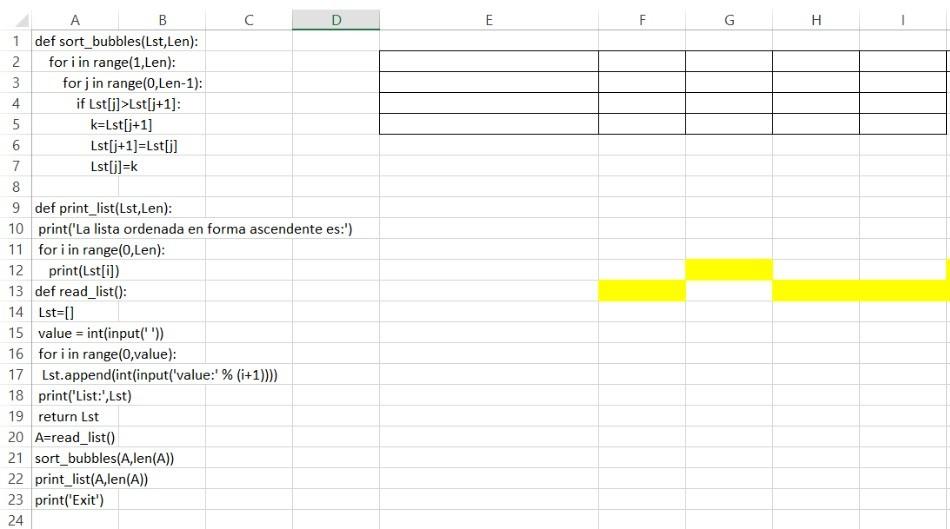
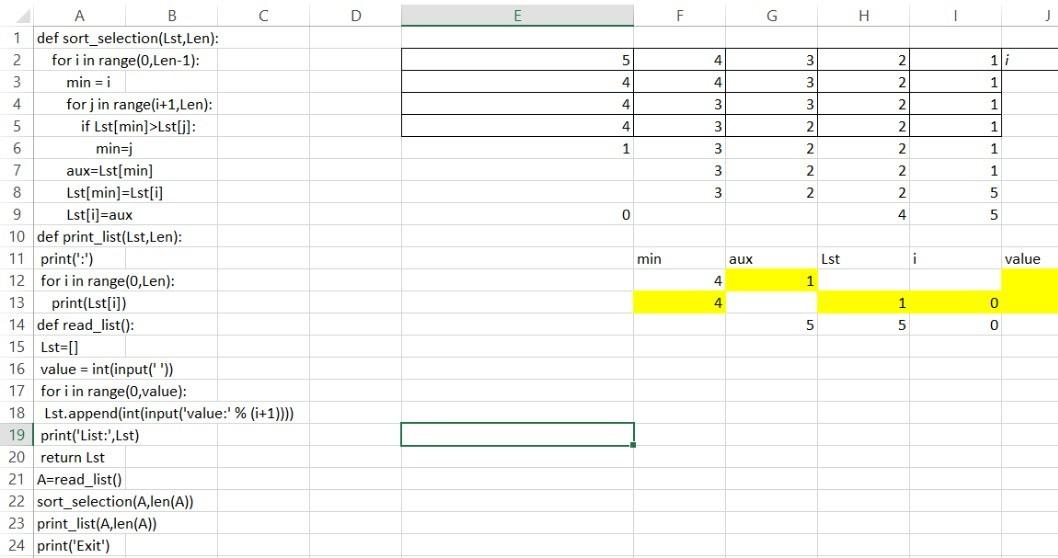
The photos are examples of what the requested desktop test would look like
is scored with zero, the minimum grade if the desktop test is incorrect and if it is not performed in excel
c IT E F G H AN LON B 1 def sort_bubbles(Lst, Len): 2 for i in range(1, Len): 3 forj in range(0, Len-1): 4 if Est[j]>Lst[j+1]: 5 k=Lst[j+1] 6 Lst[j+1)=Lst[j] 7 Lst[i]=k 8 9 def print_list(Lst, Len): 10 print('La lista ordenada en forma ascendente es:') 11 for i in range(0, Len): 12 print(Lst[i]) 13 def read_list(): 14 Lst=[] 15 value = int(input(' ')) 16 for i in range(0,value): 17 st.append(int(input('value:' % (i+1}}}} 18 print('List:',Lst) 19 return Lst 20 A=read_list() 21 sort_bubbles(A,len(A)) 22 print_list(A, len(A)) 23 print('Exit) 24 D E F G H 1 5 4 2 4 4 3 3 2 2 1 i 1 1 1 4 3 4 3 NNNN 2 2 1 3 2 1 3 2 1 3 2 2. 5 5 0 4 min aux Lst i value A B 1 def sort_selection(Lst,Len): 2 for i in range(0, Len-1): 3 min = i 4 for jin range(i+1, Len): 5 if Lst[min]>Lst[i]: 6 min=j 7 aux=Lst[min] 8 Lst[min]=Lst[i] 9 Lst[i]=aux 10 def print_list(Lst, Len): 11 print(':') 12 for i in range(0, Len): 13 print(Lst[i]) 14 def read_list(): 15 Lst=[] 16 value = int(input(' ')) 17 for i in range(0,value): 18 Lst.append(int(input('value:' % (i+1)))) 19 print("List:',Lst) 20 return Lst 21 A=read_list() 22 sort_selection(A.len(A)) 23 print_list(A, len(A)) 24 print('Exit") 4 1 4 1 0 5 5 0 c IT E F G H AN LON B 1 def sort_bubbles(Lst, Len): 2 for i in range(1, Len): 3 forj in range(0, Len-1): 4 if Est[j]>Lst[j+1]: 5 k=Lst[j+1] 6 Lst[j+1)=Lst[j] 7 Lst[i]=k 8 9 def print_list(Lst, Len): 10 print('La lista ordenada en forma ascendente es:') 11 for i in range(0, Len): 12 print(Lst[i]) 13 def read_list(): 14 Lst=[] 15 value = int(input(' ')) 16 for i in range(0,value): 17 st.append(int(input('value:' % (i+1}}}} 18 print('List:',Lst) 19 return Lst 20 A=read_list() 21 sort_bubbles(A,len(A)) 22 print_list(A, len(A)) 23 print('Exit) 24 D E F G H 1 5 4 2 4 4 3 3 2 2 1 i 1 1 1 4 3 4 3 NNNN 2 2 1 3 2 1 3 2 1 3 2 2. 5 5 0 4 min aux Lst i value A B 1 def sort_selection(Lst,Len): 2 for i in range(0, Len-1): 3 min = i 4 for jin range(i+1, Len): 5 if Lst[min]>Lst[i]: 6 min=j 7 aux=Lst[min] 8 Lst[min]=Lst[i] 9 Lst[i]=aux 10 def print_list(Lst, Len): 11 print(':') 12 for i in range(0, Len): 13 print(Lst[i]) 14 def read_list(): 15 Lst=[] 16 value = int(input(' ')) 17 for i in range(0,value): 18 Lst.append(int(input('value:' % (i+1)))) 19 print("List:',Lst) 20 return Lst 21 A=read_list() 22 sort_selection(A.len(A)) 23 print_list(A, len(A)) 24 print('Exit") 4 1 4 1 0 5 5 0
Step by Step Solution
There are 3 Steps involved in it

Get step-by-step solutions from verified subject matter experts
 Study Help