Question: Bullet point three important points that stood out to you from the reading and how they add to your learning about working with families and
Bullet point three important points that stood out to you from the reading and how they add to your learning about working with families and toddlers.
Share two things from class that stood out to you and how they add to your learning about working with families and toddlers
Two new vocabulary words, write them, define them, and then describe how you would use them.
Weekly Quote:
This can be a statement from readings, class lecture, peers, guest lecture etc. This is anything that stood out to you.
References:
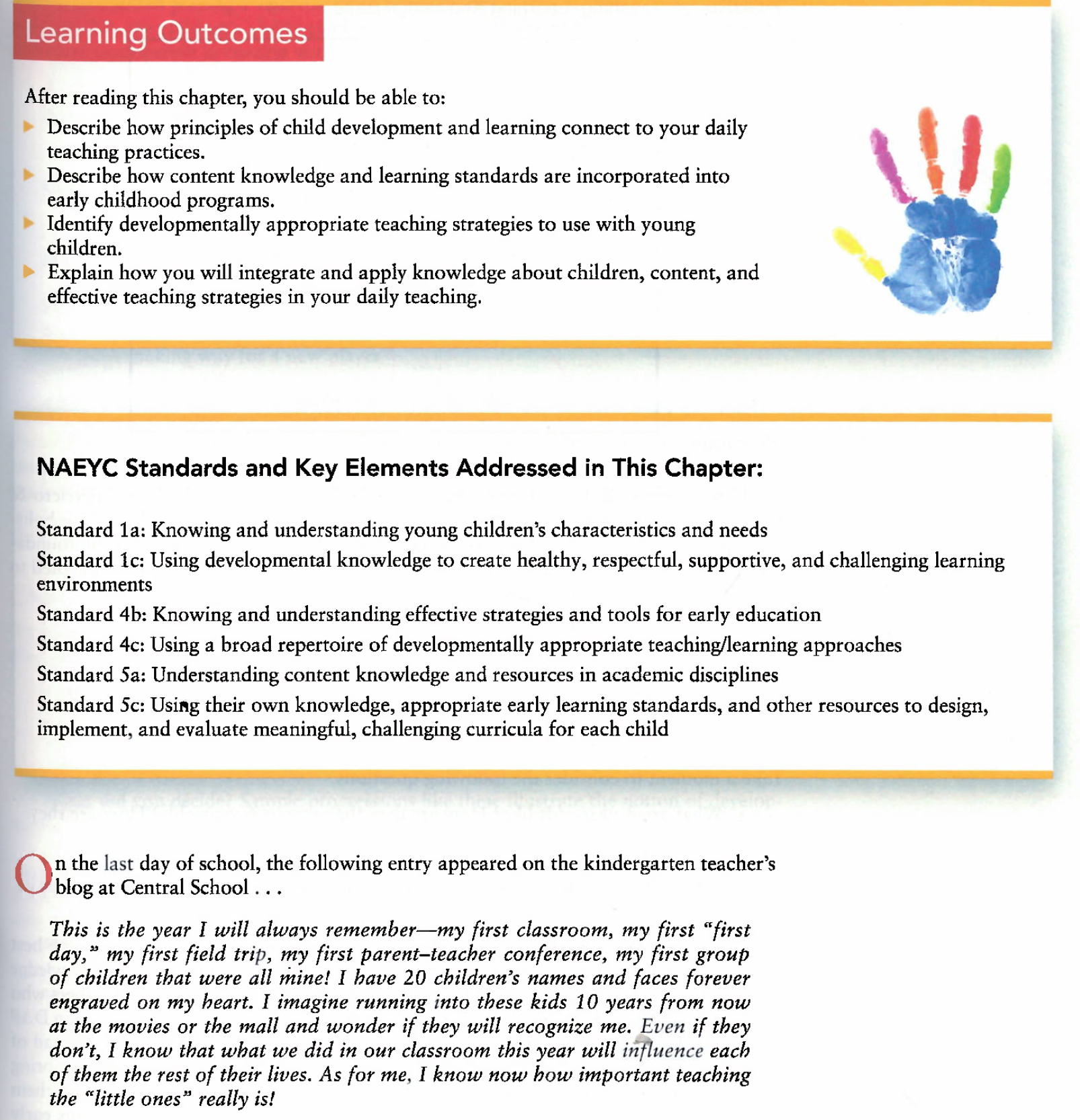
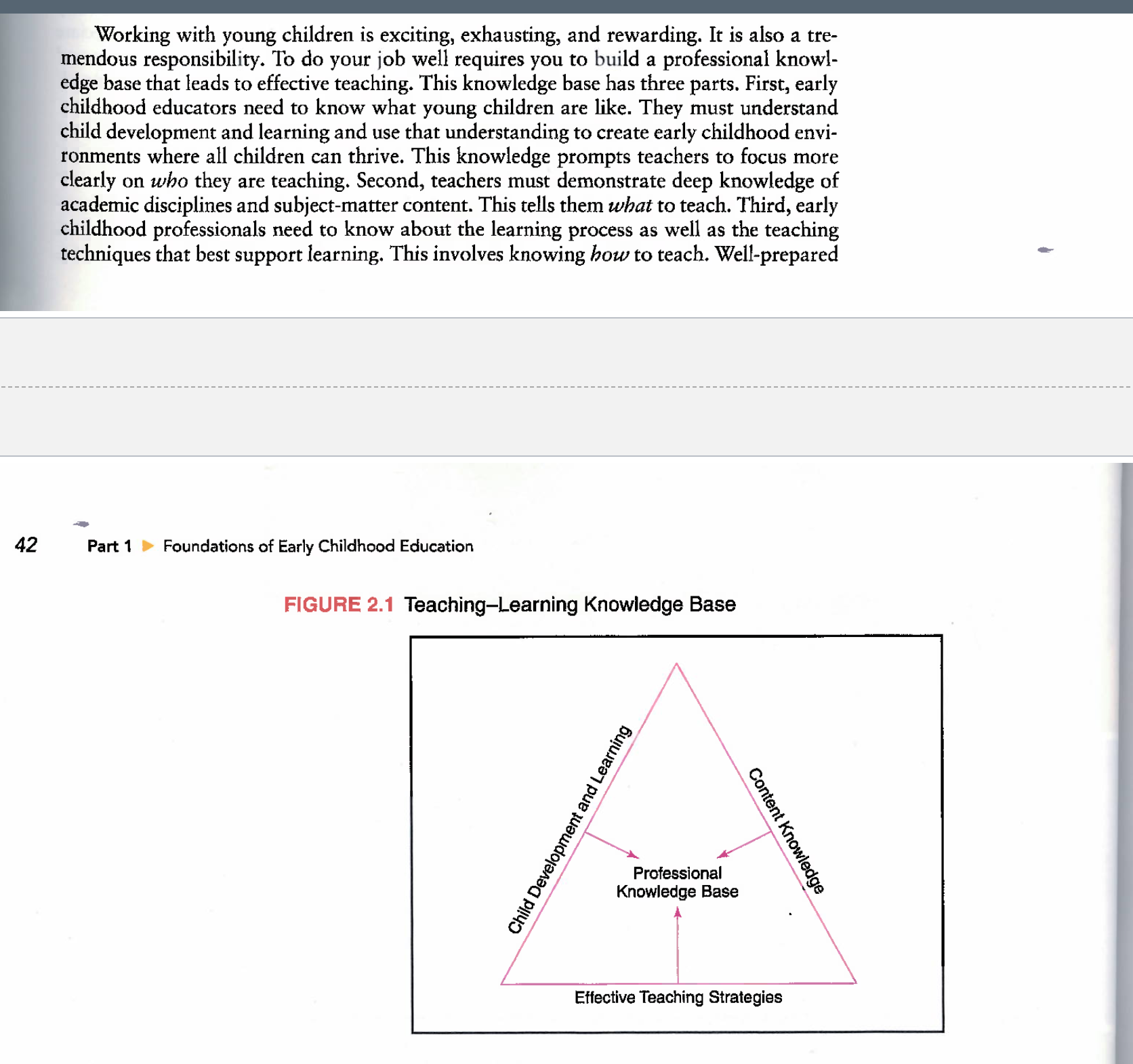
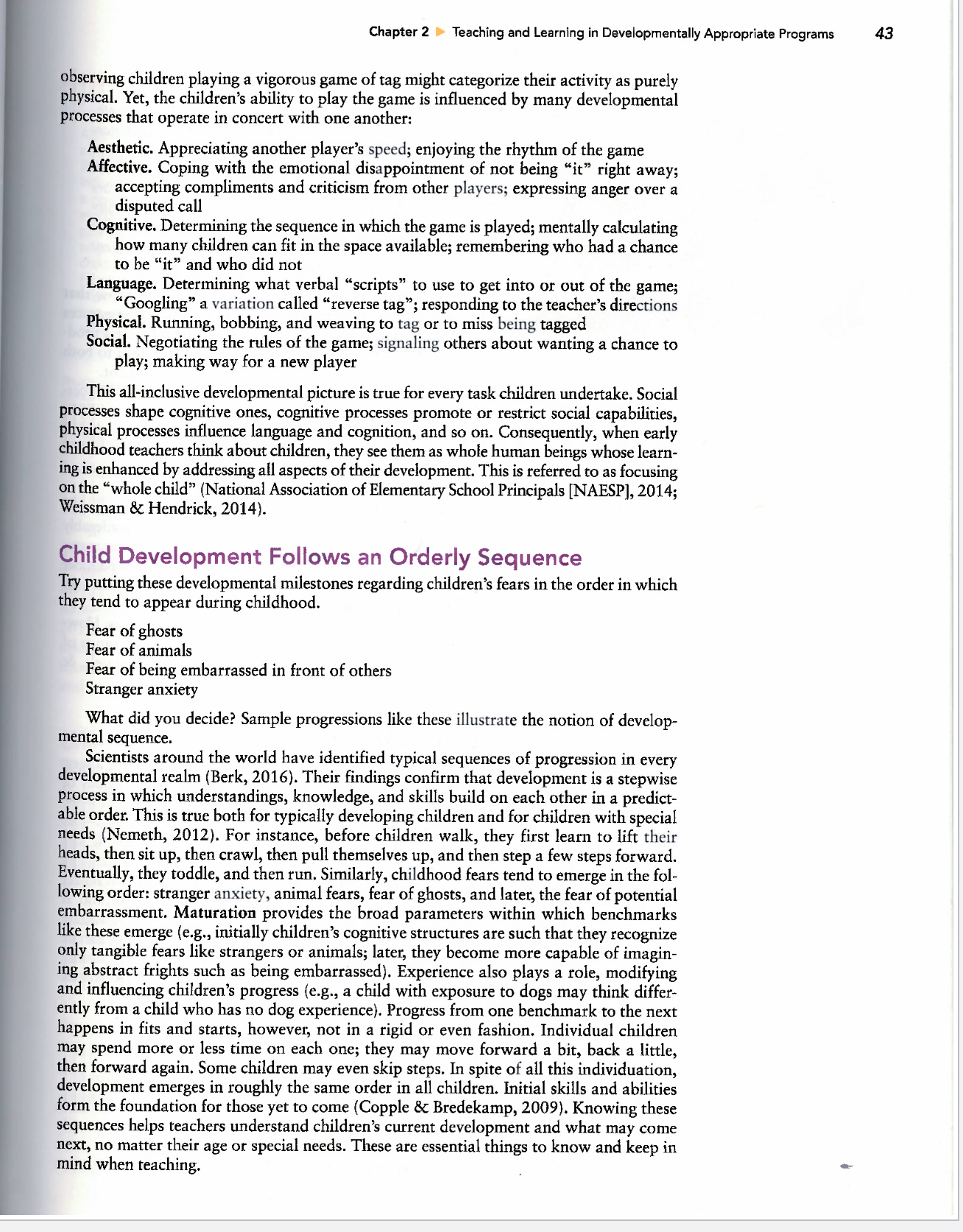
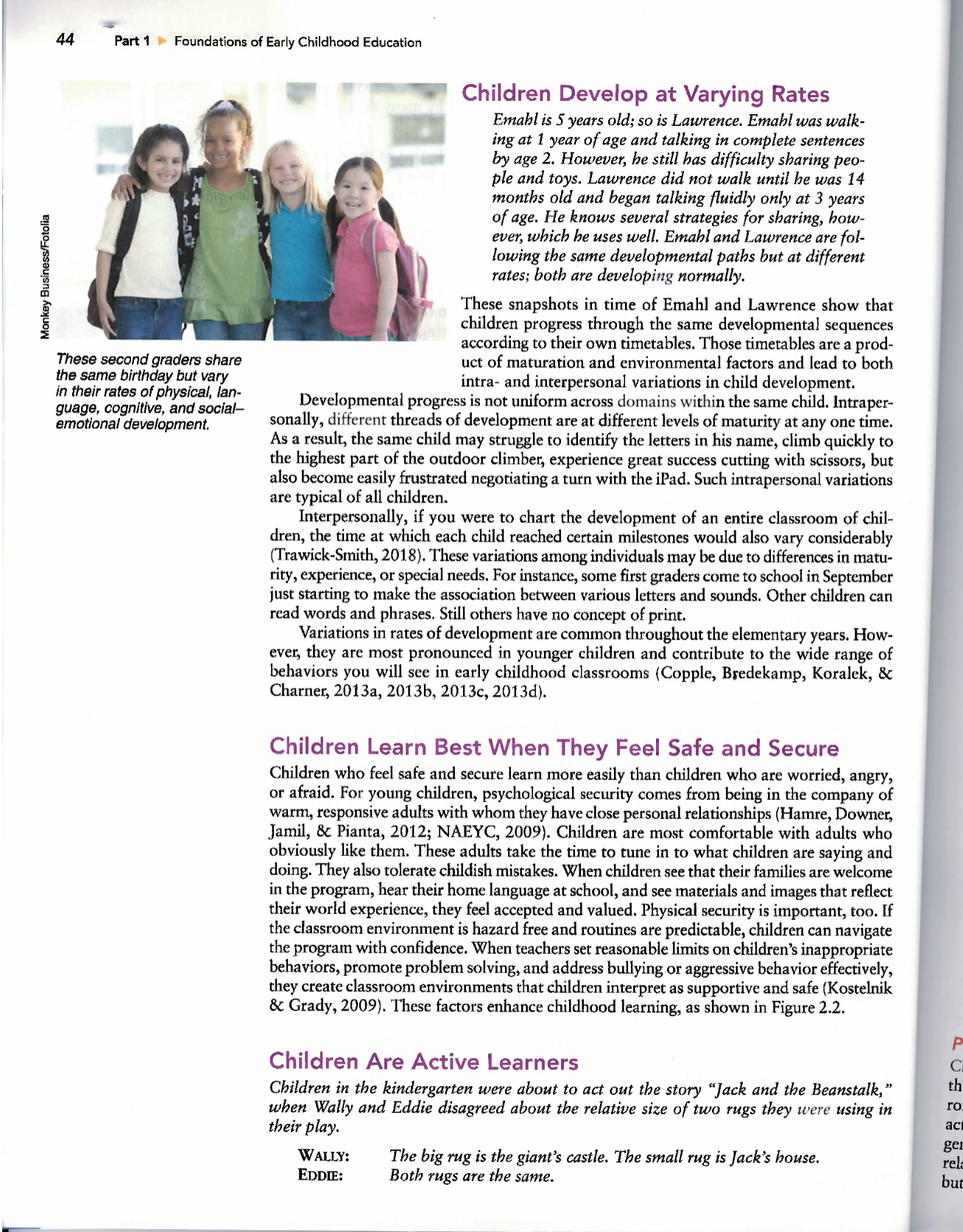
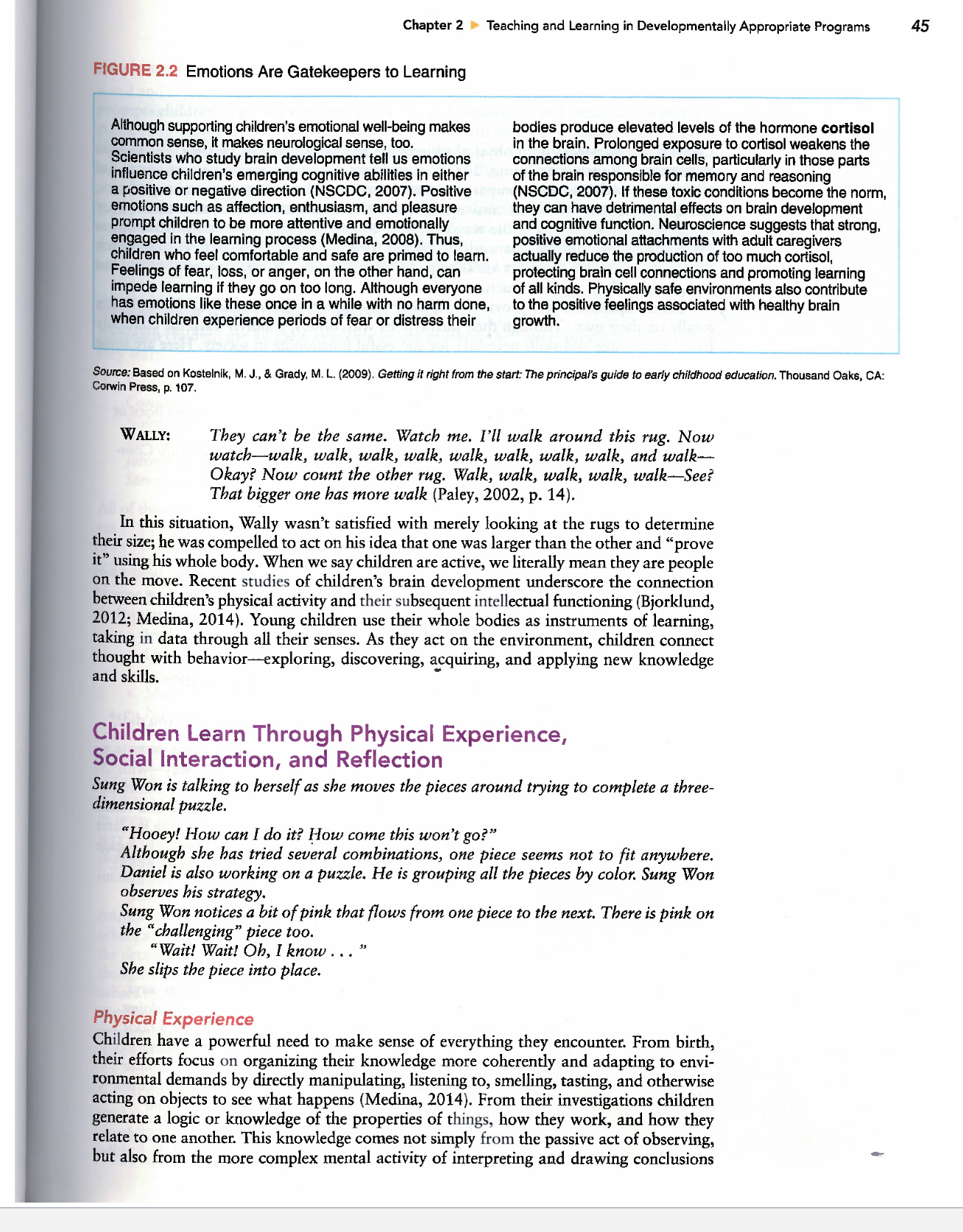
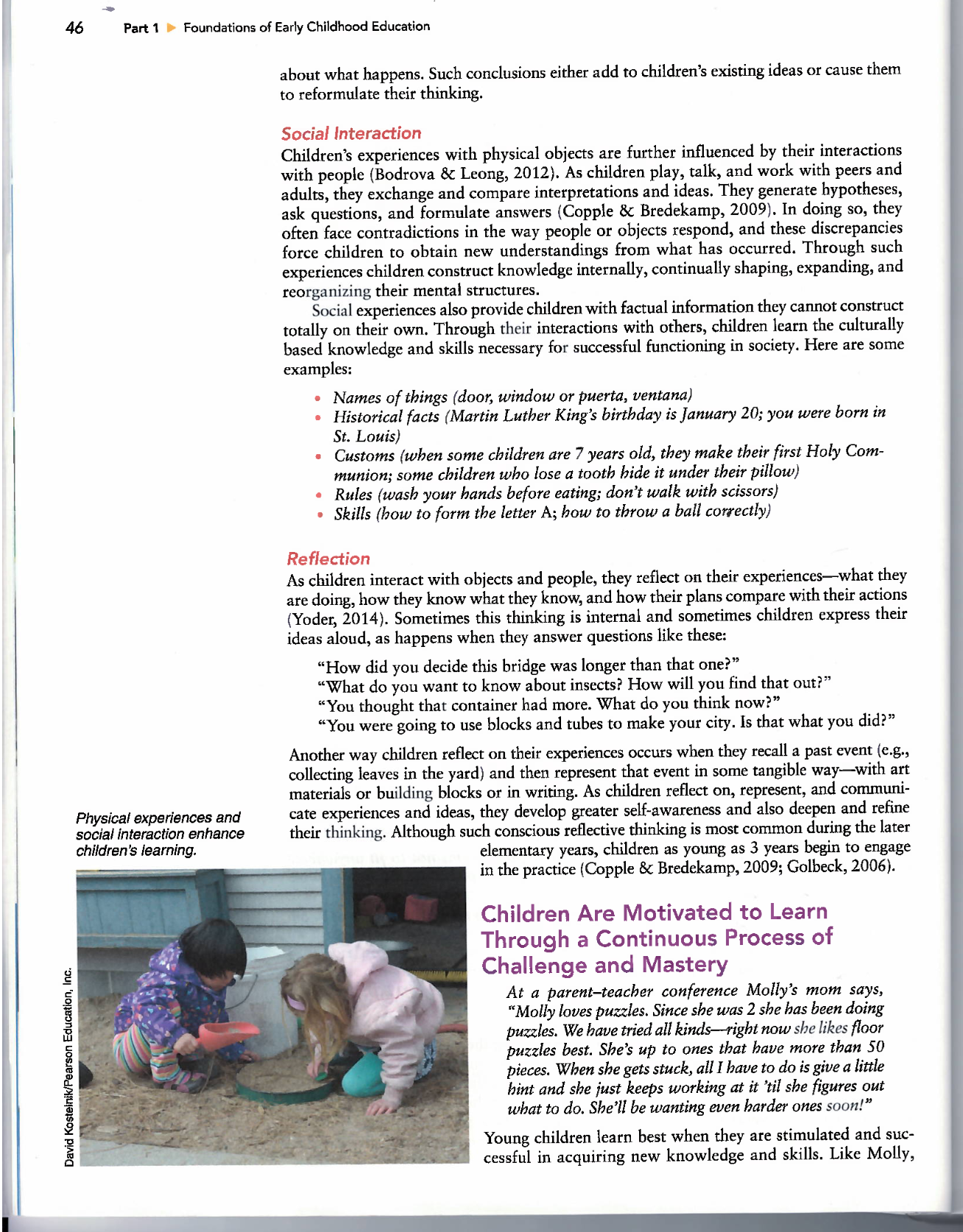
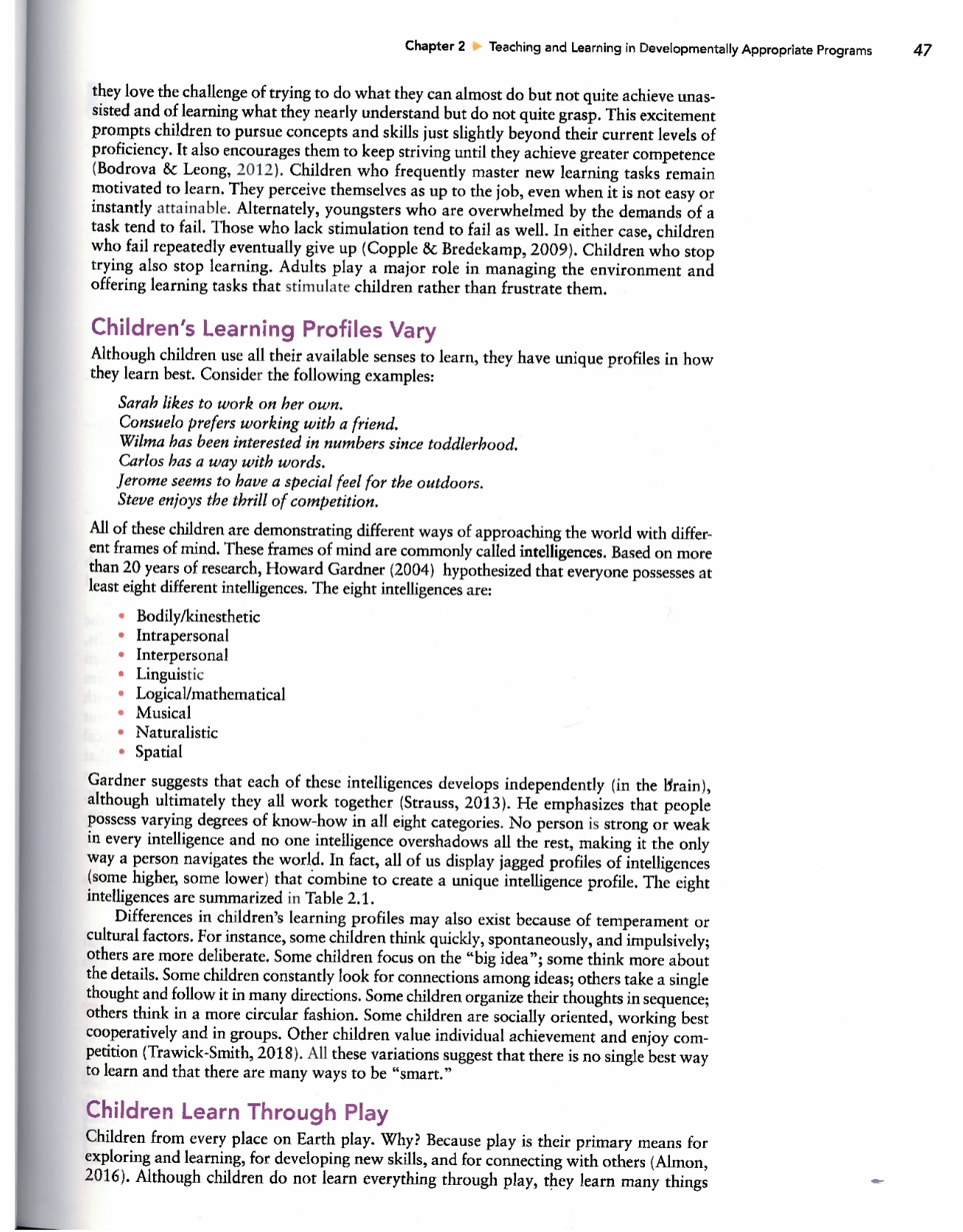
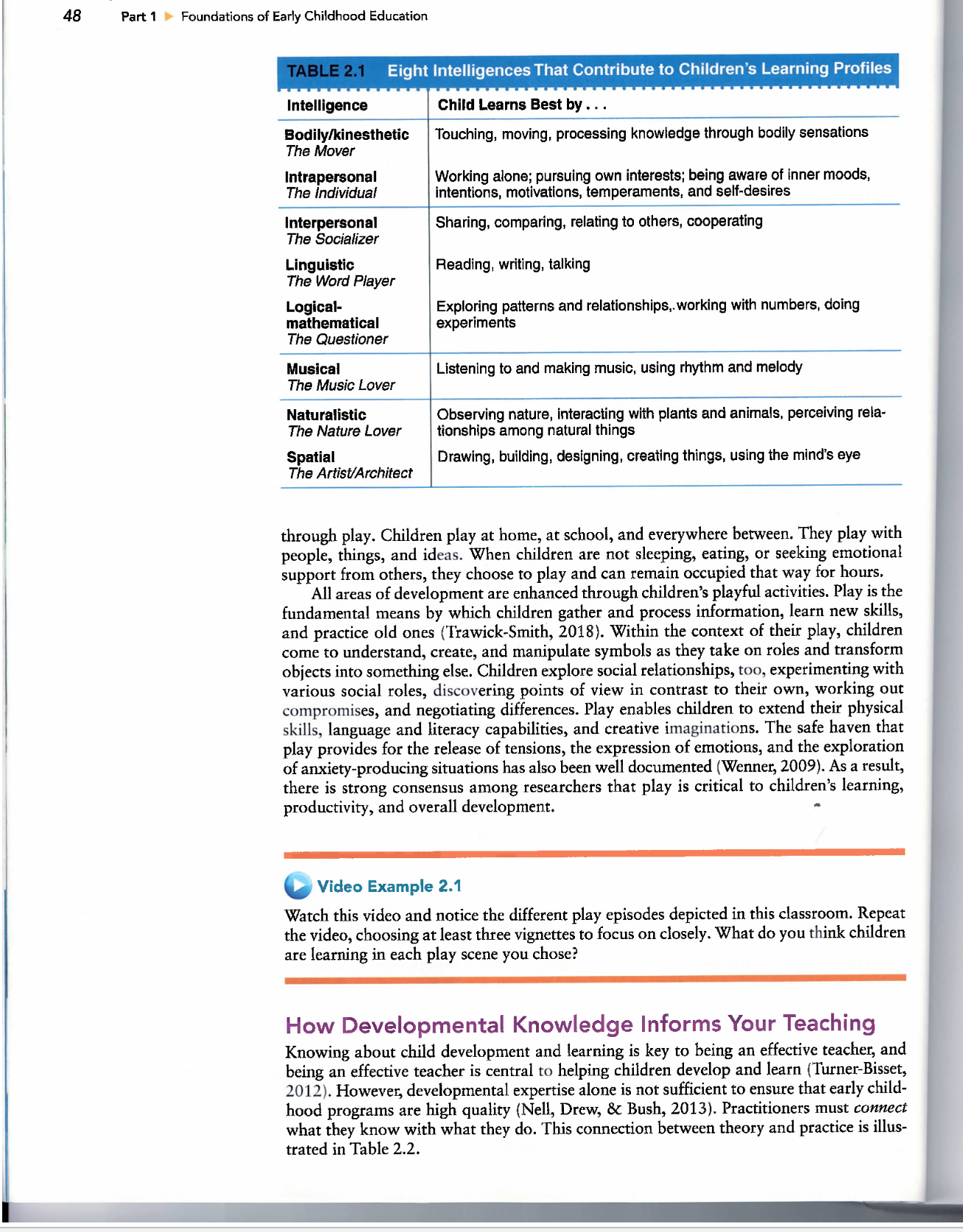
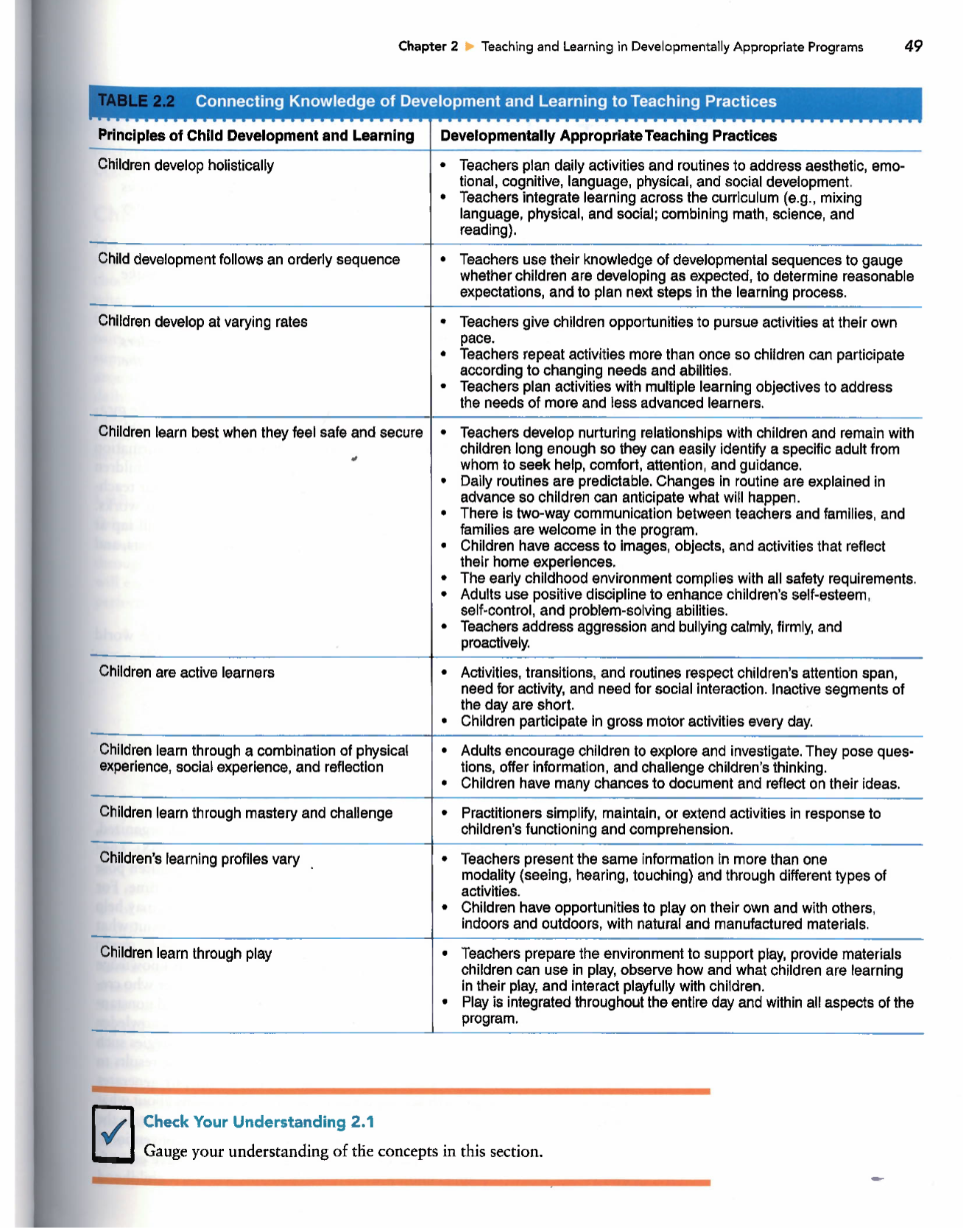
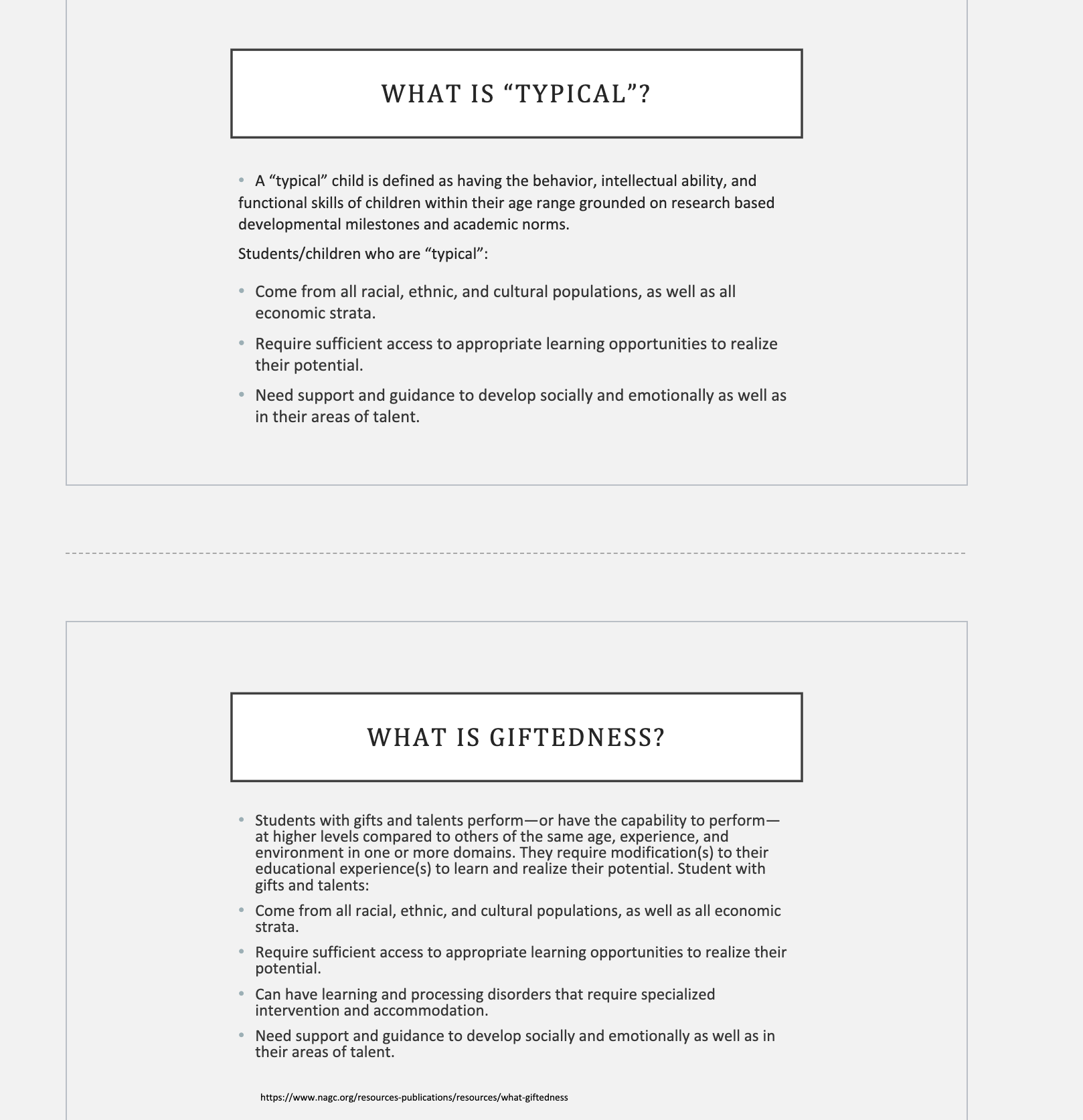
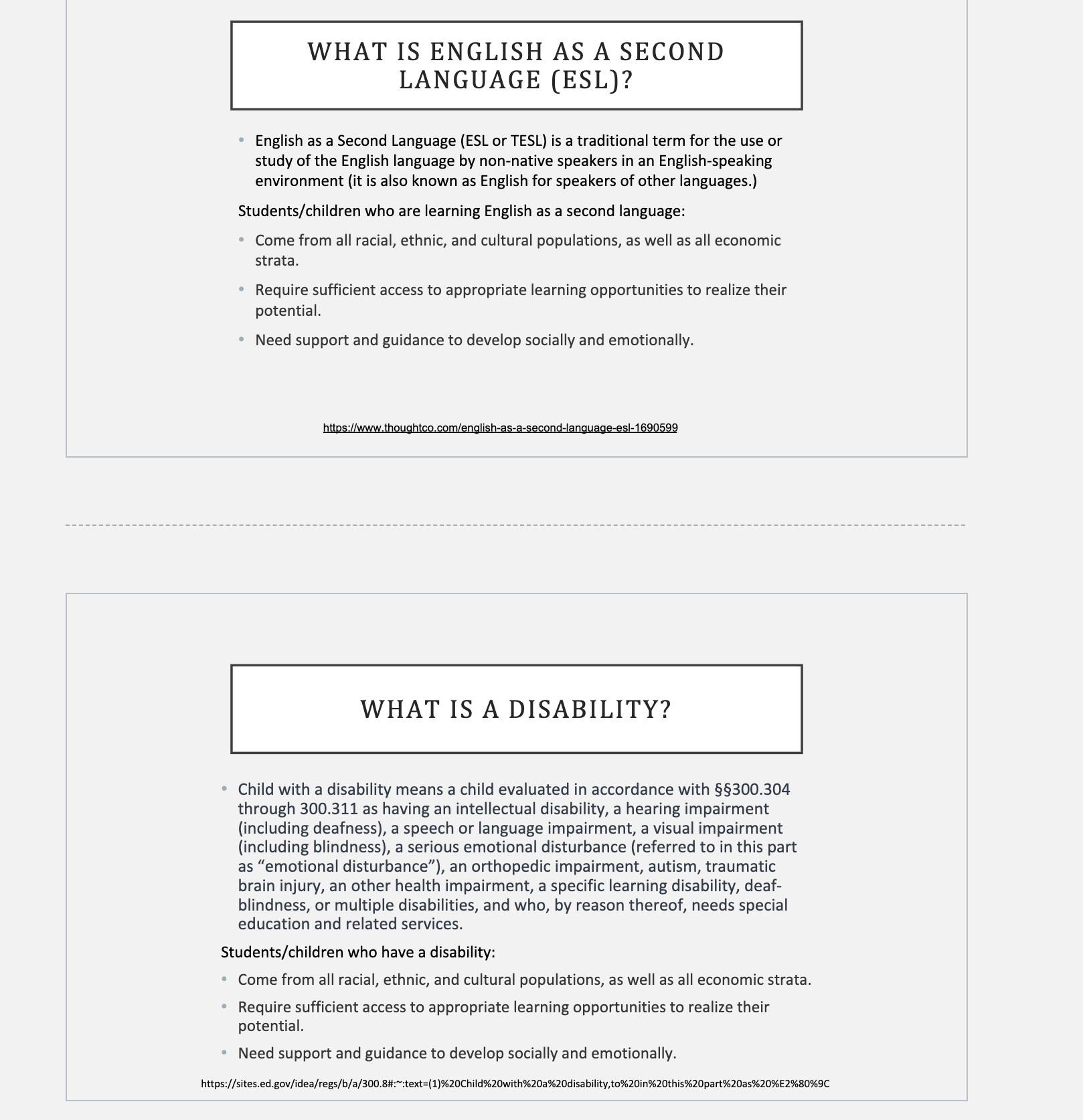
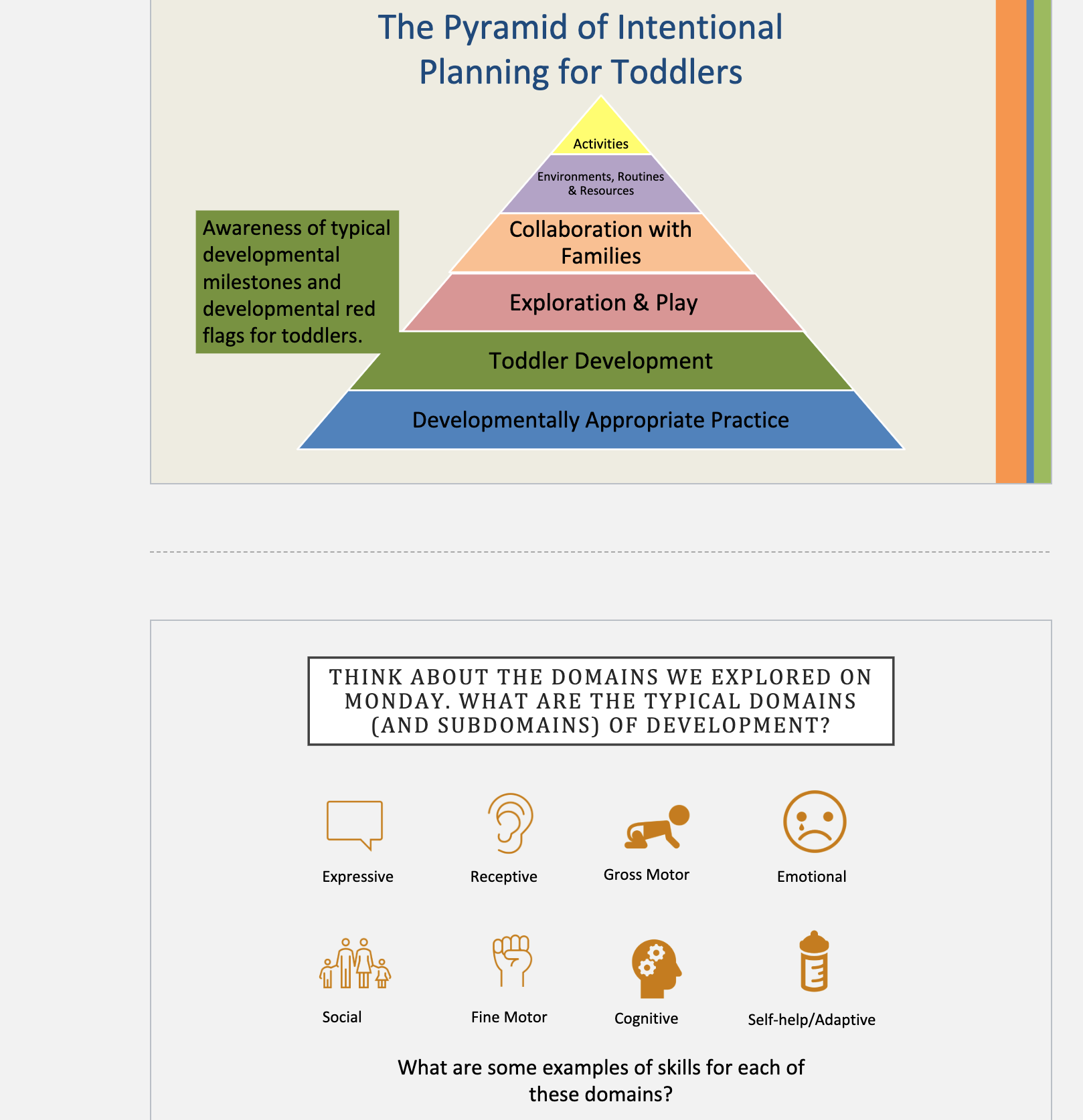
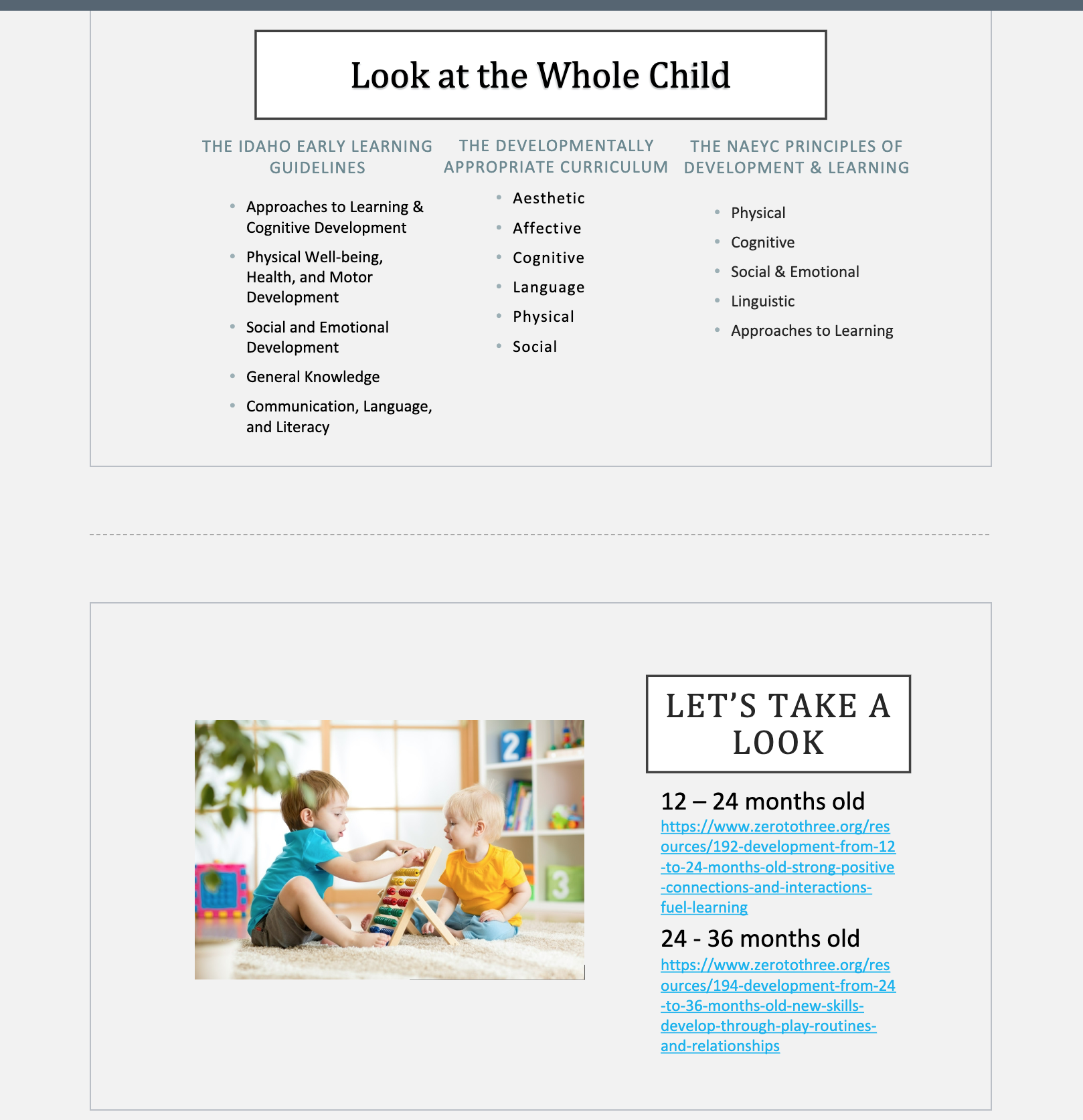
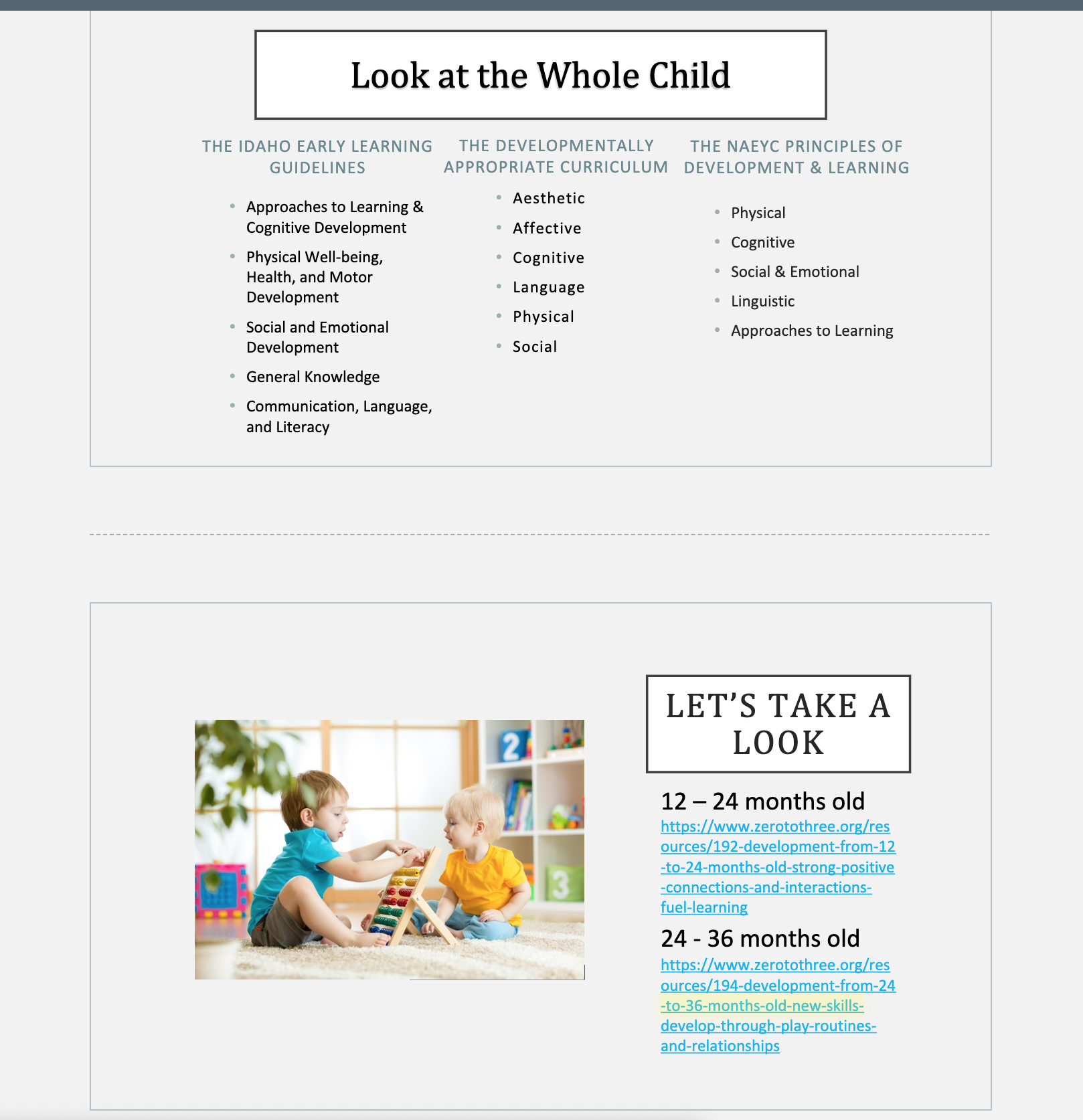
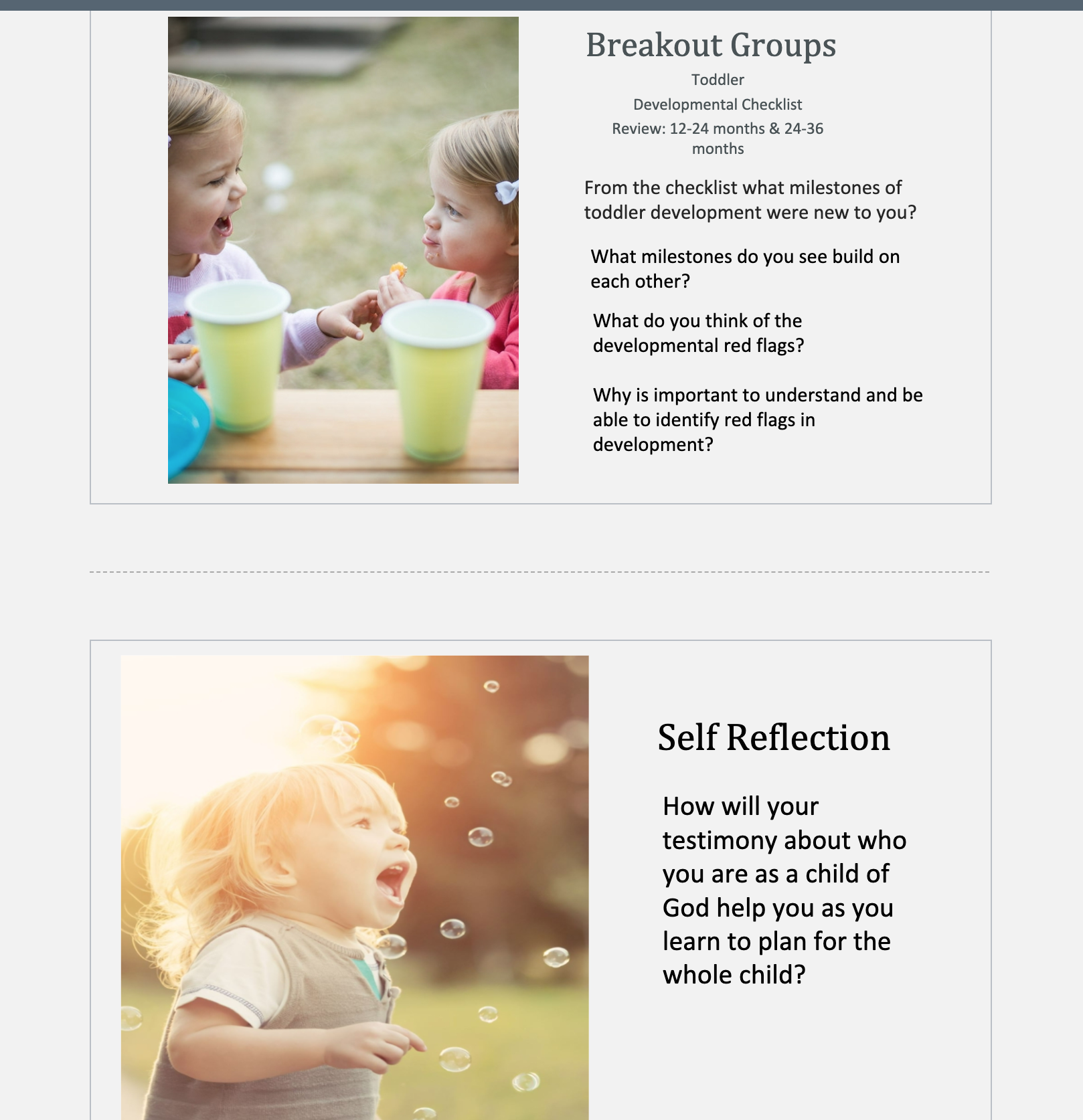
Learning Outcomes After reading this chapter, you should be able to: Describe how principles of child development and learning connect to your daily teaching practices. Describe how content knowledge and learning standards are incorporated into early childhood programs. Identify developmentally appropriate teaching strategies to use with young children. Explain how you will integrate and apply knowledge about children, content, and effective teaching strategies in your daily teaching. NAEYC Standards and Key Elements Addressed in This Chapter: Standard 1a: Knowing and understanding young children's characteristics and needs Standard 1c: Using developmental knowledge to create healthy, respectful, supportive, and challenging learning environments Standard 4b: Knowing and understanding effective strategies and tools for early education Standard 4c: Using a broad repertoire of developmentally appropriate teaching/learning approaches Standard 53: Understanding content knowledge and resources in academic disciplines Standard 5c: Using their own knowledge, appropriate early learning standards, and other resources to design, implement, and evaluate meaningful, challenging curricula for each child 11 the last day of school, the following entry appeared on the kindergarten teacher's blog at Central School . . . This is the year I will always remembermy first classroom, my first \"first day,\" my first field trip, my first parentteacher conference, my first group of children that were all thine! I have 20 children's names and faces forever engraved on my heart. I imagine running into these kids 10 years from now at the movies or the mall and wonder if they will recognize me. Even if they don't, I know that what we did in our classroom this year will iiifluence each of them the rest of their lives. As for me. I know now how important teaching the \"little ones\" really is! 42 Working with young children is exciting, exhausting, and rewarding. It is also a tre- mendous responsibility. To do your iob well requires you to build a professional knowl- edge base that leads to effective teaching. This knowledge base has three parts. First, early childhood educators need to know what young children are like. They must understand Child development and learning and use that understanding to create early childhood envi- ronments where all children can thrive. This knowledge prompts teachers to focus more clearly on who they are teaching. Second, teachers must demonstrate deep knowledge of academic disciplines and subject-matter content. This tells them what to teach. Third, early childhood professionals need to know about the learning process as well as the teaching techniques that best support learning. This involves knowing how to teach. Well-prepared .. Part 1 Foundations of Early Childhood Education FIGURE 2.1 TeachingLearning Knowledge Base Professional Knowledge Base Effective Teaching Strategies Chapter 2 Teaching and Learning in Developmentally Appropriate Programs observing children playing a vigorous game of tag might categorize their activity as purely physical. Yet, the children's ability to play the game is inuenced by many developmental Processes that operate in concert with one another: Aesthetic. Appreciating another player's speed; enjoying the rhythm of the game Affective. Coping with the emotional disappointment of not being \"it\" right away; accepting compliments and criticism from other players; expressing anger over a disputed call Cognitive. Determining the sequence in which the game is played; mentally calculating how many children can fit in the space available; remembering who had a chance to be \"it\" and who did not Language. Determining what verbal \"scripts\" to use to get into or out of the game; \"Googling\" a variation called \"reverse tag\"; responding to the teacher's directions Physical. Running, bobbing, and weaving to ta g or to miss being tagged Social. Negotiating the rules of the game; signaling others about wanting a chance to play; making way for a new player This all-inclusive developmental picture is true for every task children undertake. Social processes shape cognitive ones, cognitive processes promote or restrict social capabilities, physical processes inuence language and cognition, and so on. Consequently, when early childhood teachers think about children, they see them as whole human beings whose learn- ing is enhanced by addressing all aspects of their development. This is referred to as focusing on the \"whole child\" (National Association of Elementary School Principals [NAESP], 2014; Weissman 65 Hendrick, 2014}. Child Development Follows an Orderly Sequence Try putting these developmental milestones regarding children's fears in the order in which they tend to appear during childhood. Fear of ghosts Fear of animals Fear of being embarrassed in front of others Stranger anxiety What did you decide? Sample progressions like these illustrate the notion of develop- mental sequence. Scientists around the world have identified typical sequences of progression in every devalopmental realm (Berk, 2016]. Their ndings conrm that development is a stepwise process in which understandings, knowledge, and skills build on each other in a predict- able order. This is true both for typically developing children and for children with special needs (Nemeth, 2012). For instance, before children walk, they first learn to lift their heads, then sit up, then crawl, then pull themselves up, and then step a few steps forward. Eventually, they toddle, and then run. Similarly, childhood fears tend to emerge in the fol lowing order: stranger anxiety. animal fears, fear of ghosts, and later, the fear of potential embarrassment. Maturation provides the broad parameters within which benchmarks like these emerge (e.g., initially children's cognitive structures are such that they recognize only tangible fears like strangers or animals; later, they become more capable of imagin- ing abstract frights such as being embarrassed). Experience also plays a role, modifying and inuencing children's progress (e.g., a child with exposure to dogs may think differ- ently from a child who has no dog experience). Progress from one benchmark to the next happens in fits and starts, however, not in a rigid or even fashion. Individual children may spend more or less time on each one; they may move forward a hit, back a little, then forward again. Some children may even skip steps. In spite of all this individuation, development emerges in roughly the same order in all children. Initial skills and abilities form the foundation for those yet to come (Coppie 5c Bredekarnp, 2.009]. Knowing these sequences helps teachers understand children's current development and what may come next, no matter their age or special needs. These are essential things to know and keep in mind when teaching. 43 Monkey Bu aluesaiFotol'ia 44 Part 1 Foundations of Early Childhood Education These second graders share the some birthday but vary in their rates of physical. lan- guage, cognitive, and social emotional development. 1- .. Children Develop at Varying Rates Emahl is 5 years old; so is Lawrence. Emabl was walk- ing at .1 year ofoge and talking in complete sentences by age 2. However, be still has difficulty sharing peo- ple and toys. Lawrence did not walla until he was 14 months old and began talking uidly only at 3 years of age. He knows several strategies for sharing, how- ever, which he uses wall. Emabl and Lawrence are fol- lowing the same developmental paths but at different rates: both are developing normally. These snapshots in time of Emahl and Lawrence show that children progress through the same developmental sequences according to their own timetables. Those timetabloc are a prod- uct of maturation and environmental factors and lead to both intra- and interpersonal variations in child development. Developmental progress is not uniform across domains within the same child. Intraper- sonally, different threads of development are at different levels of maturity at any one time. As a result, the same child may struggle to identify the letters in his name, climb quickly to the highest part of the outdoor climber, experience great success cutting with scissors, but also become easily frustrated negotiating a turn with the iPad. Such intrapersonal variations are typical of all children. Inter-personally, if you were to chart the development of an entire classroom of chil~ dren, the time at which each child reached certain milestones would also vary considerably (Trawick-Smith, 2013). These variations among individuals may be due to differences in matu- rity, experience, or special needs. For instance, some rst graders come to school in September just starting to make the association between various letters and sounds. Other children can read words and phrases. Still others have no concept of print. Variations in rates of development are common throughout the elementary years. How- ever, thcy are most pronounced in younger children and contribute to the wide range of behaviors you will see in early childhood classrooms {Copple, Bredckamp, Koralck, 86 Charmer, 2013a, 2013b, 2013c, 2013d). Children Learn Best When They Feel Safe and Secure Children who feel safe and secure learn more easily than children who are worried, angry, or afraid. For young children, psychological security comes from being in the company of warm, responsive adults with whom they have close personal relationships (Hamrc, Downer, Jamil, 8C Pianta, 2012; NAEYC, 2009}. Children are most comfortable with adults who obviously like them. Those adults take the time to tune in to what children are saying and doing. They also tolerate childish mistakes. When children see that their families are welcome in the program, hear their home language at school, and see materials and images that reect their World experience, they feel accepted and valued. Physical security is important, too. If the classroom environment is hazard free and routines are predictable, children can navigate the program with confidence. When teachers set reasonable limits on children's inappropriate behaviors, promote problem solving, and address bullying or aggressive behavior effectively, they create classroom environments that children interpret as supportive and safe (Kostclnik 85 Grady, 2009). Those factors enhance childhood learning, as Shown in Figure 2.2. Children Are Active Learners Children in the kindergarten were about to act out the story "jack and the Beanstalk, \" when Wally and Eddie disagreed about the relative size of two rugs they were using in their play. WALLY: The big rug is the giant's castle. The small rug is jack's house. EDDIE: Both rugs are the some. rh r O.' 3C1 get but Chapter 2 Teaching and Learning in Developmentally Appropriate Programs 45 FIGURE 2.2 Emotions Are Gatekeepers to Learning Although supporting children's emotional well-being makes common sense, it makes neurological sense, too. Scientists who study brain development tell us emotions inuence children's emerging cognitive abilities In either a positive or negative direction {NSCDQ 2007). Positive emotions such as affection. enthusiasm, and pleasure Prompt children to be more attentive and emotionally engaged in the learning process (Medina, 2008). Thus. children who feel comfortable and safe are primed to team. Feelings of fear. loss. or anger, on the other hand. can impede learning if they go on too long. Although everyone has emotions like these once in a while with no harm done. when children experience periods of fear or distress their bodies produce elevated levels of the hormone content in the brain. Prolonged exposure to cortisol weakens the connections among brain cells. particularly in those parts of the brain responsible for memory and reasoning (NSCDC, 200?). it these toxic conditions become the norm. they can have detrimental effects on brain development and cognitive function. Neuroscience suggests that strong. positive emotional attachments with adult caregivers actually reduce the production ottoo much cortisol. protecting brain cell connections and promoting learning of all kinds. Physically safe environments also contribute to the positive feelings associated with healthy brain growth. Source: Based on Kostelnik. M. J., & Grady. M. L. (2009). Getting it right from the start: The principals guide to early childhood education. Thousand Oaks. CA: Cumin Press, p. 107. WALLY: They can't be the some. Watch me. I'll walk around this mg. Now watchwalla, walls. walk, walla, walla, walla, walk, walla, and 10:1!le Okay? Now count the other mg. Walla, walla, walla, walk, walledSee? The! bigger one has more wall: (Paley, 2002., p. 14). Ill this situation, Wally wasn't satised with merely looking at the rugs to determine their size; be was compelled to act on his idea that one was larger than the other and \"prove it" using his whole body. When we say children are active, we literally mean they are people on the move. Recent studies of children's brain development underscore the connection between children's physical activity and their subsequent intellectual functioning (Bjorkl und, 2012; Medina, 2014). Young children use their whole bodies as instruments of learning, taking in data through all their senses. As they act on the environment, children connect thought with behaviorsexploring, discovering, acquiring, and applying new knowledge and skills. ' Children Learn Through Physical Experience. Social Interaction, and Reflection Sung Won is talking to herselfas she moves the places around trying to complete c three dimensional puzzle. \"Honey! How can I do it? How come this won't go?" Although she has tried several combinations, one place seems not to t. anywhere. Daniel is also working on a puzzle. He 2's grouping all the pieces by color. Sung Won observes lois strategy. 52mg Won notices a bit of pink that flows from one piece to the next. There 1's pin]: on the \"challenging\" piece too. \"Wait! Wait! Oh, I know. . . " She slips the place into place. Physical Experience Children have a powerful need to make sense of everything they encounter. From birth, their efforts focus on organizing their knowledge more coherently and adapting to envi- rem-neuter] demands by directly manipulating, listening to, smelling, tasting, and otherwise acting on objects to see what happens (Medina, 2014). From their investigations children generate a logic or knowledge of the properties of thin gs. how they work, and how they relate to one another. This knowledge comes not simply from the passive act of observing, but also from the more complex mental activity of interpreting and drawing conclusions -. 46 Part 1 Foundations of Early Childhood Education Physical experiences and social interaction enhance children's learning. David KosloinikiPearson Education. Inc. about what happens. Such conclusions either add to children's existing ideas or cause them to reformulate their thinking. Social interaction Children's experiences with physical objects are further inuenced by their interactions with people (Bodrova 8c Leong, 2012). As children play, talk, and work with peers and adults, they exchange and compare interpretations and ideas. They generate hypotheses, ask questions, and formulate answers (Copple 85 Brcdekarnp, 2009]. In doing so, they often face contradictions in the way people or objects respond, and these discrepancies force children to obtain new understandings from what has occurred. Through such experiences children construct knowledge internally, continually shaping, expanding, and reorganizing their mental structures. Social experiences also provide children with factual information they cannot construct totally on their own. Through their interactions with others, children learn the culturally based knowledge and skills necessary for successful functioning in society. Here are some examples: 0 Names of things (door, window or purer-ta, neurone) - Historical facts ( Martin Luther King's birthday is january 20; you were born in St. Louis) - Customs (when some children are 7 years old, they make their rst Holy Com- munion,- some children who lose a tooth hide it under their pillow) - Rules (wash your hands before eating,- don't walk with scissors) - Skills (bow to form the letter A; how to throw a ball correctly) Reflection As children interact with ohiects and people, they reect on their experienceswhat they are doing, how they know what they know, and how their plans compare with their actions (Yoda, 2014). Sometimes this thinking is internal and sometimes children express their ideas aloud, as happens when they answer questions like these: \"How did you decide this bridge was longer than that one?\" \"What do you want to know about insects? How will you find that out?\" \"You thought that container had more. What do you think now?" \"You were going to use blocks and tubes to make your city. Is that what you did?\" Another way children reect on their experiences occurs when they recall a past event {e.g., collecting leaves in the yard) and then represent that event in some tangible waywith art materials or building blocks or in writing. As children reect on, represent, and communi- cate experiences and ideas, they develop greater self-awareness and also deepen and rene their thinking. Although such conscious reective thinking is most common during the later elementary years, children as young as 3 years begin to engage in the practice (Copple 8c Bredekamp, 2009; Golheck, 2006). Children Are Motivated to Learn Through a Continuous Process of Challenge and Mastery At a parentteacher conference Molly's mom says, \"Molly loves puzzles. Since she was 2 she has been doing puzzles. We have tried all kindsright now she lilacs oor puzzles best. She's up to ones that have more than 50 pieces. When sire gets stuck, all I have to do is give a little hint and sire fust keeps working at it 'til she figures out what to do. She'll be wanting even harder ones soon!\" Young children learn best when they are stimulated and suc- cessful in acquiring new knowledge and skills. Like Molly, Chapter 2 Teaching and Learning in Developmentally Appropriate Programs they love the challenge of trying to do what they can almost do but not quite achieve unas- sisted and of learning what they nearly understand but do not quite grasp. This excitement prompts children to pursue concepts and skills just slightly beyond their current levels of proficiency. It also encourages them to keep striving until they achieve greater competence (Bodrova 85 Leong, 2012}. Children who frequently master new learning tasks remain motivated to learn. They perceive themselves as up to the job1 even when it is not easy or instantly attainable. Alternately, youngsters who are Overwhelmed by the demands of a task tend to fail. Those who lack stimulation tend to fail as well. In either case, children who fail repeatedly eventually give up (Copple Sc Btedekamp, 2009}. Children who stop trying also stop learning. Adults play a major role in managing the environment and offering learning tasks that stimulate children rather than frustrate them. Children's Learning Profiles Vary Although children use all their available senses to learn, they have unique profiles in how they learn best. Consider the following examples: Sarah likes to work on her own. Consuelo prefers working with a friend. Wilma has been interested in numbers since toddlerhood. Carlos has a way with words. jerome seems to have a special feel for the outdoors. Steve enioys the thrill of competition. All of these children are demonstrating different ways of approaching the 1world with differ- ent frames of mind. These frames of mind are commonly called intelligences. Based on more than 20 years of research, Howard Gardner {2004) hypothesized that everyone possesses at least eight different intelligenccs. The eight intelligence-s are: - Bodilylkincsthetic Intrapersonal Interpersonal Linguistic Logical/mathematical Musical I Naturalistic - Spatial Gardner suggests that each of these intelligences develops independently (in the Brain), although ultimately they all work together (Strauss, 2013}. He emphasizes that people possess varying degrees of know-how in all eight categories. No person is strong or weak in every intelligence and no one intelligence overshadows all the rest, making it the only way a person navigates the world. In fact, all of us display jagged profiles of intelligences (some higher, some lower) that combine to create a unique intelligence profile. The eight intelligences are summarized in Table 2.1. Differences in children's learning profiles may also exist because of temperament or cultural factors. For instance, some children think quickly, spontaneously, and impulsively; others are more deliberate. Some children focus on the \"big idea\"; some think more about the details. Some children constantly look for connections among ideas; others take a single thought and follow it in many directions. Some children organize their thoughts in sequence; others think in a more circular fashion. Some children are socially oriented, working best cooperatively and in groups. Other children value individual achievement and enjoy com- petition {Trawick-Smith, 2018). All these variations suggest that there is no single best way to learn and that there are many ways to be \"smart." Children Learn Through Play Children from every place on Earth play. my? Because play is their primary means for exploring and learning, for developing new skills, and for connecting with others (Almon, 2016}. Although children do not learn everything through play, they learn many things 47 48 Part 1 Foundations of Early Childhood Education Eight lntelligences That Contribute to Children's Learning Profiles Intelligence Child Learns Best by . . . Bodiiyfkineslhetic Touching. moving, processing knowledge through bodily sensations The Mover lntrapersonal Working alone; pursuing own interests: being aware of inner moods. The individual Intentions. motivatlo ns. temperaments, and selfdesires Interpersonal Sharing. comparing. relating to others, cooperating The Socializer Linguistic Reading, writing. talking The Word Player Logical- Exploring patterns and relationships..working with numbers. doing mathematical experiments The Guestr'oner Musical Listening to and making music, using rhythm and melody The Music Lover Naturalistic Observing nature. interacting with plants and animals, perceiving rela- The Nature Lover tionships among natural things Spatial Drawing. building, designing. creating things. using the mind's eye The Artist/Archite ct through play. Children play at home, at school, and everywhere between. They play with people, things, and ideas. When children are not sleeping, eating, or seeking emotional support from others, they choose to play and can remain occupied that way for hours. All areas of development are enhanced through children's playful activities. Play is the fundamental means by which children gather and process information, learn new skills, and practice old ones {TrawickSmith, 2018). Within the context of their play, children come to understand, create, and manipulate symbols as they take on roles and transform obiects into something else. Children explore social relationships, too, experimenting with various social roles, discovering points of view in contrast to their own, working out compromises, and negotiating differences. Play enables children to extend their physical skills, language and literacy capabilities, and creative imaginations. The safe haven that play provides for the release of tensions, the expression of emotions, and the exploration of armiety~producing situations has also been well documented (Wenner, 2009). As a result, there is strong consensus among researchers that play is critical to children's learning, productivity, and overall development. c b. Video Example 2.1 Watch this video and notice the different play episodes depicted in this classroom. Repeat the video, choosing at least three vignettes to focus on closely. What do you think children are learning in each play scene you chose? How Developmental Knowledge Informs Your Teaching Knowing about child development and learning is key to being an effective teacher, and being an effective teacher is central to helping children develop and learn (TurnerBisset, 2012). However, developmental expertise alone is not sufcient to ensure that early child- hood programs are high quality (Nell, Drew, 8c Bush, 2.013). Practitioners must connect what they know with what they do. This connection between theory and practice is illus- trated in Table 2.2. Chapter 2 Teaching and Learning in Developmentally Appropriate Programs 49 Connecting Knowledge of Development and Learning to Teaching Practices Principles oi Child Development and Learning Developmentally Appropnate't'eschlng Practices Children develop holistically - Teachers plan daily activities and routines to address aesthetic. emo- tional, cognitive. language. physical. and social development. 0 Teachers integrate learning across the curriculum (e.g.. mixing language. physical. and social: combining math. science. and reading}. _ Child development follows an orderly sequence 0 Teachers use their knowledge of developmental sequences to gauge whether children are developing as expected. to determine reasonable expectations. and to plan next steps in the learning process. Children develop at varying rates - Teachers give children opportunities to pursue activities at their own pace. . Teachers repeat activities more than once so children can participate according to changing needs and abilities. - Teachers plan activities with multiple learning objectives to address the needs of more and less advanced learners. Children learn best when they feel safe and secure It Teachers develop nurturing relationships with children and remain with children long enough so they can easily identify a specic adult lrom whom to seek help. comfort. attention. and guidance. 0 Daily routines are predictable. Changes In routine are explained in advance so children can anticipate what will happen. - There Is two-way communication between teachers and families. and families are welcome in the program. 0 Children have access to Images. objects. and activities that reflect their home experiences. a The early childhood environment corn plies with all safety requirements. ' Adults use positive discipline to enhance children's self-esteem. self-control. and problem-solving abilities. - Teachers address aggression and bullying calmly. lln'nly. and proactively. in... Children are active learners - Activities. transitions. and routines respect children's attention span. need for activity. and need for social interaction. Inactive segments of the day are short. - Children participate In gross motor activities every day. -__ Children learn through a combination cl physical - Adults encourage children to explore and investigate. They pose ques- experience. social experience. and reflection tlons. offer information. and challenge children's thinking. - Children have many chances to document and reflect on their ideas. Children leem through mastery and challenge 0 Practitioners simplify. maintain. or extend activities in response to children's functioning and comprehension. Children's learning proles vary . ' Teachers present the same information in more than one modality (seeing, hearing, touching) and through different types of activities. o Children have opportunities to play on their own and with others. Indoors and outdoors. with natural and manufactured materials. Children learn through play ' Teachers prepare the environment to support play. provide materials children can use in play. observe how and what children are learning in their play, and Interact playfully with children. ' Play is integrated throughout the entire day and within all aspects of the program. Check Your Understanding 2.1 Gauge your understanding of the concepts in this section. As you watch the video, think about... 0 What does it mean to educate the whole child? 0 What aspects of teaching the whole child sound difficult to implement? What seems easy? httpsgyoutu.be/CSuszAK3Ss What does this mean then for children who... ....are typical? ....are gifted? are learning English as a second language? have a disability? ..... are medically fragile? WHAT IS \"TYPICAL"? I\" A \"typica child is defined as having the behavior, intellectual ability, and functional skills of children within their age range grounded on research based developmental milestones and academic norms. Students/children who are \"typical": Come from all racial, ethnic, and cultural populations, as well as all economic strata. Require sufficient access to appropriate learning opportunities to realize their potential. Need support and guidance to develop socially and emotionally as well as in their areas of talent. WHAT IS GIFTEDNESS? Students with gifts and talents performor have the capability to perform at higher levels compared to others of the same age, experience, and environment in one or more domains. They require modification(s) to their educational experience(s) to learn and realize their potential. Student with gifts and talents: Come from all racial, ethnic, and cultural populations, as well as all economic strata. Require sufficient access to appropriate learning opportunities to realize their potential. Can have learning and processing disorders that require specialized intervention and accommodation. Need support and guidance to develop socially and emotionally as well as in their areas of talent. https:I/www.nag:.orgfresource3epubIicatinns/rasources/whatgiftedness WHAT IS ENGLISH AS A SECOND LANGUAGE [ESL]? English as a Second Language (ESL or TESL) is a traditional term for the use or study of the English language by nonnative speakers in an Englishspeaking environment (it is also known as English for speakers of other languages.) Students/children who are learning English as a second language: Come from all racial, ethnic, and cultural populations, as well as all economic strata. Require sufficient access to appropriate learning opportunities to realize their potential. Need support and guidance to develop socially and emotionally. hnswwwxhoughtco-Oomlenglishas-a-aemndIangane-l-169Q599 WHAT IS A DISABILITY? Child with a disability means a child evaluated in accordance with 300.304 through 300.311 as having an intellectual disability, 3 hearing impairment (including deafness), a speech or language impairment, a visual impairment (including blindness), a serious emotional disturbance (referred to in this part as "emotional disturbance\"), an orthopedic impairment, autism, traumatic brain injury, an other health impairment, 3 specific learning disability, deaf- blindness, or multiple disabilities, and who, by reason thereof, needs special education and related services. Students/children who have a disability: Come from all racial, ethnic, and cultural populations, as well as all economic strata. Require sufficient access to appropriate learning opportunities to realize their potential. Need support and guidance to develop socially and emotionally. https:l'fsites.ed.gov/idea/reg5]b/a/300.8:":text:[1l%20Ch'i ld%20with9620a%20di5ability,to%20in%20thi5%ZOpart%ZUas9620%E2%80%9C WHAT IS MEDICALLY FRAGILE? A child is defined as "medically fragile" when, due to abuse or neglect, illness, congenital disorder or brain injury, he/she requires medications, treatments and/or specialized care or equipment. Students/children who are medically fragile: Come from all racial, ethnic, and cultural populations, as well as all economic strata. . Require sufficient access to appropriate learning opportunities to realize their potential. Need support and guidance to develop socially and emotionally. https://penfieldbuildingblocks.org/medically-fragile/what-is- medicallyfragile/#:":text=A%20child%20is%20defined%20as,Fetal%20alcohol%20syndrome IWHOLE What does this mean for CHILD you as a teacher or early interventionist?The Pyramid of Intentional Planning for Toddlers Activities Environments, Routines & Resources Awareness of typical Collaboration with developmental Families milestones and developmental red Exploration & Play flags for toddlers. Toddler Development Developmentally Appropriate Practice THINK ABOUT THE DOMAINS WE EXPLORED ON MONDAY. WHAT ARE THE TYPICAL DOMAINS (AND SUBDOMAINS) OF DEVELOPMENT? Expressive Receptive Gross Motor Emotional Social Fine Motor Cognitive Self-help/Adaptive What are some examples of skills for each of these domains?Look at the Whole Child THE IDAHO EARLY LEARNING THE DEVELOPMENTALLY THE NAEYC PRINCIPLES OF IDELINES APPROPRIATE CURRICULUM DEVELOPMENT & LEARNING Approaches to Learning & Aesthetic . Physical Cognitive Development Affective Cognitive Physical Well-being, Cognitive Health, and Motor Social & Emotional . Language Development . Linguistic . Physical Social and Emotional Approaches to Learni Development . Social General Knowledge Communication, Language, and Literacy LET'S TAKE A 2 LOOK 12 - 24 months old https://www.zerotothree.org/res ources/192-development-from-12 -to-24-months-old-strong-positive 13 connections-and-interactions- fuel-learning 24 - 36 months old https://www.zerotothree.org/res purces/194-development-from-24 -to-36-months-old-new-skills- develop-through-play-routines- and-relationshipsLook at the Whole Child THE IDAHO EARLY LEARNING THE DEVELOPMENTALLY THE NAEYC PRINCIPLES OF IDELINES APPROPRIATE CURRICULUM DEVELOPMENT & LEARNING Approaches to Learning & Aesthetic . Physical Cognitive Development Affective Cognitive Physical Well-being, Cognitive Health, and Motor Social & Emotional . Language Development . Linguistic . Physical Social and Emotional Approaches to Learni Development . Social General Knowledge Communication, Language, and Literacy LET'S TAKE A 2 LOOK 12 - 24 months old https://www.zerotothree.org/res ources/192-development-from-12 -to-24-months-old-strong-positive 13 connections-and-interactions- fuel-learning 24 - 36 months old https://www.zerotothree.org/res purces/194-development-from-24 -to-36-months-old-new-skills- develop-through-play-routines- and-relationshipsBreakout Groups Toddler Developmental Checklist Review: 12-24 months & 24-36 months From the checklist what milestones of toddler development were new to you? What milestones do you see build on each other? What do you think of the developmental red flags? Why is important to understand and be able to identify red flags in development? Self Reection How will your testimony about who you are as a child of God help you as you learn to plan for the whole child
Step by Step Solution
There are 3 Steps involved in it
1 Expert Approved Answer
Step: 1 Unlock
Question Has Been Solved by an Expert!
Get step-by-step solutions from verified subject matter experts
Step: 2 Unlock
Step: 3 Unlock
Students Have Also Explored These Related Accounting Questions!











 Study Help