







Question: Bungee MatLab function Bungee jumping involves two separate modes: an initial free fall followed by a subsequent deceleration caused by the stretching of the bungee
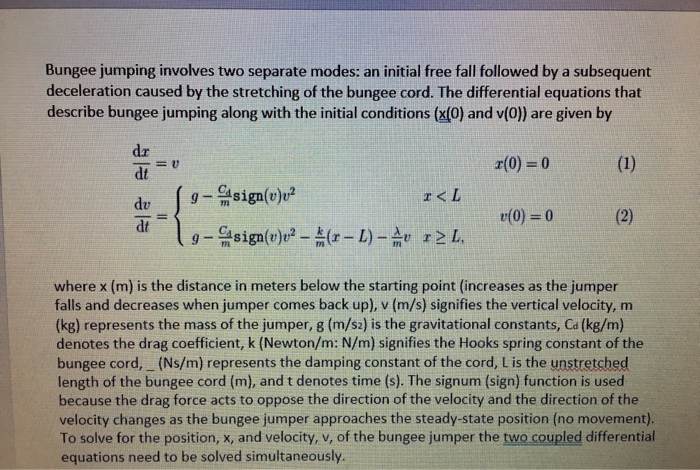
Bungee jumping involves two separate modes: an initial free fall followed by a subsequent deceleration caused by the stretching of the bungee cord. The differential equations that describe bungee jumping along with the initial conditions (SO) and v(0)) are given by dr dt dv dt 2(0) = 0 e(0) = 0 where x (m) is the distance in meters below the starting point (increases as the jumper falls and decreases when jumper comes back up), v (m/s) signifies the vertical velocity, m (kg) represents the mass of the jumper, g (m/s2) is the gravitational constants, Cd (kg/m) denotes the drag coefficient, k (Newton/m: N/m) signifies the Hooks spring constant of the bungee cord,-(Nam) represents the damping constant of the cord, L is the unstretched length of the bungee cord (m), and t denotes time (s). The signum (sign) function is used because the drag force acts to oppose the direction of the velocity and the direction of the velocity changes as the bungee jumper approaches the steady-state position (no movement) To solve for the position, x, and velocity, v, of the bungee jumper the two coupled differential equations need to be solved simultaneously
Step by Step Solution
There are 3 Steps involved in it

Get step-by-step solutions from verified subject matter experts
 Study Help