







Question: Burmister developed two - layer system ( 1 9 4 3 ) and three - layer system ( 1 9 4 5 ) for the
Burmister developed twolayer system and threelayer system for
the analysis of flexible pavements. There are five basic assumptions of the nlayer
system as presented in the figure below. Please fill the missed assumptions.
points
i Each layer is homogeneous, isotropic, and linear elastic material.
ii
iii Each layer has a finite thickness but the lowest layer is infinite in thickness.
iv
v Continuity conditions are satisfied at the layer interfaces
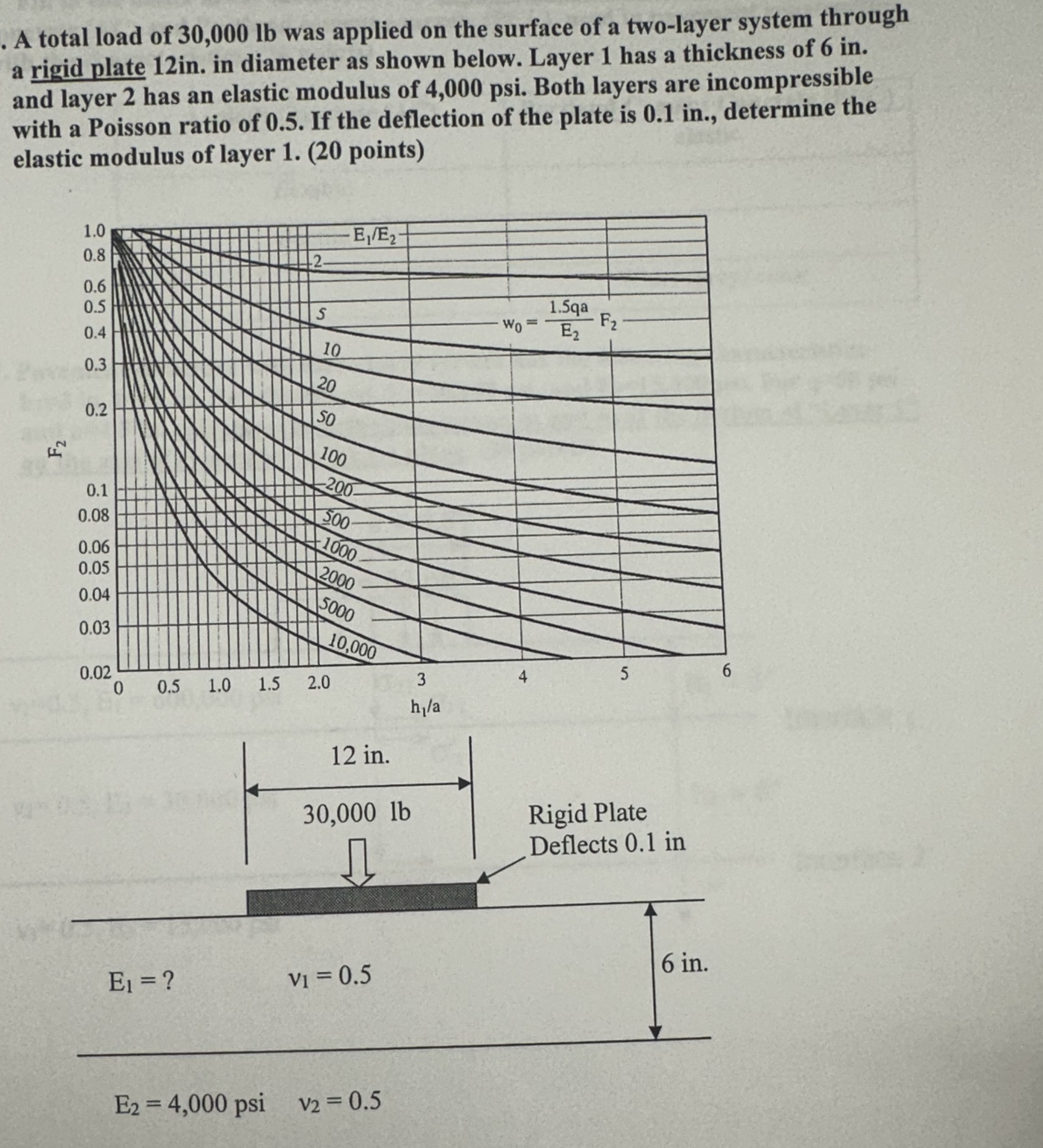
A total load of was applied on the surface of a twolayer system through
a rigid plate in in diameter as shown below. Layer has a thickness of in
and layer has an elastic modulus of Both layers are incompressible
with a Poisson ratio of If the deflection of the plate is in determine the
elastic modulus of layer points
A total load of was applied on the surface of a twolayer system through
a rigid plate in in diameter as shown below. Layer has a thickness of in
and layer has an elastic modulus of Both layers are incompressible
with a Poisson ratio of If the deflection of the plate is in determine the
elastic modulus of layer points
Step by Step Solution
There are 3 Steps involved in it
1 Expert Approved Answer
Step: 1 Unlock

Question Has Been Solved by an Expert!
Get step-by-step solutions from verified subject matter experts
Step: 2 Unlock
Step: 3 Unlock
 Study Help