







Question: BUS 501 Survey In this reflection, you will evaluate your own personal code of ethics. Generally, the following 12 Ethical Principles are valid for a
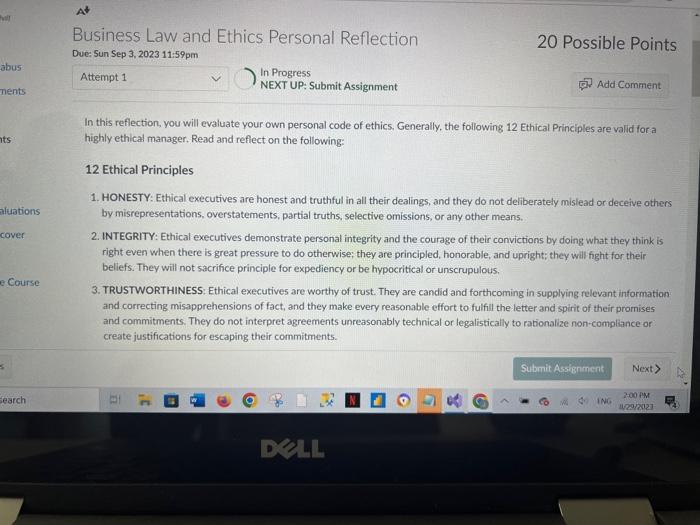
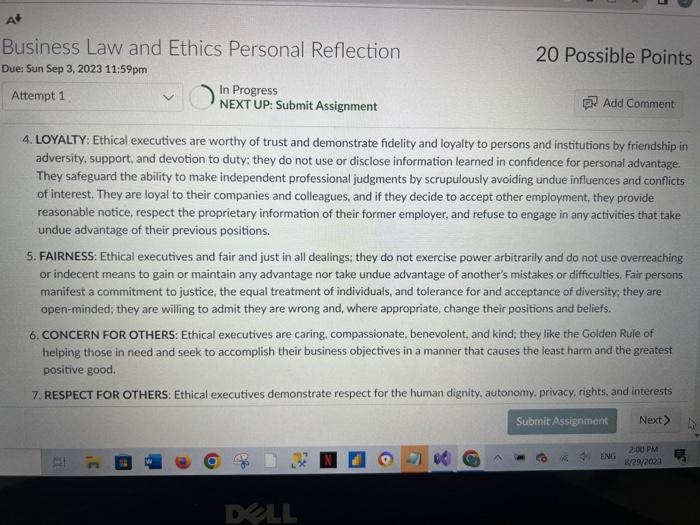
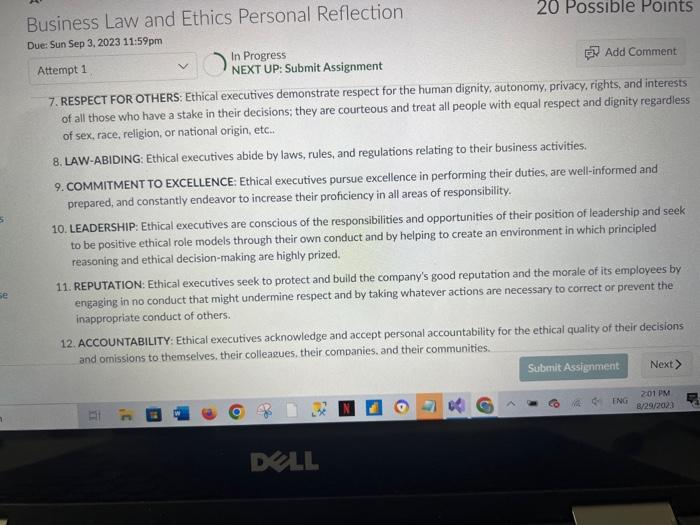
In this reflection, you will evaluate your own personal code of ethics. Generally, the following 12 Ethical Principles are valid for a highly ethical manager. Read and reflect on the following: 12 Ethical Principles 1. HONESTY: Ethical executives are honest and truthful in all their dealings, and they do not deliberately mislead or deceive others by misrepresentations, overstatements, partial truths, selective omissions, or any other means. 2. INTEGRITY: Ethical executives demonstrate personal integrity and the courage of their convictions by doing what they think is right even when there is great pressure to do otherwise; they are principled, honorable, and upright; they will fight for their beliefs. They will not sacrifice principle for expediency or be hypocritical or unscrupulous. 3. TRUSTWORTHINESS: Ethical executives are worthy of trust. They are candid and forthcoming in supplying relevant information and correcting misapprehensions of fact, and they make every reasonable effort to fulfill the letter and spirit of their promises and commitments. They do not interpret agreements unreasonably technical or legalistically to rationalize non-compliance or create justifications for escaping their commitments. 4. LOYALTY: Ethical executives are worthy of trust and demonstrate fidelity and loyalty to persons and institutions by friendship in adversity, support, and devotion to duty: they do not use or disclose information learned in confidence for personal advantage. They safeguard the ability to make independent professional judgments by scrupulously avoiding undue influences and conflicts of interest. They are loyal to their companies and colleagues, and if they decide to accept other employment, they provide reasonable notice, respect the proprietary information of their former employer, and refuse to engage in any activities that take undue advantage of their previous positions. 5. FAIRNESS: Ethical executives and fair and just in all dealings; they do not exercise power arbitrarily and do not use overreaching or indecent means to gain or maintain any advantage nor take undue advantage of another's mistakes or difficulties. Fair persons manifest a commitment to justice, the equal treatment of individuals, and tolerance for and acceptance of diversity; they are open-minded; they are willing to admit they are wrong and, where appropriate, change their positions and beliefs. 6. CONCERN FOR OTHERS: Ethical executives are caring, compassionate, benevolent, and kind; they like the Golden Rule of helping those in need and seek to accomplish their business objectives in a manner that causes the least harm and the greatest positive good. vue: Sun Sep 3, 2023 11:59pm In Progress NEXT UP: Submit Assignment 7. RESPECT FOR OTHERS: Ethical executives demonstrate respect for the human dignity, autonomy, privacy, rights, and interests of all those who have a stake in their decisions; they are courteous and treat all people with equal respect and dignity regardless of sex, race, religion, or national origin, etc.. 8. LAW-ABIDING: Ethical executives abide by laws, rules, and regulations relating to their business activities. 9. COMMITMENT TO EXCELLENCE: Ethical executives pursue excellence in performing their duties, are well-informed and prepared, and constantly endeavor to increase their proficiency in all areas of responsibility. 10. LEADERSHIP: Ethical executives are conscious of the responsibilities and opportunities of their position of leadership and seek to be positive ethical role models through their own conduct and by helping to create an environment in which principled reasoning and ethical decision-making are highly prized. 11. REPUTATION: Ethical executives seek to protect and build the company's good reputation and the morale of its employees by engaging in no conduct that might undermine respect and by taking whatever actions are necessary to correct or prevent the inappropriate conduct of others. 12. ACCOUNTABILITY: Ethical executives acknowledge and accept personal accountability for the ethical quality of their decisions and omissions to themselves, their colleagues, their companies. and their communities
Step by Step Solution
There are 3 Steps involved in it

Get step-by-step solutions from verified subject matter experts
 Study Help