



Question: Bus. Communication There are 2 approaches to write direct and indirect u must use one approach in writing feedback about this course Lesikar's Business Communication:
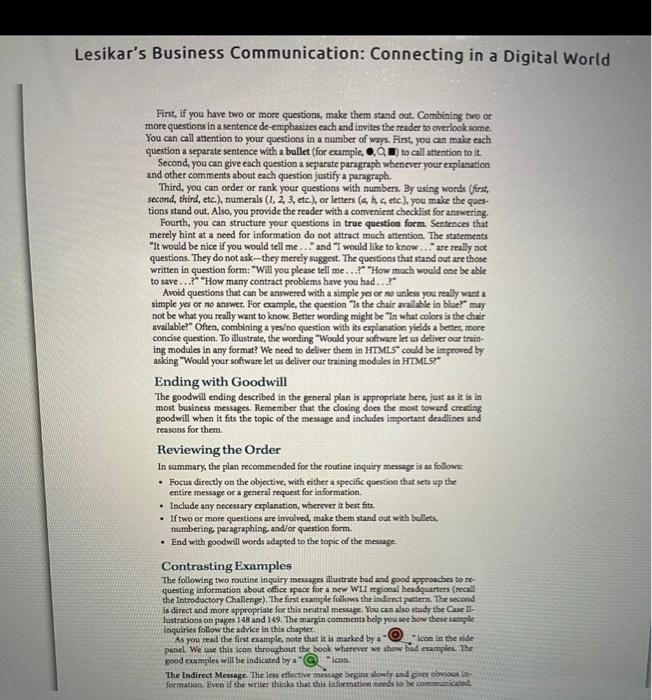
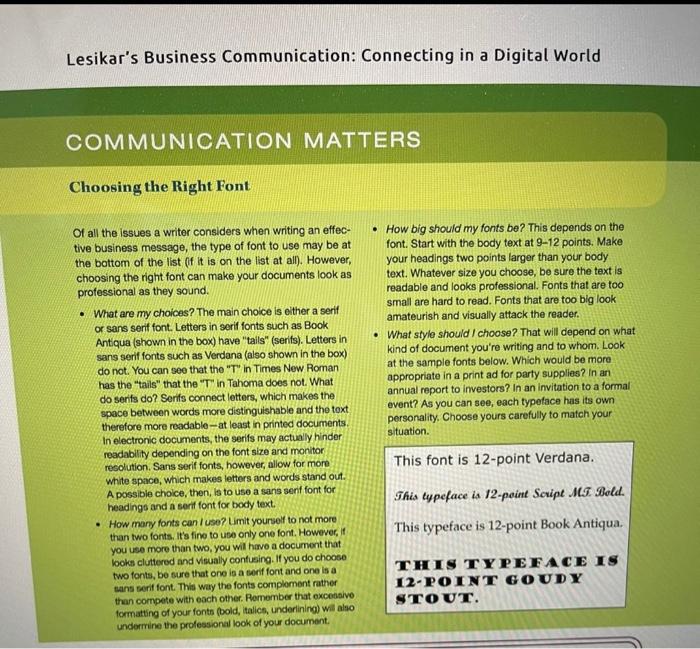
Lesikar's Business Communication: Connecting in a Digital World First, if you have two or more questions, make them stand out. Combining two or more questions in a sentence de emphasizes each and invites the reader to overlook some You can call attention to your questions in a number of ways. First, you can make each question a separate sentence with a bullet (for example, to call attention to it Second, you can give each question a separate paragraph whenever your explanation and other comments about each question justify a paragraph. Third, you can order or rank your questions with numbers. By using words (first, second, third, etc.), numerals (1, 2, 3, etc.), or letters (a, betc.), you make the ques- tions stand out. Also, you provide the reader with a convenient checklist for answering. Fourth, you can structure your questions in true question form. Sentences that merely hint at a need for information do not attract much attention. The statements "It would be nice if you would tell me...and I would like to know... are really not questions. They do not ask-they merely suggest. The questions that stand out are those written in question form: "Will you please tell me...?" How much would one be able to save...?**How many contract problems have you had...?" Avoid questions that can be answered with a simple yesor me unless you really want a simple yes or no answer. For example, the question is the chair available in bluer may not be what you really want to know. Better wording might be in what colors is the chair available?" Often, combining a yeso question with its explanation yields a better, more concise question. To illustrate the wording "Would your software let us deliver our train- ing modules in any format? We need to deliver them in HTML could be improved by asking "Would your software let us deliver our training modules in HTML57* Ending with Goodwill The goodwill ending described in the general plan is appropriate here, just as it is in most business messages. Remember that the dosing does the most toward creating goodwill when it fits the topic of the message and includes important deadlines and reasons for them. Reviewing the Order In summary, the plan recommended for the routine inquiry message is as follows: Focus directly on the objective, with either a specific question that sets up the entire message or a general request for information. Include any necessary explanation, wherever it best fits. If two or more questions are involved, make them stand out with bullets numbering, paragraphing, and/or question form. End with goodwill words adapted to the topic of the message Contrasting Examples The following two routine inquiry messages illustrate bad and good approaches to re- questing information about office space for a new WLI regional headquarters (recall the Introductory Challenge). The first cample follows the indirect pattern. The second is direct and more appropriate for this neutral message. You can also study the Case - lustrations on pages 148 and 149. The margin comments help you see how these sample inquiries follow the advice in this chapter As you read the first example, note that it is marked by icon in the side panel. We use this icon throughout the book wherever we show bid examples. The good examples will be indicated by a The Indirect Message. The les effective message begins slowly and gives a la for nation. Even if the write thinks that this information seeds to be communicate Icon Lesikar's Business Communication: Connecting in a Digital World COMMUNICATION MATTERS Choosing the Right Font Of all the issues a writer considers when writing an effec- tive business message, the type of font to use may be at the bottom of the list of It is on the list at all). However, choosing the right font can make your documents look as professional as they sound. What are my choices? The main choice is either a serif or sans serif font. Letters in serif fonts such as Book Antiqua (shown in the box) have "tails" (serts). Letters in sans serif fonts such as Verdana (also shown in the box) do not. You can 300 that the "T" in Times New Roman has the "tails" that the "T" in Tahoma does not. What do serits do? Serifs connect letters, which makes the space between words more distinguishable and the text therefore more readable-at least in printed documents In electronic documents, the serifs may actually hinder readability depending on the font size and monitor resolution. Sans serif fonts, however, allow for more white space, which makes letters and words stand out. A possible choice, then, is to use a sans sent font for headings and a serif font for body text How many fonts can I uso? Limit yourself to not more than two fonts. It's fine to use only one font. However, you use more than two, you will have a document that looks cluttered and visually confusing. If you do choose two fonts, be sure that one is a serif font and one is a sans serif font. This way the fonts complomant rather than compete with each other. Remember that excessivo formatting of your fonts (bold, italics, underlining) will also undermine the professional look of your document. How big should my fonts be? This depends on the font. Start with the body text at 9-12 points. Make your headings two points larger than your body text. Whatever size you choose, be sure the text is readable and looks professional. Fonts that are too small are hard to read. Fonts that are too big look amateurish and visually attack the reader. What style should I choose? That will depend on what kind of document you're writing and to whom. Look at the sample fonts below. Which would be more appropriate in a print ad for party supplies in an annual report to investors? In an invitation to a formal event? As you can see, each typeface has its own personality. Choose yours carefully to match your situation. This font is 12-point Verdana. This typeface ia 12-point Script MT. Bold. This typeface is 12-point Book Antiqua. THIS TYPEFACE IS 12-POINT GOUDY STO UT
Step by Step Solution
There are 3 Steps involved in it

Get step-by-step solutions from verified subject matter experts