Question: BUSINESS ETHICS: Please HELP, see the attached document BUSINESS ETHICS: Please read the case study below & answer the question at the end: ORgANIZATIONAL ThEORIsTs
BUSINESS ETHICS:
Please HELP, see the attached document
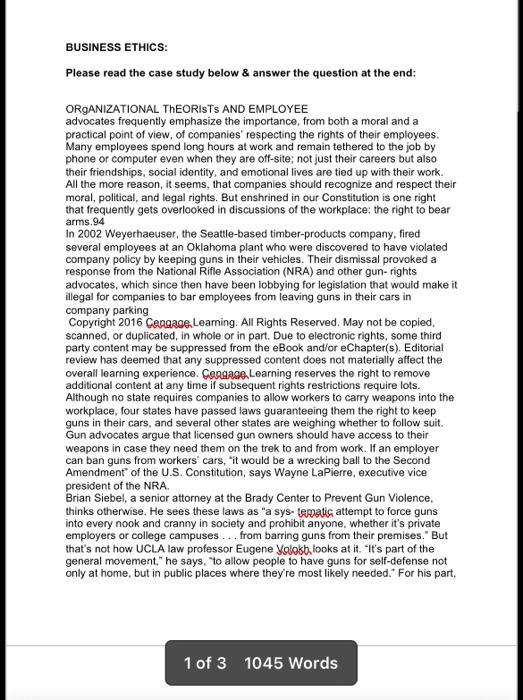
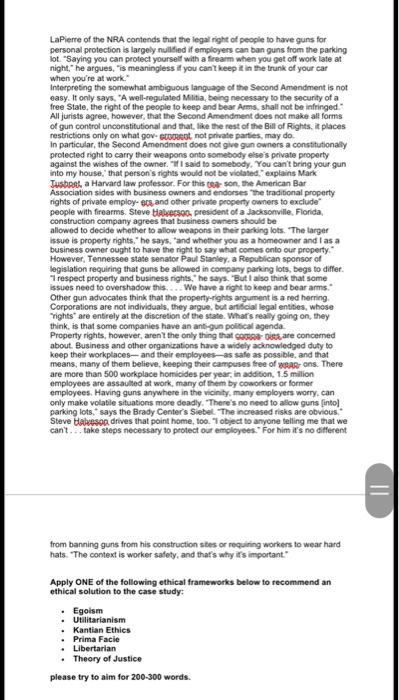
BUSINESS ETHICS: Please read the case study below & answer the question at the end: ORgANIZATIONAL ThEORIsTs AND EMPLOYEE advocates frequently emphasize the importance, from both a moral and a practical point of view, of companies' respecting the rights of their employees. Many employees spend long hours at work and remain tethered to the job by phone or computer even when they are off-site; not just their careers but also their friendships, social identity, and emotional lives are tied up with their work. All the more reason, it seems, that companies should recognize and respect their moral, political, and legal rights. But enshrined in our Constitution is one right that frequently gets overlooked in discussions of the workplace: the right to bear arms.94 In 2002 Weyerhaeuser, the Seattle-based timber-products company, fired several employees at an Oklahoma plant who were discovered to have violated company policy by keeping guns in their vehicles. Their dismissal provoked a response from the National Rifle Association (NRA) and other gun-rights advocates, which since then have been lobbying for legislation that would make it illegal for companies to bar employees from leaving guns in their cars in company parking Copyright 2016 Cepgage Leaming. All Rights Reserved. May not be copied, scanned, or duplicated, in whole or in part. Due to electronic rights, some third party content may be suppressed from the eBook and/or eChapter(s). Editorial review has deemed that any suppressed content does not materially affect the overall learning experience. Cepgage, Learning reserves the right to remove additional content at any time if subsequent rights restrictions require lots. Although no state requires companies to allow workers to carry weapons into the workplace, four states have passed laws guaranteeing them the right to keep guns in their cars, and several other states are weighing whether to follow suit. Gun advocates argue that licensed gun owners should have access to their weapons in case they need them on the trek to and from work. If an employer can ban guns from workers" cars, "it would be a wrecking ball to the Second Amendment" of the U.S. Constitution, says Wayne LaPierre, executive vice president of the NRA. Brian Siebel, a senior attorney at the Brady Center to Prevent Gun Violence, thinks otherwise. He sees these laws as "a sys- tepatic attempt to force guns into every nook and cranny in society and prohibit anyone, whether it's private employers or college campuses ... from barring guns from their premises." But that's not how UCLA law professor Eugene Yolokblooks at it. "It's part of the general movement," he says, "to allow people to have guns for self-defense not only at home, but in public places where they're most likely needed. For his part, LaPierre of the NPA contends that the legal right of people to have guns for personal protection is largely nullitied if employers can ban guns from the parking lot. "Saying you can protect yourselt with a frearm when you get off work late at night," he argues, "is meaningless if you cant keep it it the trunk of your car when you're at work." Interpreting the somewhat ambiguous language of the Second Amendment is not easy. It only says, "A well-regulated Mitia, being necessary to the security of a free State, the right of the people to keep and bear Arms, shall not be infringed." All jurists agree, however, that the Second Amendment does not make all forms of gun control unconstitutional and that. like the rest of the Bill of Rights, it places restrictions only on what gov- ecopent, not private parties, may do. In particular, the Second Amendment does not give gun owners a constitutionaly protected right to carry their weopons onto somebody else's private property against the wishes of the owner. "If I said to somebody. You can't bring your gun into my house," that person's rights would not be viotased," explains Mark Jusboef, a Harvard law professor. For this tea-son, the American Bar Association sides with business owners and endorses the traditional property rights of private employ- ecs and other private peoperty owners to exclude" people with firearms. Steve Halserson, president of a Jacksonville, Florida, construction company agrees that business owners should be allowed to decide whether to allow weapons in their parking lots. "The larger issue is property rights." he says, "and whether you as a homeowner and I as a business owner ought to have the right to say what comes cnto our property." However, Tennessee state senator Paul 5tanley, a Republican sponsor of legislation requiring that guns be allowed in company parking lots, begs to differ. I respect property and business nights," he says. "But I also think that some issues need to overshadow this. ... We have a right to keep and bear arms." Other gun advocates think that the property-rights argument is a red herring: Corporations are not individuals, they argue, but articial legal entises, whose "think, is that some companies have an ant-gun political agenda. Property rights, however, arent the only thing that covoly- 0ies are concerned about. Business and other organizations have a widely acknowledged duty to keep their workplaces - and their employees-as sale as possible, and that means, many of them believe, keeping their campuses tree of weacr ons. There are more than 500 workplace homicides per year, in addition, 1.5 million employees are assaulied at work, many of them by coworkers or former employees. Having guns anywhere in the vicinity, many employers worry, can only make volable situations more deadly. "There's no need to allow guns [into] parking lots, says the Brady Center's Siebel. The increased risks are obvious," Steve Helveson, drives that point home, too. "T object to anyone telling me that we cant ... take steps necessary to protect our employees." For him it's no different from banning guns from his construction stes or requiring workers to wear hard hats. "The context is worker salety, and that's why if's important." Apply ONE of the following ethical frameworks below to recommend an ethical solution to the case study: - Egoism - Utalitarianism - Kantian Ethies - Prima Facie - Libertarian - Theory of Justice please try to aim for 200300 words









 Study Help