







Question: Business executives often prefer to work with : Dollar or percentage While the IRR's reinvestment rate assumption is the IRR, the MIRR's reinvestment rate assumption
Business executives often prefer to work with : Dollar or percentage
While the IRR's reinvestment rate assumption is the IRR, the MIRR's reinvestment rate assumption is the project's: WACC, NPV, MIRR
As a result, the MIRR is generally a better indicator of a project's true: breakeven, liquidity, risk, or profitability
than IRR. Unlike the IRR, there can: always or never
be more than one MIRR, and the MIRR can be compared with the project's: WACC, NPV, or Cost
when deciding to accept or reject projects. For : dependent or independent
projects, the NPV, IRR, and MIRR always reach the same accept/reject conclusion; so the three criteria are equally good when evaluating : independent or dependent
projects. If projects are mutually exclusive and they differ in size, conflicts in project acceptance: can or cannot
arise. In these cases, the : IRR, NPV, or MRR
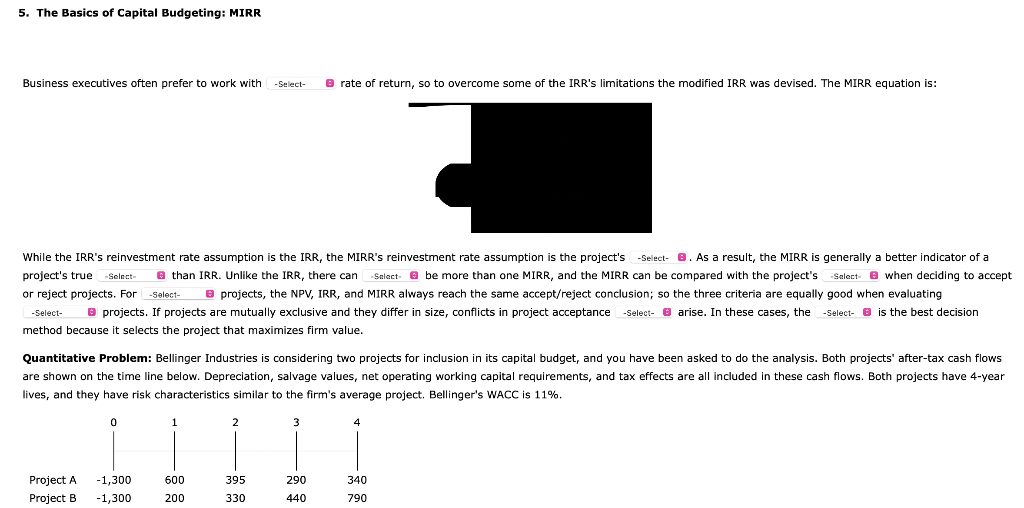
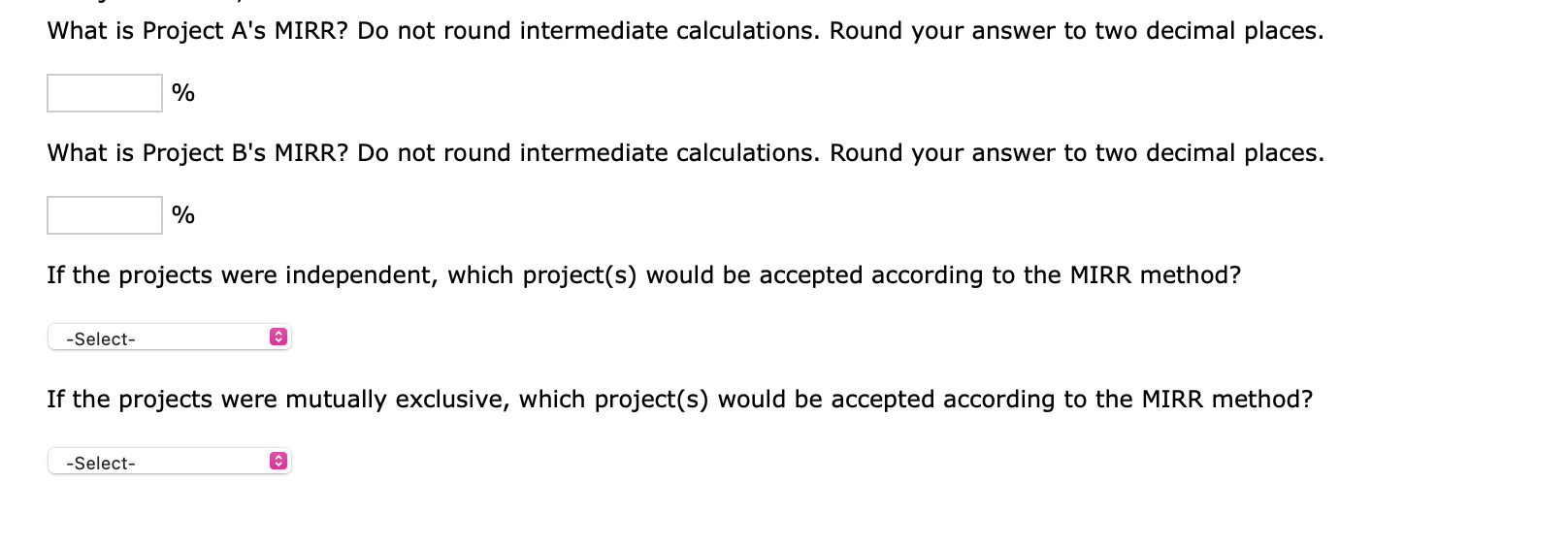
5. The Basics of Capital Budgeting: MIRR Business executives often prefer to work with -Select- B rate of return, so to overcome some of the IRR's limitations the modified IRR was devised. The MIRR equation is: While the IRR's reinvestment rate assumption is the IRR, the MIRR's reinvestment rate assumption is the project's -Select- e. As a result, the MIRR is generally a better indicator of a project's true Select @ than IRR. Unlike the IRR, there can Select @ be more than one MIRR, and the MIRR can be compared with the project's Select when deciding to accept or reject projects. For -Select- projects, the NPV, IRR, and MIRR always reach the same accept/reject conclusion; so the three criteria are equally good when evaluating -Select- projects. If projects are mutually exclusive and they differ in size, conflicts in project acceptance -Select- arise. In these cases, the -Select- is the best decision method because it selects the project that maximizes firm value. Quantitative Problem: Bellinger Industries is considering two projects for inclusion in its capital budget, and you have been asked to do the analysis. Both projects' after-tax cash flows are shown on the time line below. Depreciation, salvage values, net operating working capital requirements, and tax effects are all included in these cash flows. Both projects have 4-year lives, and they have risk characteristics similar to the firm's average project. Bellinger's WACC is 11%. 0 1 2 4 340 Project A Project B -1,300 -1,300 600 200 395 330 290 440 790 What is Project A's MIRR? Do not round intermediate calculations. Round your answer to two decimal places. % What is Project B's MIRR? Do not round intermediate calculations. Round your answer to two decimal places. % If the projects were independent, which project(s) would be accepted according to the MIRR method? -Select- If the projects were mutually exclusive, which project(s) would be accepted according to the MIRR method? -Select
Step by Step Solution
There are 3 Steps involved in it

Get step-by-step solutions from verified subject matter experts
 Study Help