







Question: B&Ws management team had established a 35-week completion time for this effort. A preliminary assessment by Phillips indicated that some of the project tasks would
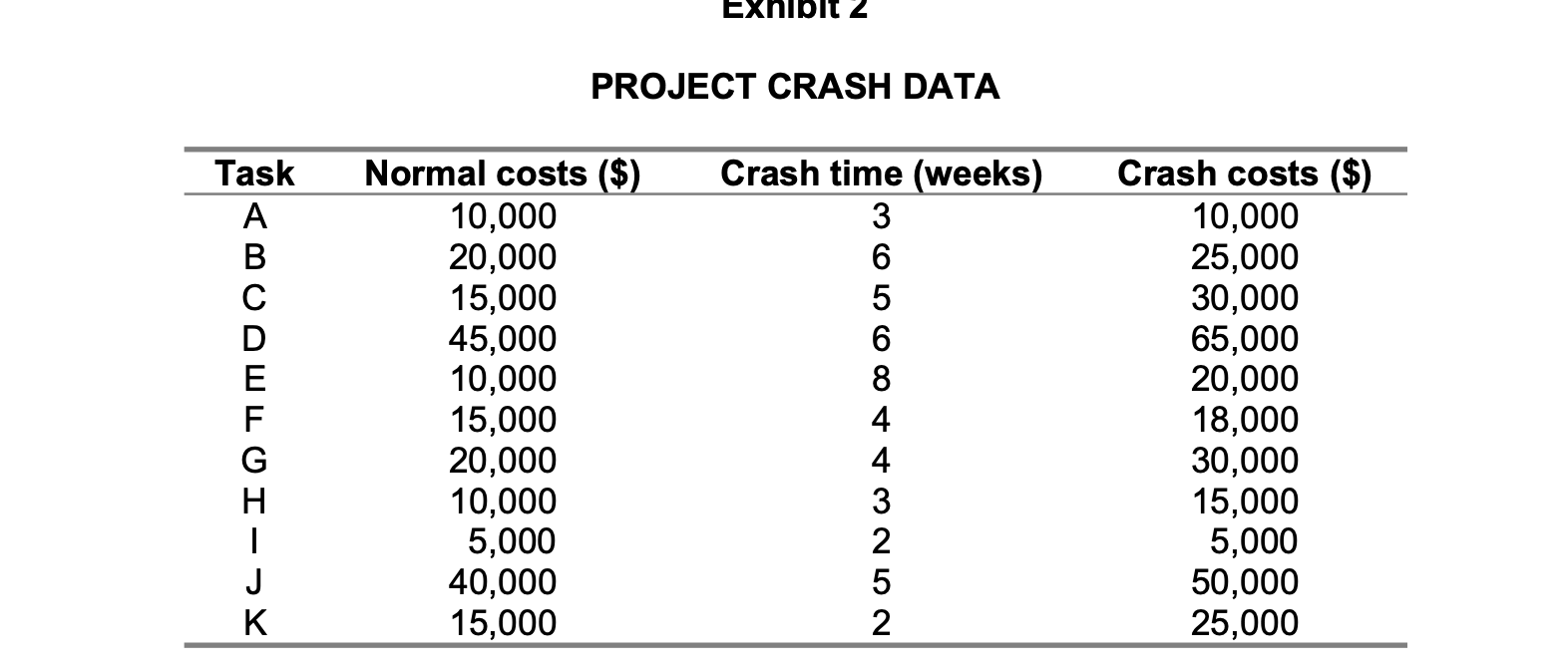
B&Ws management team had established a 35-week completion time for this effort. A preliminary assessment by Phillips indicated that some of the project tasks would need to be shortened to meet the management deadline of 35 weeks. Accordingly, the project manager had prepared a set of task-crashing estimates (see Exhibit 2). Phillips knew that this was an important project to manage and that he would have to do a thorough analysis for the board. He needed to estimate the completion time and budget for the project. Furthermore, he knew that he would need to determine the probability that the project could be completed within the deadline of 35 weeks.
Phillips knew that the board would want to know the minimum expected time in which the project could be completed and the probability of completing the project in this time. In addition, Phillips wanted to assess the additional costs for reducing the project time to the required 35 weeks, and which specific tasks could be crashed to achieve this milestone. He thought that there could be some potential issues that might cause the market assessment to take longer than expected. Phillips wanted to investigate the impact on the crashing solution if the expected time for task B (market assessment) was increased from seven to nine weeks. He had thought of an idea that could decrease development time significantly. Therefore, Phillips also wanted to see the impact on the crashing solution if the expected time for task D (development) was decreased to seven weeks.
The management team would certainly want to see the crashing cost function at the next board meeting, so Phillips had to produce that as well. He was curious to discover whether or not the crash cost curve was non-linear.
Phillips had taken a course on project management in business school. He was eager to use some of the techniques he had learned, such as the Program Evaluation and Review Technique (PERT), project crashing and linear programming, to do the analysis on this project. He only had one week to complete the analysis, thus he was eager to get started.
Question 2: What is the minimum expected time in which this project can be completed? (Please answer with detail answer with all necessary Calculations!!) 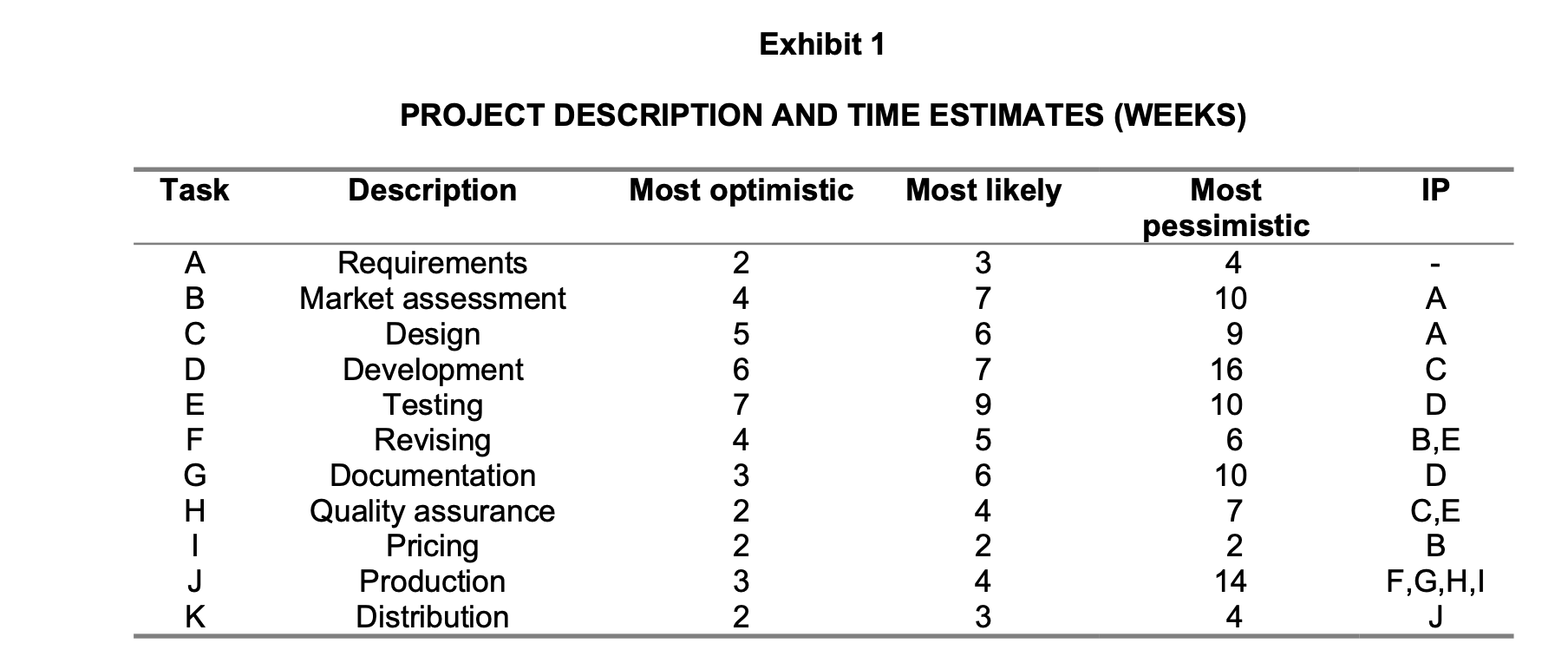
Step by Step Solution
There are 3 Steps involved in it

Get step-by-step solutions from verified subject matter experts
 Study Help