







Question: By stating answer, please provide details on each answer. 5. True or false. Place T or F next to each statement. (xxxx pts. each) a
By stating answer, please provide details on each answer.
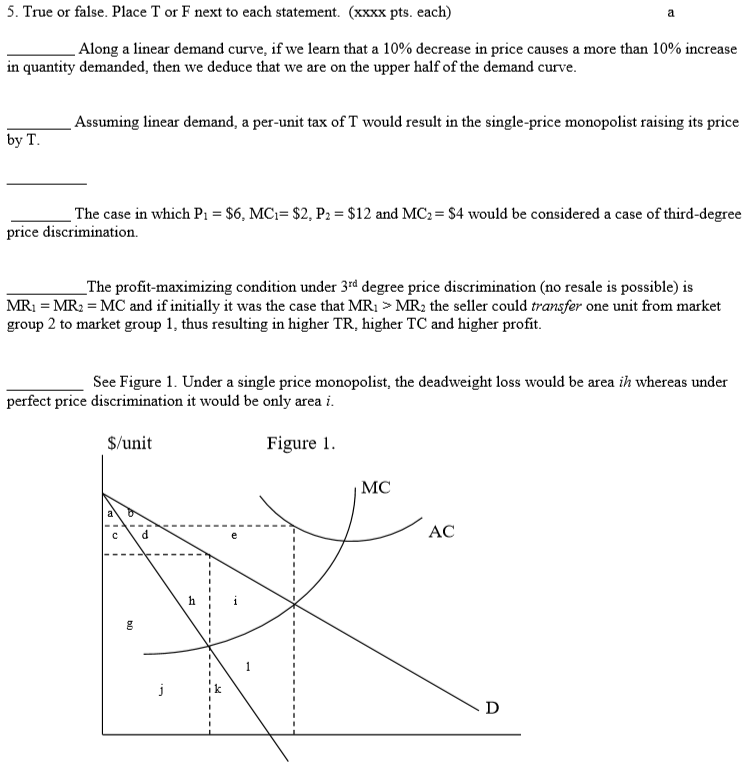
5. True or false. Place T or F next to each statement. (xxxx pts. each) a Along a linear demand curve, if we learn that a 10% decrease in price causes a more than 10% increase in quantity demanded, then we deduce that we are on the upper half of the demand curve. Assuming linear demand, a per-unit tax of T would result in the single-price monopolist raising its price by T. The case in which P1 = $6, MC1= $2, P, = $12 and MC = $4 would be considered a case of third-degree price discrimination. The profit-maximizing condition under 3"d degree price discrimination (no resale is possible) is MR1 = MR = MC and if initially it was the case that MRi > MRz the seller could transfer one unit from market group 2 to market group 1, thus resulting in higher TR, higher TC and higher profit. See Figure 1. Under a single price monopolist, the deadweight loss would be area in whereas under perfect price discrimination it would be only area i. $/unit Figure 1. MC AC D
Step by Step Solution
There are 3 Steps involved in it

Get step-by-step solutions from verified subject matter experts
 Study Help