







Question: By using Matlab ( required) Page 2. Nested for loops and bacterla Bacterial growth can be modeled by the equation, shown below.Bis the current number
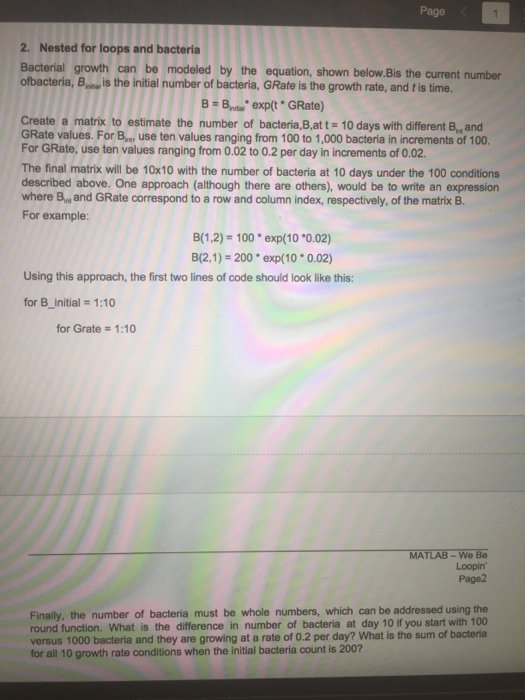
Page 2. Nested for loops and bacterla Bacterial growth can be modeled by the equation, shown below.Bis the current number ofbacteria, Bis the initial number of bacteria, GRate is the growth rate, and t is time. B-B" exp(t GRate Create a matrix to estimate the number of bacteria,Batt= 10 days with different Brand GRate values. For B., use ten values ranging from 100 to 1,000 bacteria in increments of 100. For GRate, use ten values ranging from 0.02 to 0.2 per day in increments of 0.02 The final matrix will be 10x10 with the number of bacteria at 10 days under the 100 conditions described above. One approach (although there are others), would be to write an expression where B and GRate correspond to a row and column index, respectively, of the matrix B. For example: B(1,2) 100 exp(10 *0.02) B(2,1) 200 exp(10 0.02) Using this approach, the first two lines of code should look like this: for B_initial 1:10 for Grate# 1:10 MATLAB-We Be Loopin Page2 Finally, the number of bacteria must be whole numbers, which can be addressed using the round function. What is the difference in number of bacteria at day 10 if you start with 100 versus 1000 bacteria and they are growing at a rate of 0.2 per day? What is the sum of bacteria for all 10 growth rate conditions when the initial bacteria count is 200
Step by Step Solution
There are 3 Steps involved in it

Get step-by-step solutions from verified subject matter experts
 Study Help