







Question: BY USING PYTHON You can get source codes of sorting programs from the internet. Question 1 is mentioned below. QUESTION 1: Perform a benchmark analysis
BY USING PYTHON
You can get source codes of sorting programs from the internet. Question 1 is mentioned below.
 QUESTION 1:
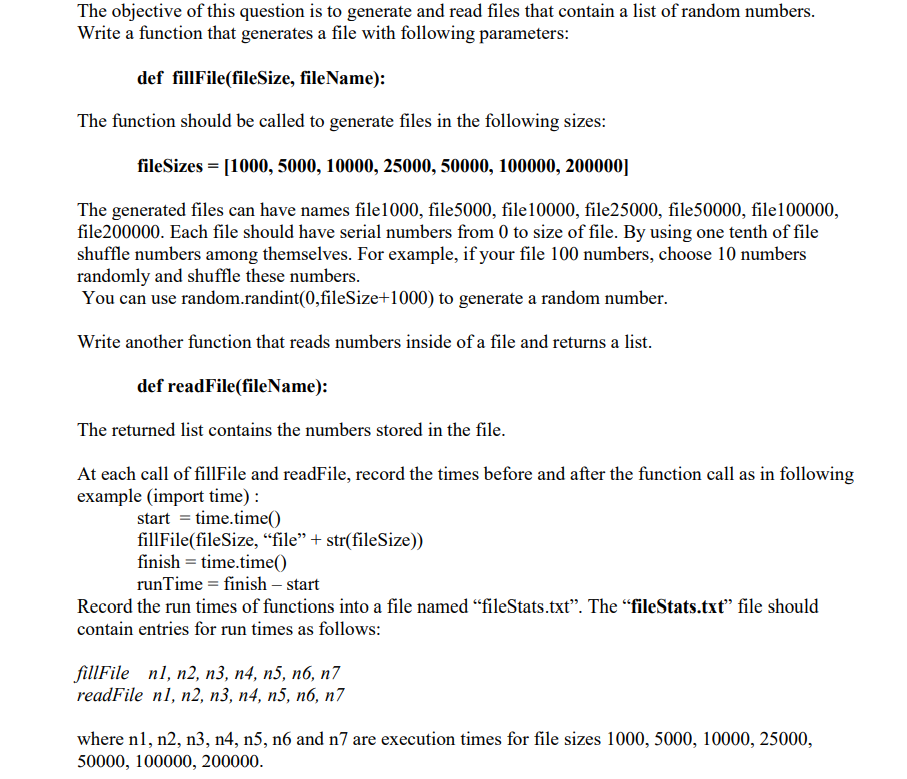
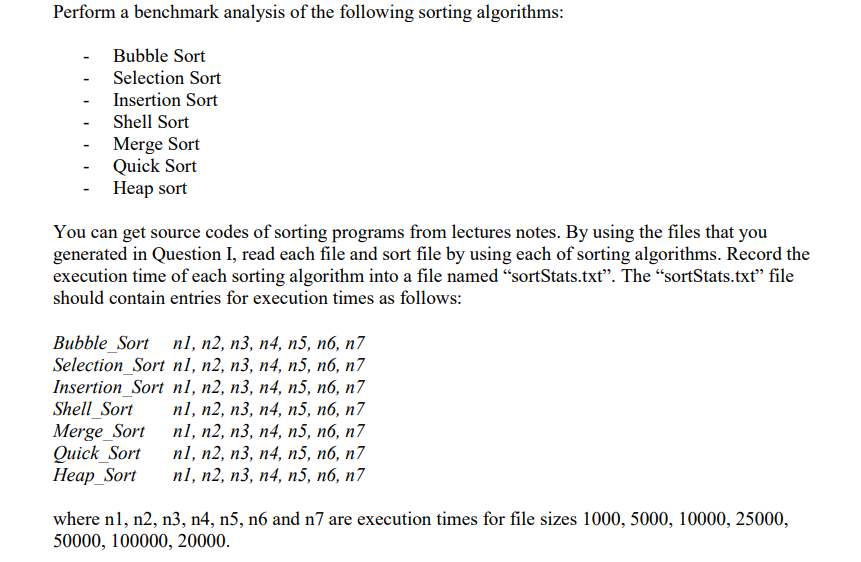
Perform a benchmark analysis of the following sorting algorithms: Bubble Sort Selection Sort Insertion Sort Shell Sort Merge Sort Quick Sort Heap sort You can get source codes of sorting programs from lectures notes. By using the files that you generated in Question I, read each file and sort file by using each of sorting algorithms. Record the execution time of each sorting algorithm into a file named "sortStats.txt. The sortStats.txt file should contain entries for execution times as follows: Bubble_Sort nl, n2, n3, n4, n5, no, n7 Selection_Sort nl, n2, n3, n4, n5, no, n7 Insertion_Sort nl, n2, n3, n4, n5, no, n7 Shell_Sort nl, n2, n3, n4, n5, no, n7 Merge Sort nl, n2, n3, n4, n5, no, n7 Quick_Sort nl, n2, n3, n4, n5, no, n7 Heap_Sort nl, n2, n3, n4, n5, no, n7 where nl, n2, n3, n4, n5, n6 and n7 are execution times for file sizes 1000, 5000, 10000, 25000, 50000, 100000, 20000. The objective of this question is to generate and read files that contain a list of random numbers. Write a function that generates a file with following parameters: def fillFile(fileSize, fileName): The function should be called to generate files in the following sizes: fileSizes = [1000, 5000, 10000, 25000, 50000, 100000, 200000] The generated files can have names file1000, file5000, file10000, file25000, file50000, file100000, file200000. Each file should have serial numbers from 0 to size of file. By using one tenth of file shuffle numbers among themselves. For example, if your file 100 numbers, choose 10 numbers randomly and shuffle these numbers. You can use random.randint(0, fileSize+1000) to generate a random number. Write another function that reads numbers inside of a file and returns a list. def readFile(fileName): The returned list contains the numbers stored in the file. At each call of fillFile and readFile, record the times before and after the function call as in following example (import time) : start = time.time() fillFile(fileSize, file + str(fileSize)) finish = time.time runTime = finish start Record the run times of functions into a file named fileStats.txt. The fileStats.txt file should contain entries for run times as follows: fillFile nl, n2, n3, n4, n5, no, n7 readFile nl, n2, n3, n4, n5, no, n7 where nl, n2, n3, n4, n5, n6 and n7 are execution times for file sizes 1000, 5000, 10000, 25000, 50000, 100000, 200000
Step by Step Solution
There are 3 Steps involved in it

Get step-by-step solutions from verified subject matter experts
 Study Help